


You've probably had this happen already. A Facebook campaign looks healthy in the platform, the lead form is filling up, and the spend is moving. Then the CRM tells a different story, the phone isn't ringing, and the owner wants to know why the ad “worked” but the pipeline didn't.
That gap is why ads on social media feel messy for so many USA small businesses. The platforms are built to show activity, but your business lives or dies on qualified leads, booked calls, store visits, and revenue. If you're spending limited budget and limited time, the only thing that matters is proving lift, not collecting vanity metrics.
Table of Contents
- Why Ads on Social Media Feel So Confusing Right Now
- How Ads on Social Media Actually Work
- Comparing the Main Social Ad Platforms
- Targeting Options and What Is Changing
- Creative Best Practices That Move Real Results
- Budgets and Bidding Without the Guesswork
- Measuring What Actually Matters Beyond the Dashboard
- Your First 90 Days Running Ads on Social Media
Why Ads on Social Media Feel So Confusing Right Now
A local service owner can see 40 leads inside an app, then realize half never answered the phone and several were outside the service area. A retailer can get strong engagement on TikTok and still struggle to tie any of it to actual orders. That's the daily frustration with paid social, the dashboard says one thing, the bank account says another.
The confusion starts because platform-reported conversions are not the same as business outcomes. Social platforms are great at counting what happened inside their own systems, but they don't always see what happens after a click, after a call, or after a prospect comes back through branded search later. If you're running ads on social media without a clean measurement setup, you can end up rewarding the channel for activity that would have happened anyway.
The right question is not “Did the ad get clicks”
It's “Did the ad create profitable demand?” That's the difference between busy reporting and real media buying. Paid social can absolutely help a small business, but it works best when you treat it like a channel for qualified demand generation, not a popularity contest.
Practical rule: if a metric can't connect to revenue, it's only a steering wheel, not the finish line.
For a lot of owners, the useful mindset shift is simple. Stop asking which ad got the most attention and start asking which audience, offer, and creative combination produced the best downstream result. That framing keeps you from chasing cheap traffic that never turns into booked work.
The rest of this guide stays close to that reality. You'll get the auction basics, a side-by-side platform comparison, the targeting layers that still matter, creative choices that move lead quality, budgeting rules that don't waste cash, and a measurement approach that fits a small team. The point is to help you spend smarter this quarter, not to turn you into a dashboard hobbyist.
How Ads on Social Media Actually Work
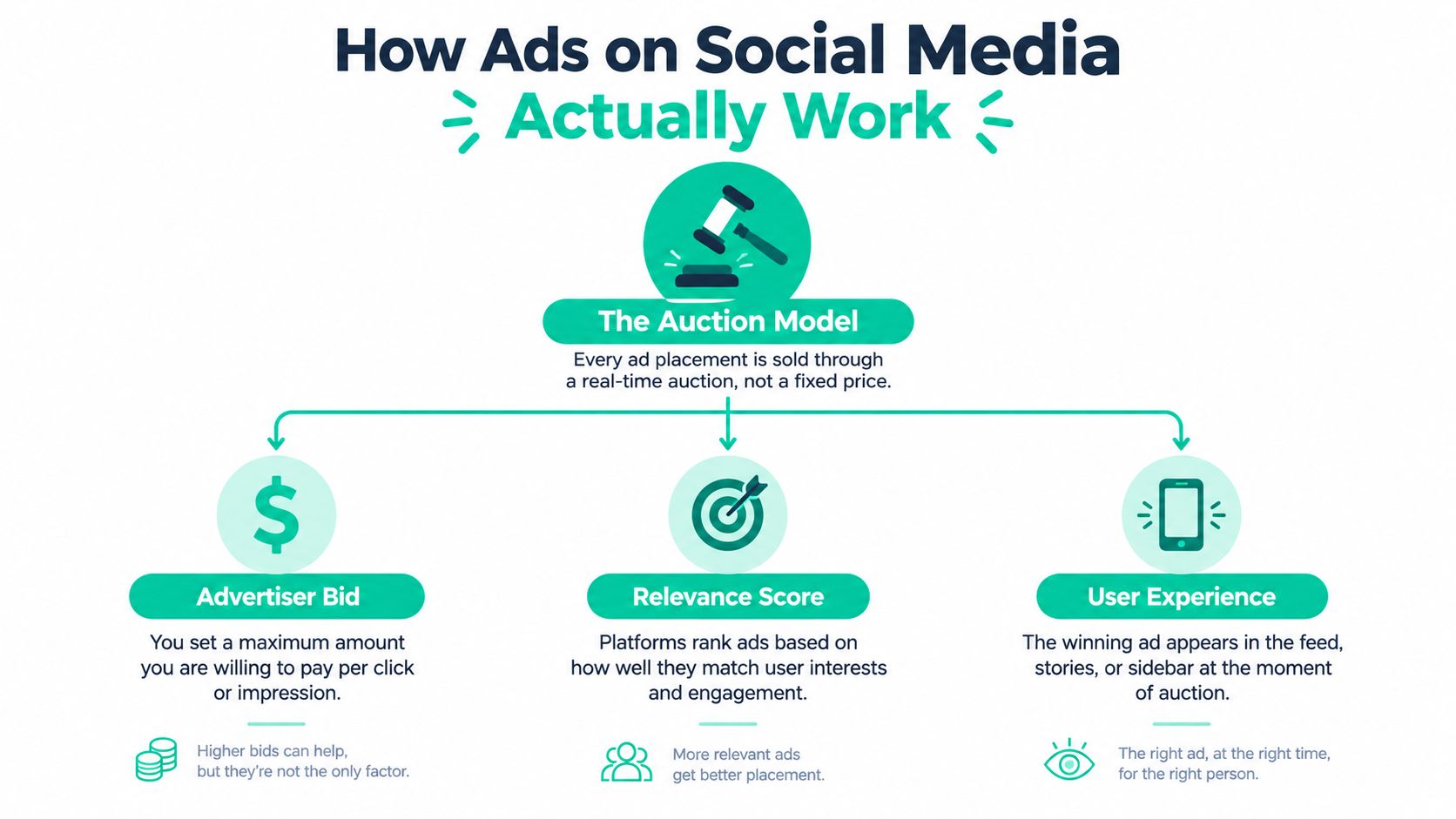
At the simplest level, paid social works like a fast auction. You're not renting a fixed slot the way you might with a newspaper ad. You're entering a live marketplace where the platform decides whose ad gets shown based on the bid, the expected value of the ad, and the user experience.
The four pieces that matter
Bid is the most obvious piece. It tells the platform how much you're willing to pay for the action you care about, whether that's a click, a lead, or another result. Budget tells it how much room it has to spend while it looks for that result. Creative is what the user sees, and it matters more than many owners want to admit because weak creative drags everything down.
The fourth piece is the platform's internal judgment about whether your ad is likely to do well with the person who's about to see it. You don't control that score directly, but you do control the inputs. Better message match, cleaner targeting, and more relevant offers usually give the system a better chance to work.
The formats you'll run into
- Image ads work when the offer is clear in one glance and the landing page can do the rest.
- Video ads are strongest when you need a demo, a quick explanation, or more trust.
- Carousel ads help when you need to show multiple products, steps, or angles.
- Collection ads are useful when people need to browse products without leaving the platform.
- Lead form ads reduce friction when you want inquiries fast.
- Click-to-call ads matter for businesses where the phone is the conversion.
Boosted posts are where many small accounts go wrong. A boost is usually a simplified promotion of an existing post, while a proper ad setup gives you tighter targeting, better testing, and clearer reporting. If your goal is leads or sales, the full ad manager is the safer place to spend.
The same framework shows up across Meta, TikTok, LinkedIn, and YouTube, but each platform leans into different user behavior. Once you understand that social ads are auction-driven, you can read a campaign summary without guessing what the platform is doing behind the scenes. If you want a broader PPC context for how auctions work, this complete guide to PPC advertising is a useful companion.
Comparing the Main Social Ad Platforms
For most USA small businesses, the question is not where everyone is spending time. It is where your offer has the clearest path to revenue. That is why I avoid the default advice to be everywhere at once. Split a modest budget across too many networks, and you learn very little that helps the next spend decision.
Platform fit depends on the job
Meta usually works best when you need broad reach, retargeting, and efficient follow-up. It is often the strongest starting point for local services, ecommerce, and businesses with enough website or CRM data to retarget well. TikTok is a better fit for native, fast-moving creative and tends to perform when attention, discovery, and impulse matter.
LinkedIn fits professional services and B2B offers where lead quality matters more than raw volume. YouTube helps when a product needs explanation or when a buyer already has intent and wants to watch before acting. Start with the platform where your customer already pays attention, even if another channel shows a lower CPM on paper.
| Platform | Typical US Audience | Best Fit | Dominant Format | Budget Reality |
|---|---|---|---|---|
| Meta | Broad consumer audiences, local and national | Retargeting, ecommerce, local services | Image, video, carousel | Often efficient for testing and follow-up |
| TikTok | Discovery-heavy, mobile-first users | New offers, impulse purchases, creative-led growth | Short video | Native creative matters more than polish |
| Professionals, decision-makers | B2B lead gen, high-value services | Sponsored content, lead forms | Usually worth it only when lead value is high | |
| YouTube | Broad audience with video intent | Demos, education, consideration-stage demand | Video | Strong when the story needs more than a static ad |
Pick one primary channel first
For most small businesses, the cleaner setup is one primary acquisition platform and one retargeting platform. That keeps learning focused and keeps creative production manageable. If you force every network to behave the same way, you spend time optimizing the wrong thing.
A small business does not need a full platform spread to prove demand. It needs one channel that can bring in new prospects, plus one place to bring back people who already showed interest.
Once the first channel is producing dependable qualified leads or sales, then expansion makes sense. Until then, keep the system simple. One primary platform, one retargeting platform.
Targeting Options and What Is Changing

Most platforms still give you four broad targeting layers. You can go wide with geography and demographics, narrow with interests and behaviors, build similar audiences from a source list, or go straight after people who've already interacted with you. The trade-off is always the same, more scale usually means less intent.
Build the stack in the right order
Start with retargeting if you already have site visitors, video viewers, or lead list data. Those people know you already, which usually makes them easier to convert than cold traffic. Then build a lookalike or similar audience from your best customer source, not just any list you happen to have.
After that, test one interest-based audience as a signal check, then let the platform optimize inside a broader layer. That broad layer is more important now than it used to be because privacy changes have weakened a lot of the old detailed targeting tricks. First-party data matters more, and you should use your CRM, lead forms, and consent-based site tracking to feed the machine.
A simple four-audience setup
- Source-based retargeting: people who visited the site, watched video, or submitted a form.
- Lookalike audience: built from your best leads or buyers.
- Interest seed: one clean theme tied to the offer, not a kitchen sink of categories.
- Broad audience: a wider layer that gives the platform room to find converting users.
That setup is enough for a lot of small accounts. It keeps the structure simple while still giving you multiple angles to test. If you don't have strong first-party data yet, spend more time improving your lead capture and CRM hygiene before you blame the platform.
The biggest mistake is over-filtering because it feels precise. In practice, narrow targeting can starve the algorithm and make learning slower. Broader targeting, paired with better creative and stronger conversion tracking, often gives you a cleaner path to useful results.
Creative Best Practices That Move Real Results
Social proof can move performance, but only when it feels real. In Facebook field experiments, adding social cues increased click-through rates by 3.8% to 5.4% and like rates by 9.6% to 11.6%, and stronger-tie cues produced bigger effects than weaker ones source. That does not mean every ad needs a badge or testimonial. It means trust signals can change behavior when they fit the audience and the offer.
What good creative actually does
Creative has two jobs. It has to stop the scroll, then make the offer clear fast. If someone cannot tell what they get, who it is for, and why it matters in a few seconds, the ad is trying to do too much.
For TikTok and Reels, native-feeling video usually outperforms polished brand material because it matches how people already consume content there. Captions and on-screen text matter because many users watch with sound off. The landing page should carry the same promise, tone, and offer, or the click turns into friction and weaker conversion.
Judge the click by intent, not curiosity. A curious click that never converts is a cost, not a win.
A simple creative checklist
- Hook fast: lead with the problem, result, or proof.
- Match the page: the landing page should continue the same message.
- Use real proof: reviews, customer clips, founder explanations, or service evidence.
- Test one variable at a time: change the hook, format, or proof, not all three.
- Watch downstream quality: a higher CTR can still produce worse leads.
A lot of small businesses waste time polishing ads that look good and sell badly. A better weekly rhythm is one fresh creative variant per ad set, with the same audience, same offer, and same landing page. That makes the data easier to read, and it keeps you from confusing attention with intent.
Engagement can look convincing in the dashboard, especially when a post gets shared or commented on. The problem is that engagement is often too far upstream to show whether the campaign will pay back. Creative earns its budget through qualified leads and booked revenue, and nothing else on the dashboard proves that.
Budgets and Bidding Without the Guesswork
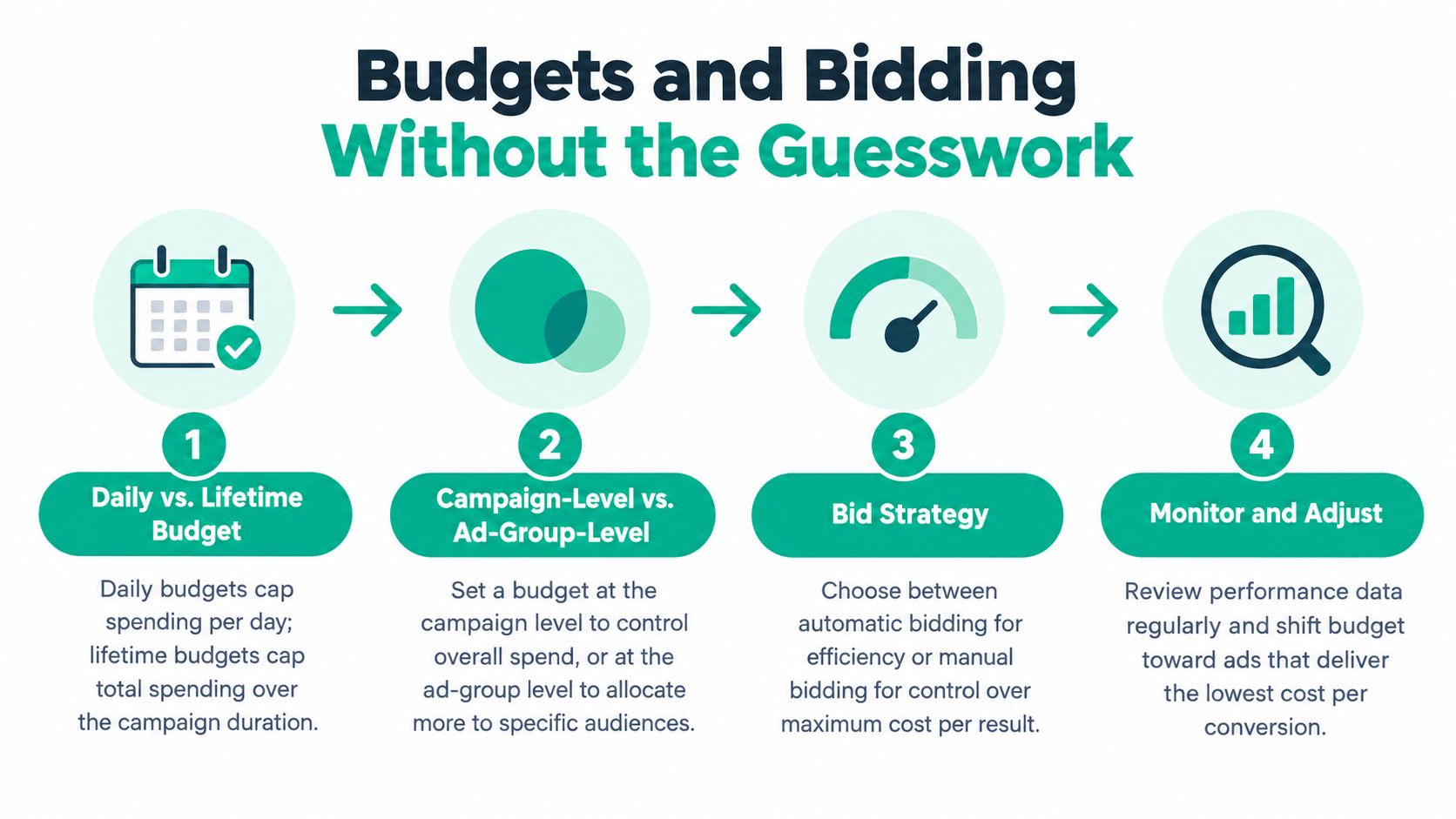
A budget only feels confusing until you separate spend control from auction behavior. Daily budget limits what a campaign can spend in a day. Lifetime budget caps spend across the full run. Campaign-level budgets give the platform more room to shift money where it thinks results will come from, while ad-group-level budgets give you tighter control over where each dollar goes.
Use TikTok's rules as a planning baseline
TikTok is a useful reference because its guidance is unusually specific. It lists minimum budgets of $50 at the campaign level and $20 at the ad-group level, and for Target Cost per Result it recommends a daily ad-group budget of at least 20 times the bid budget and bidding FAQ. Its auction guide also says campaign-level budget should be at least 10% of combined ad-group budgets, and budget changes should stay below 50% at a time auction best practices guide.
That guidance matters because thin budgets get choked by the auction. If the bid is too high for the money you have available, delivery stalls before the account learns much. If you keep changing settings all day, you make it harder to see which change mattered.
A cleaner day-one setup
Start with one campaign, then one ad group unless segmentation has a clear purpose. Give the system enough room to spend against the bid, and leave the settings alone long enough to collect signal. If you need a deeper walkthrough for small-business media budgets, see this guide to small business PPC services.
For a small business, that usually beats a complicated structure. Limited time makes every extra layer harder to read, and tight budgets punish accounts that split traffic too early. You want enough volume to learn, but not so many moving parts that you can't tell whether the lead quality changed because of the audience, the creative, or the budget.
A campaign that can't spend cleanly usually points to a setup problem before it points to weak demand.
The practical question is simple. Does the setup keep money flowing toward qualified outcomes, or does it waste budget on settings the account never needed in the first place?
Measuring What Actually Matters Beyond the Dashboard
A lot of social ad reporting makes weak performance look good because platforms can claim credit for people who were already close to converting. In the Facebook experiments studied by Northwestern Kellogg study, observational models often missed the causal effects seen in randomized tests, even after the researchers controlled for demographic and behavioral variables. That gap is why platform numbers deserve skepticism, especially when a small business has to decide where limited budget goes next.
Build a minimum viable measurement stack
You do not need a data team to measure better. You need a holdout or geo test, one business outcome that matters, and CRM or call-tracking data that shows what happened after the click. If you sell services, that outcome might be a qualified lead or booked appointment. If you sell products, it might be revenue or repeat purchase.
What to stop counting as success
- Form fills without follow-up: a lead is not valuable if nobody answers the phone.
- Boosted post engagement: likes and comments do not pay the bills.
- Cheap reported conversions: the lowest-cost lead often hides the weakest lead quality.
- Platform-only attribution: branded search lift and offline actions can disappear inside the dashboard.
Small businesses feel this problem first. If the platform undercounts higher-value offline or delayed outcomes, optimizing to the cheapest reported conversion can reduce profit. That is why I prefer comparing exposed and control groups whenever the budget is large enough to justify it.
For a simpler conversion lens that fits with the measurement stack above, see this social media engagement rate guide. Engagement still matters, but only as one signal inside the larger business picture.
A good test of your setup is whether you could explain the method to your accountant in two sentences. If you cannot, the measurement is too fuzzy to budget against.
The goal is not to make reporting complicated. It is to stop making budget calls from numbers that flatter the channel but do not protect the business. Measured lift beats polished attribution every time.
Your First 90 Days Running Ads on Social Media
The first month should be about plumbing, not scale. Get the naming structure right, make sure tracking works, upload CRM lists where you can, and build one retargeting audience from real site or video activity. If the basics are broken, every later test gets harder to trust.
A workable 30-60-90 rhythm
Days 1 to 30: Launch one campaign with one clear objective, one audience stack, and one landing page. Fix the technical pieces, confirm that leads are entering the CRM, and make sure calls or booked appointments are visible outside the ad platform.
Days 31 to 60: Add a second audience layer, then test one new creative each week. Compare platform-reported results with actual business outcomes, not just clicks or form fills. If the leads look cheaper but the close rate drops, the apparent win is costing you margin.
Days 61 to 90: Run a simple holdout or geo test if volume allows it. That gives you a cleaner read on incremental impact, especially if social is also creating branded search or assisted conversions elsewhere.
Red flags that mean rebuild, not more budget
Who should own the rebuild decision matters here. If you are the owner or the person signing off on spend, make the call with whoever handles your CRM, sales follow-up, and landing pages, because the fix is often outside the ad account.
- Rising CPM with flat qualified lead volume
- Creative fatigue that fresh variants can't fix
- Attribution gaps that keep widening instead of narrowing
Those signals usually mean the account needs a structural change, not a bigger spend. That can mean a better offer, a cleaner landing page, a tighter qualification step, or a new measurement setup. The right move is to solve the bottleneck, not pour more money into it.
Small businesses do best with paid social when the work stays disciplined. They test cleanly, measure carefully, and let booked revenue decide which campaigns survive. If you want help building that kind of program, Assertive Agency can plan and run paid social campaigns with tracking, creative testing, and budget control tied to lead quality and revenue.
