


For small business PPC services, a realistic 2025 starting point is an average $5.26 CPC and about $70.11 per lead for small-business-oriented campaigns, which is why structure matters so much when every click has a cost. If your ads feel like they're burning through cash without a clear return, the problem is usually not the idea of PPC, it's the way the account is managed.
You're probably in the middle of the same pattern many owners face. Competitors keep showing up above you, the phone is quiet some days and overloaded on others, and the dashboard says traffic is coming in while the sales side tells a different story. That gap is exactly where the right service model changes everything.
Table of Contents
- Why PPC Spending Feels Risky Without the Right Service Model
- How Small Business PPC Services Evolved Toward Measurable Outcomes
- What Small Business PPC Services Include
- Common Service Tiers for Small Businesses and Startups
- How PPC Pricing Models Work in Practice
- How Campaign Mechanics Shape Expected Results
- The Hidden Gaps in PPC Measurement and Compliance
- How to Evaluate and Choose a PPC Partner
Why PPC Spending Feels Risky Without the Right Service Model
A local roofing contractor once launched Google Ads after seeing competitors dominate every search for emergency repairs. The account got clicks, the budget got spent, and the owner still couldn't tell which leads were real. That's the part many miss, the problem usually isn't the keyword list, it's the lack of structure around what counts as success.

What goes wrong first
When campaigns are built around clicks alone, the account can look active while the business stays flat. A lot of small businesses buy traffic before they define qualified leads, booked jobs, signed cases, or completed purchases, so the reporting never matches the way revenue happens.
Practical rule: if the agency can't explain how a click becomes a customer, you're buying noise, not growth.
That risk gets worse when the provider won't separate what the platform reports from what the business truly needs. A form fill from a tire-kicker, a call from outside the service area, or a duplicate conversion can all make the numbers look better than they are. Small business PPC services work when they connect media spend to a real commercial outcome.
Why service tiers matter
Service tier changes the outcome because it changes the discipline. A thin setup may launch ads, but a stronger engagement looks at search intent, landing pages, tracking, and budget allocation together. That's the difference between paying for visibility and paying for a managed pipeline.
The best way to think about PPC is as a system, not a shortcut. The keyword list is only one piece. The service model decides whether the rest of the machine is built to catch wasted spend or just let it leak.
How Small Business PPC Services Evolved Toward Measurable Outcomes
Google Ads began as Google AdWords on October 23, 2000, with about 350 advertisers, and the original model was based on cost per thousand impressions rather than the PPC system most advertisers associate with it today (Google Ads evolution). That matters because early paid search was about exposure first. Modern small business PPC services are about outcomes first.
The measurement shift changed the job
By February 2002, Google had moved to PPC, which tied spend more directly to user action instead of just showing an ad. Conversion tracking followed in 2005, making it possible to evaluate calls, form submissions, purchases, and lead quality, not just clicks (Google Ads evolution). That sequence explains why PPC management stopped being simple ad placement and became a measurement discipline.
Self-service access also changed the market. Smaller advertisers could participate without buying traditional media placements or maintaining a large ad department, so PPC opened the door for local and niche businesses that could not play in old-school media buying. Once tracking entered the picture, the channel started rewarding businesses that could connect spend to evidence.
What that means now
Today, the account has to be built around tracked actions, not vanity metrics. Keyword targeting, bid adjustments, geographic segmentation, landing-page testing, and cost-per-lead analysis all depend on the same idea, the click only matters if it leads to something measurable.
Good management feels operational, not glamorous, because it ties every decision to tracked outcomes.
That is also why modern service conversations should start with measurement before creative. If tracking is weak, the bidding model gets weak. If the conversion signal is clean, the rest of the system can optimize.
What Small Business PPC Services Include
A proper PPC engagement begins before any ad goes live, with an account audit that surfaces wasted spend, broken conversion tracking, mismatched landing pages, and keyword overlap. Without that baseline, optimization turns into guesswork.
The core workflow
Good PPC delivery is a sequence of decisions, not a single task. In practice, it usually moves in this order:
- Audit the account and offer. The provider checks search terms, conversion setup, audience structure, and landing-page alignment.
- Define the business goal. That might be phone calls, booked consultations, ecommerce revenue, or qualified quote requests.
- Build the campaign structure. Tight themes, clean ad groups, and clear service segmentation reduce cross-contamination between unrelated searches.
- Set up tracking. The account needs primary conversions, not just generic page views.
- Launch ad copy and landing pages. Messaging has to match the query, or quality drops and costs rise.
- Test and refine. Ads, bids, negatives, and pages get adjusted based on real performance.
- Report clearly. Monthly reporting should show what changed, what improved, and where money was wasted.
If you want a plain-English reference for the broader platform setup, the guide on what PPC advertising is is a useful companion.
What to expect from the service itself
A useful service covers both execution and judgment. Someone has to choose keywords, block bad traffic, verify conversions, manage bids, and keep the ads relevant to the page the visitor lands on. If any of those pieces are skipped, the account usually drifts toward higher costs and weaker lead quality.
The reporting side matters just as much. A useful report does not stop at impressions and clicks. It explains what the numbers mean for the business, which campaigns deserve more budget, and which ones need to be cut. For small businesses, that often means separating online conversions from offline results like calls, booked jobs, or sales that happen after the lead leaves the website.
Common Service Tiers for Small Businesses and Startups
Not every business needs the same level of management. A startup testing demand, a local service company trying to book more calls, and a multi-location operator with multiple offers all need different depth, different reporting, and different levels of landing-page support.
| PPC Service Tier Comparison | Best For | Typical Focus |
|---|---|---|
| Starter | Businesses testing paid search for the first time | Basic campaign setup, keyword research, conversion tracking, simple reporting |
| Growth | Companies that want steady lead volume and clearer ROI | More campaign segmentation, frequent testing, landing-page improvements, tighter negative keyword control |
| Custom or Bespoke | Complex accounts, multi-location brands, or high-value offers | Deeper account structure, advanced reporting, broader creative support, more hands-on optimization |
How to read the tiers
Starter plans are useful when the goal is to learn what the market responds to without overbuilding the account. They usually cover the essentials, but they can leave out the kind of iterative work that keeps spend efficient over time.
Growth plans tend to make sense once the account has enough activity to justify tighter management. At that point, the value comes from better segmentation, cleaner conversion signals, and regular testing across ads and pages.
Bespoke work becomes necessary when the business has more moving parts. Multiple locations, multiple services, or higher-value sales cycles create more room for wasted spend, so the structure has to get more precise.
Watch the scope, not the label. A cheap plan that skips conversion validation is often more expensive than a fuller plan with real reporting.
How PPC Pricing Models Work in Practice
Pricing usually comes down to how the provider packages labor, strategy, and ongoing management. Some agencies use a flat monthly retainer, others use a percentage of ad spend, and some mix the two. The right model depends less on the label and more on what's included.
What affects the price
Several things push cost up or down. Account size matters because more campaigns, more services, and more locations take more time. Competition matters because crowded auctions demand more refinement. Conversion volume matters because low-volume accounts usually need more hands-on interpretation. Creative and landing-page support also change the price because they require work beyond platform management.
The benchmark context explains why price alone can be misleading. With average small-business-oriented leads near $70.11 and average CPC around $5.26 in 2025, even a cheap management fee can hide weak performance if the account bleeds on irrelevant clicks (benchmark summary). The same source places average Google Ads conversion rate at about 7.52%, which is another reminder that your own numbers matter more than a generic package quote (benchmark summary).
How to compare proposals
A low monthly fee sounds nice until you realize the provider only touches bids once a month and never audits the landing page. A higher fee can be sensible if it includes tracking, testing, and reporting that protect the budget.
For a practical pricing reference, average PPC cost context helps frame what management work is likely to sit on top of media spend.
The safest comparison is simple. Ask what is included, what changes over time, and what evidence you'll receive each month. If two proposals look similar on price but one includes actual optimization work, they are not the same service.
How Campaign Mechanics Shape Expected Results
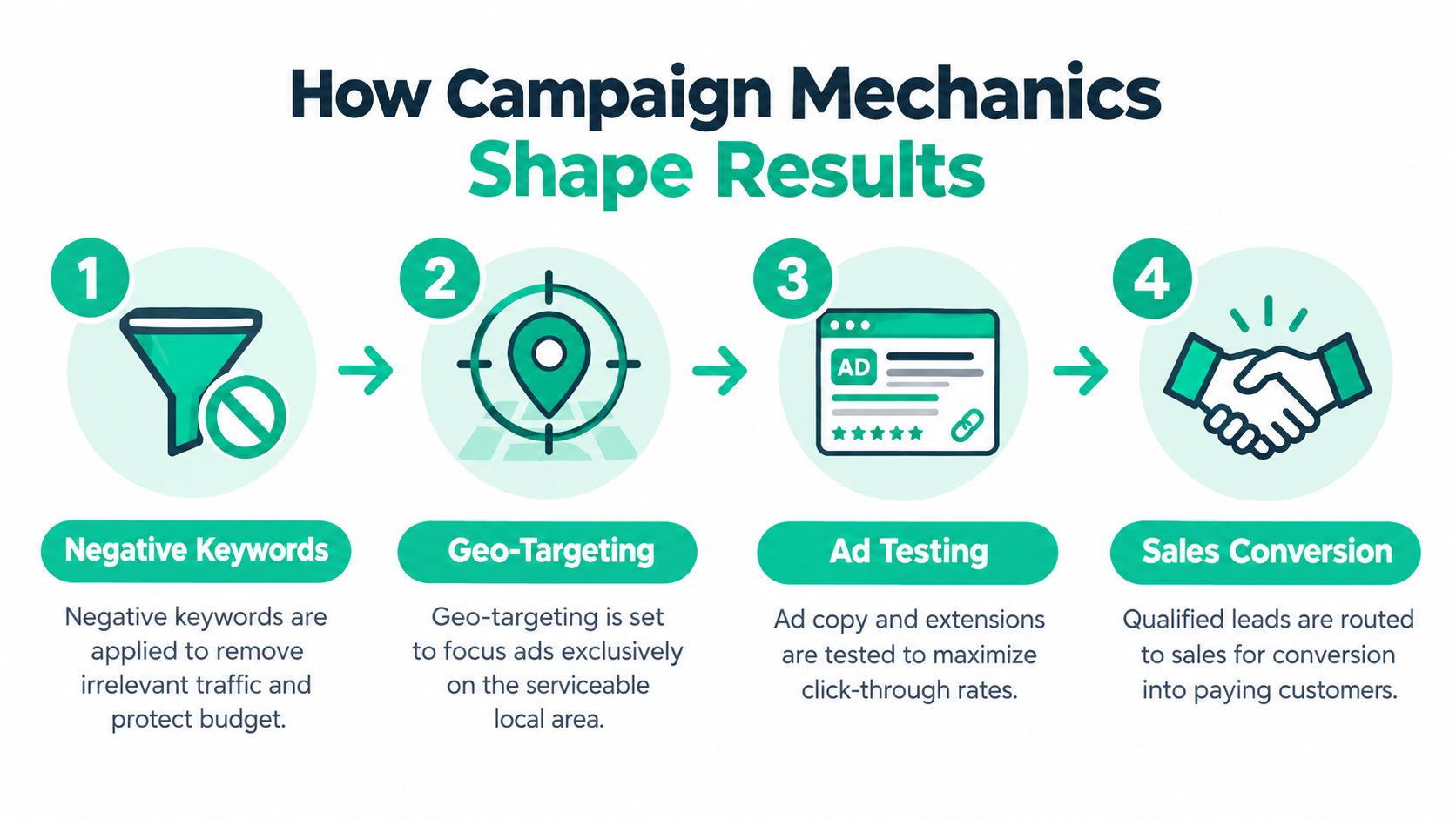
A plumber and a law firm spending $2,000 each on Google Ads will not produce comparable results if their campaign structures differ. One account may be built to filter out poor-fit searches, while the other pays for broad traffic that never turns into leads. That difference shows up in the mechanics, not the spend.
The pieces that move the needle
Google does not rank ads on bid alone. Ad Rank uses bid plus quality signals such as expected click-through rate, ad relevance, landing-page experience, search context, device, location, timing, and competing ads (Ad Rank guidance). A stronger page and tighter ad relevance can improve eligibility and lower wasted spend without forcing higher bids.
Negative keywords stop irrelevant searches from draining budget. Geographic targeting matters because service businesses do not benefit from clicks in areas they cannot serve. Ad testing matters too, since the copy has to match intent, not just read well.
What good structure looks like
Good structure groups similar services together instead of mixing everything into one bucket. A plumber should not force emergency calls, installation jobs, and maintenance searches into the same ad group if the landing pages differ. That mismatch weakens relevance and makes each click work harder than it should.
If the account is broad, the waste is usually broad too.
The best gains usually come from small, repeated improvements. Cleaner search themes, better exclusions, tighter page match, and steady testing tend to outperform one big campaign overhaul.
The Hidden Gaps in PPC Measurement and Compliance
Clicks and form fills do not always equal real business results. A law firm can get plenty of inquiries and still miss the cases that matter. An HVAC company can drive calls and still not know which ones turned into booked service. That gap is where offline attribution matters.
Why lead tracking has to go further
Google Ads requires conversion tracking for Smart Bidding, and Google recommends at least 30 conversions over about a month or longer before judging Smart Bidding, with at least 50 conversions for Target ROAS (Google Ads conversion tracking guidance). That only helps if the conversions are clean. Duplicate events, weak tagging, or low-value micro-actions can train the bidding system in the wrong direction.
For service businesses, the stronger setup usually includes CRM-linked reporting, call outcomes, booked appointments, qualified lead status, and closed revenue. That lets the account manager separate leads that look good on paper from leads that delivered results.
Compliance is part of performance
The FTC says online advertising has to follow the same basic rules as other advertising, which means claims must be truthful, not misleading, and supported by evidence (FTC online advertising guidance). It also says disclosures need to be clear and conspicuous, so users can notice and understand them.
The FTC also warns that paid search results need to be clearly distinguishable from unpaid results, so search ads should not look like organic listings (FTC deceptive paid search guidance). For small businesses, that affects ad copy, offers, disclaimers, and landing-page claims at the same time.
Compliance is not separate from performance. It protects trust, and trust affects conversion.
How to Evaluate and Choose a PPC Partner
The best partner is the one who can explain what they'll measure, how they'll fix problems, and what happens if the account underperforms. That sounds basic, but a lot of proposals stay vague on exactly those points.
Questions that reveal real competence
Ask how they define a conversion, and listen for specifics. A qualified partner should be able to separate calls, forms, purchases, booked appointments, and low-value actions. Ask who owns the account, who writes the ads, and who checks the tracking.
Also ask how they report results. If the answer is just “we send a monthly summary,” that's not enough. You want to know what changed, why it changed, and what was learned from the change.
A structured audit-first process usually gives the clearest read on fit. It shows whether the provider can diagnose the account before selling a long engagement, and it gives you a chance to see how they think. The page at how to choose a digital marketing agency is a practical reference if you're comparing providers beyond PPC alone.
What good and bad signals look like
Good signals include clear deliverables, realistic expectations, and a willingness to talk about tracking quality. Bad signals include promises of easy rankings, vague “growth” language, and packages that never mention conversion setup.
A provider should also be comfortable discussing what happens when the account has too little data for aggressive automation. That matters because small businesses don't all have the same volume, and automation without signal quality can make a thin account worse.
If you're choosing among multiple firms, pick the one that treats the budget like a business asset, not a media toy. You want accountability, not noise.
If you want PPC that's tied to real leads, real calls, and real revenue, Assertive Agency builds and manages Google Ads programs with tracking, testing, and reporting built in. Visit Assertive Agency to see how their PPC audits, campaign management, and monthly plans fit a small business that needs clearer results, not just more clicks.
