


A local business owner sees a national Google Ads benchmark and sets a monthly budget around it. Then the first few weeks produce clicks, but the phone stays quiet. The problem usually isn't that the business chose paid search. It's that average cost per click was treated as a forecast instead of a starting point.
A click from someone searching for an emergency service in your area can be worth far more than a cheaper click from someone browsing for general information. Your city, service, keyword intent, match type, device mix, landing page, and competition all shape the price you pay. The right question isn't just, “What does a click cost?” It's, “What does a qualified opportunity cost, and can the business profitably acquire it?”
Table of Contents
- What Is Average Cost Per Click
- US CPC Benchmarks by Industry
- How Match Types and Platforms Change CPC
- What Actually Determines Your Click Price
- Rising CPC and Better Campaign Economics
- Practical Ways to Manage Your Average CPC
- Key Takeaways for US Advertisers
What Is Average Cost Per Click
Cost per click, or CPC, is the amount an advertiser pays when someone clicks an ad. Average CPC is the blended result across the clicks in a campaign or account. It can combine different keywords, match types, devices, locations, search times, and auction conditions.
That makes the average useful for planning, but it doesn't make it a guaranteed bid. A campaign might pay different amounts for the same keyword because one search happens on a mobile device in one location and another happens on desktop in a different location. Google Ads and other paid platforms also calculate costs through auctions, so the price changes as competition and eligibility change.
A cheap click isn't automatically a good click. A person searching for “criminal defense lawyer near me” has a different commercial intent from someone searching for “how criminal charges work.” The first click may cost more, but it can be much closer to a consultation. The second may cost less and still consume budget without creating a useful lead.
Practical rule: Never judge a click by price alone. Judge it by the value of the action that follows.
For revenue planning, CPC is only the first input. You also need to understand how many clicks become inquiries, how many inquiries become qualified opportunities, and what those opportunities are worth. A $5 click can be inexpensive if it produces profitable cases or booked jobs. A $2 click can be wasteful if it attracts people outside your service area or looking for free information.
If you're new to paid search, this complete guide to PPC advertising provides useful context on how paid campaigns work. The central point is simple: average CPC helps estimate traffic cost, but it doesn't measure campaign success by itself.
US CPC Benchmarks by Industry
The latest broad benchmark gives US advertisers a useful reference point, but it shouldn't become a budget rule. WordStream's 2025 benchmark covered 16,446 US-based campaigns running from April 2024 through March 2025 and reported an overall average CPC of $5.26. The preceding benchmark period reported $4.66, based on 17,998 campaigns running from April 1, 2023, through March 31, 2024. The earlier period also reported an average click-through rate of 6.42%. WordStream's benchmark data shows why the period and sample matter.
A separate 2024 analysis using more than 3.4 million keywords and $923 million in total spend estimated average US CPC at $4.18. That difference doesn't mean one source is wrong. It reflects different advertisers, inventory, categories, methods, and sample composition.
Category averages are more useful than one national number
The 2025 category figures show how sharply costs vary:
| Industry | Average CPC |
|---|---|
| Attorneys and legal services | $8.58 |
| Dentists and dental services | $7.85 |
| Home and home improvement | $7.85 |
| Business services | $5.58 |
| Automotive repair, service, and parts | $3.90 |
| Real estate | $2.53 |
| Restaurants and food | $2.05 |
| Arts and entertainment | $1.60 |
These figures come from the same WordStream benchmark source, but they still aren't city-level forecasts. An HVAC company in a competitive service area may face a different auction from an HVAC company in a smaller market. A law firm also needs to separate high-intent consultation searches from research queries before using a legal-services average to set bids.
Use the national category figure as a sanity check, then build your own range from historical auction data, keyword intent, service area, and conversion economics. For monthly planning, category-level context is far more useful than applying $5.26 to every campaign, but your own qualified lead data matters more than either figure.
How Match Types and Platforms Change CPC
Two businesses in the same city can pay different prices for similar keywords because they aren't entering the same auctions. Match type controls how closely a search must relate to the keyword, while platform controls the kind of attention you're buying.
Broad match can uncover additional searches and increase reach, but it requires strong conversion signals, negative keywords, and regular query review. Phrase match offers more control while still allowing variations. Exact match is tighter, which often makes it useful for high-intent services where relevance matters more than maximum volume.
The right choice depends on the business goal:
- Broad match: Useful for discovery when the account has reliable conversion tracking and enough useful data to guide bidding.
- Phrase match: A practical middle ground for service campaigns that need reach without opening the door to every loosely related query.
- Exact match: Strong for valuable, specific searches such as a named service plus a location, especially when irrelevant clicks are expensive.
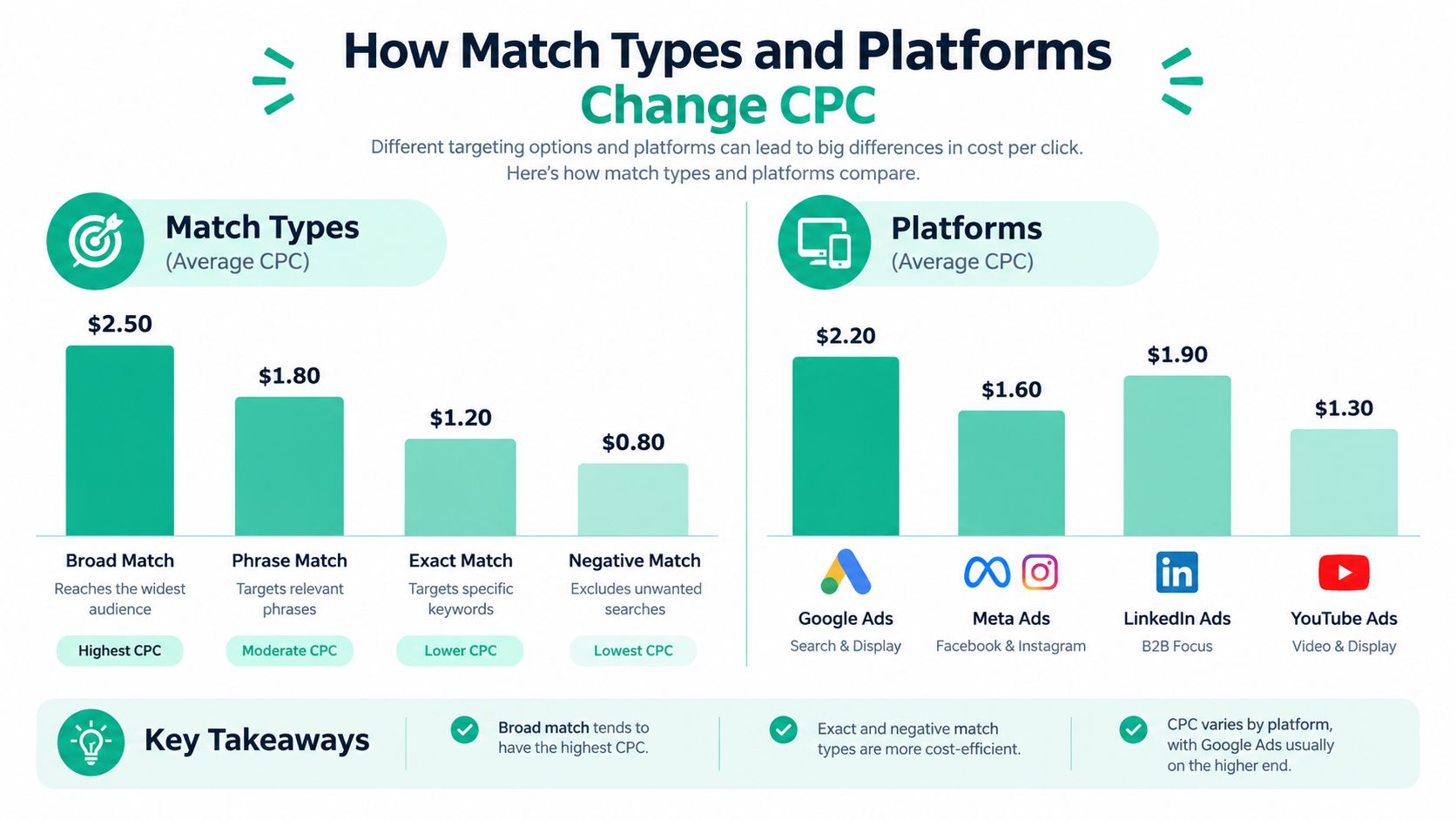
Platform choice changes the meaning of a click. Search captures active demand, so it often fits urgent local services such as auto repair, HVAC, dental care, and legal consultations. Display can support awareness and remarketing, but many impressions come from people who aren't actively looking for the service. Social platforms can create demand, introduce an offer, or bring previous visitors back, but a social click doesn't carry the same intent as a direct service search.
Don't lower CPC by moving valuable search demand into a cheaper channel without checking lead quality. A cheaper platform can produce more casual visits, while a higher-priced search campaign can produce fewer but more sales-ready inquiries.
What Actually Determines Your Click Price
Google's auction doesn't evaluate only your keyword and monetary bid. Google explains how Ad Rank works, including factors such as the search term, user's location, device, time of search, query nature, other ads and results on the page, and additional user signals.
Google also applies Ad Rank thresholds, which are minimum quality requirements for an ad to appear in a particular position. Relevance, expected performance, and the landing-page experience can affect eligibility and cost. That's why two advertisers bidding on related terms may see different results, even when their maximum bids look similar.
Build the forecast from your own campaign context
Start with the data you can control and inspect:
- Separate brand and non-brand traffic. Branded searches usually reflect existing awareness, while non-brand searches show the cost of reaching new demand.
- Break out locations. Review cities, ZIP codes, or service areas separately when the account has enough traffic to make the comparison useful.
- Compare devices. Mobile traffic may be more valuable for urgent calls, while desktop traffic may support research-heavy decisions.
- Review search terms. Find queries that spend budget without matching the service, then add negative keywords or tighten targeting.
- Connect clicks to outcomes. Track calls, forms, booked appointments, qualified leads, and revenue rather than stopping at platform-reported clicks.
A campaign average is useful because it smooths out individual auction fluctuations. A fixed keyword price isn't useful because the auction context keeps changing.
If your landing page fails to match the ad, expensive clicks become even harder to justify. Review common landing page optimization mistakes before assuming the bid is the main problem.
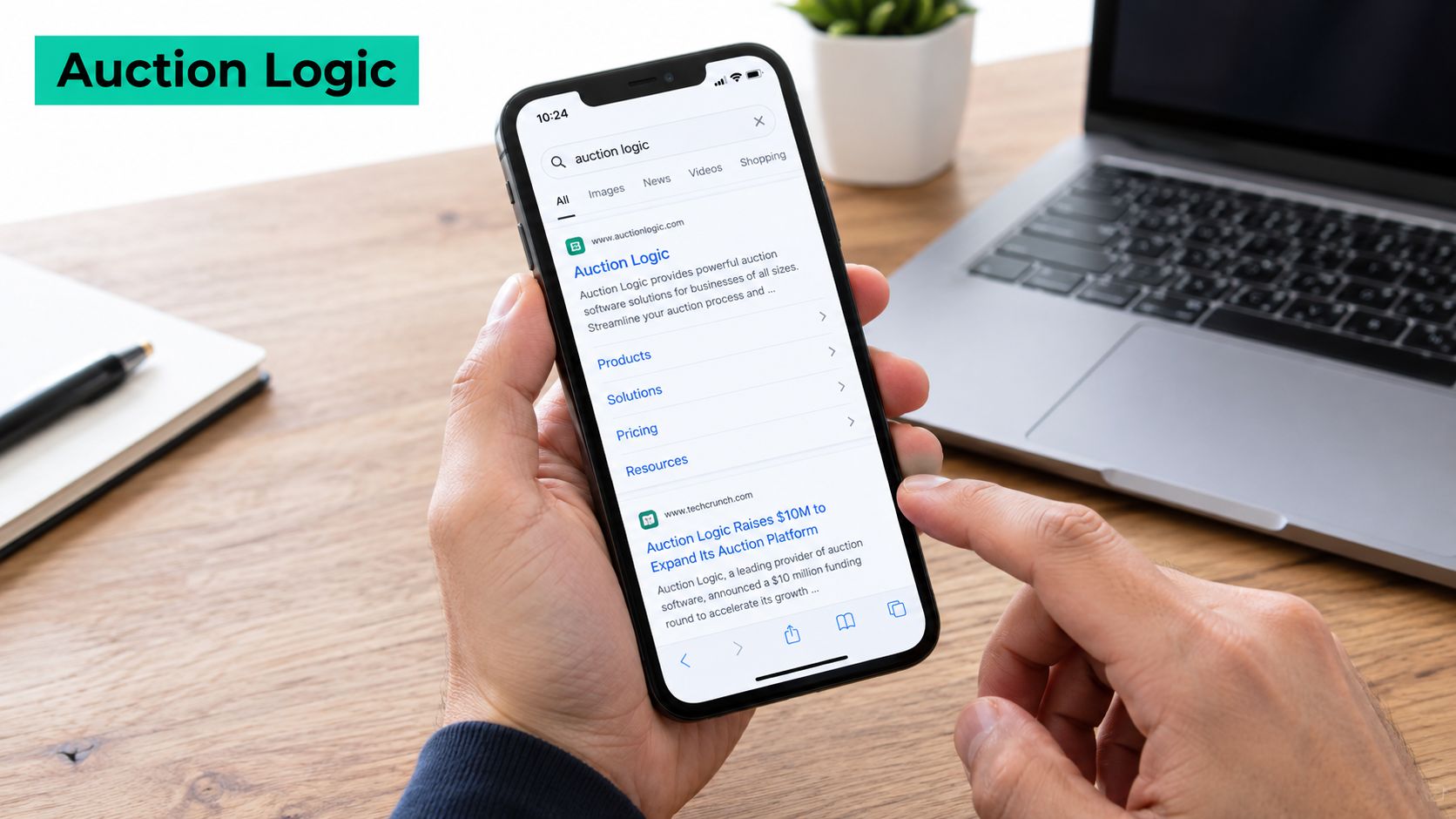
Use the auction data as a diagnostic tool, not just a billing report. This video also illustrates the auction logic advertisers need to understand:
Rising CPC and Better Campaign Economics
Higher CPC doesn't automatically mean a campaign is getting worse. The more important question is whether the additional cost is buying better traffic and stronger outcomes.
The 2025 benchmark data reported average CPC at $5.26, up from $4.66 in the prior period. At the same time, average conversion rate improved to 7.52%, compared with 6.96%, while average cost per lead rose more modestly to $70.11 from $66.69. The source also reported CPC increases in 87% of industries. Search Engine Land's coverage of the benchmark provides the relevant comparison.
Those figures don't prove that every account is healthy. They do prove that CPC alone can't answer whether an advertiser should reduce bids or stop advertising. Better keyword selection, stronger landing pages, improved conversion tracking, and more precise targeting can offset a higher price per visit.
A campaign can tolerate a higher CPC when it produces more qualified opportunities at an acceptable cost.
The practical reporting order should be:
- CPC: What did each visit cost?
- Conversion rate: How often did a click create a tracked action?
- Qualified lead rate: How many actions matched the service, location, and customer profile?
- Cost per qualified lead: What did it cost to create a real sales opportunity?
- Revenue impact: Did those opportunities produce profitable work?
Privacy changes make first-party conversion data more important, while AI-generated search experiences are changing how users interact with search results and paid placements. Those shifts make surface-level click reporting less reliable as a business decision tool.
Don't cut bids just because the average CPC moved upward. First check whether the campaign is attracting better searches, converting more effectively, and producing qualified leads at an acceptable cost. A cheap click that never reaches the sales team is still an expensive acquisition.
Practical Ways to Manage Your Average CPC
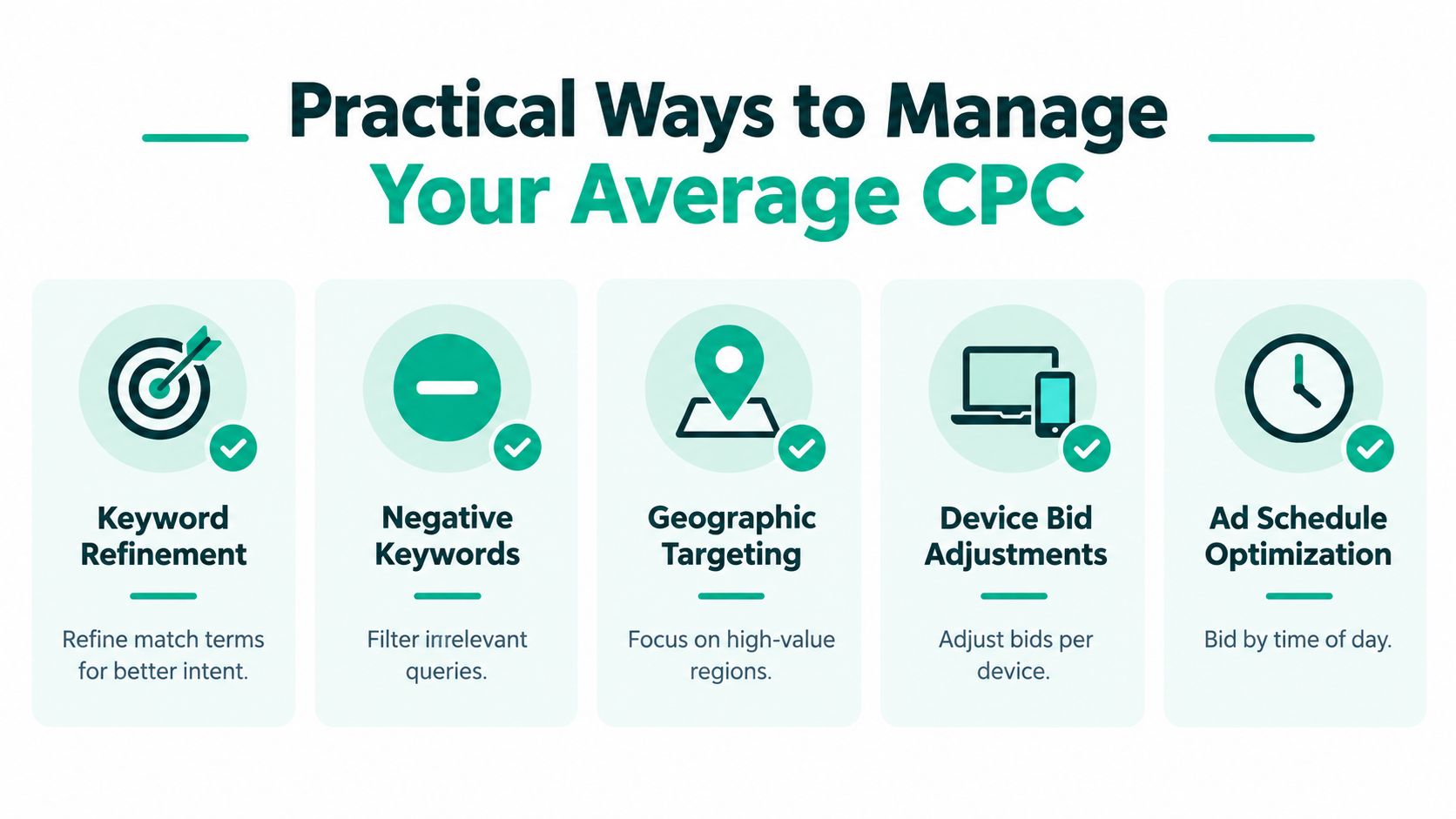
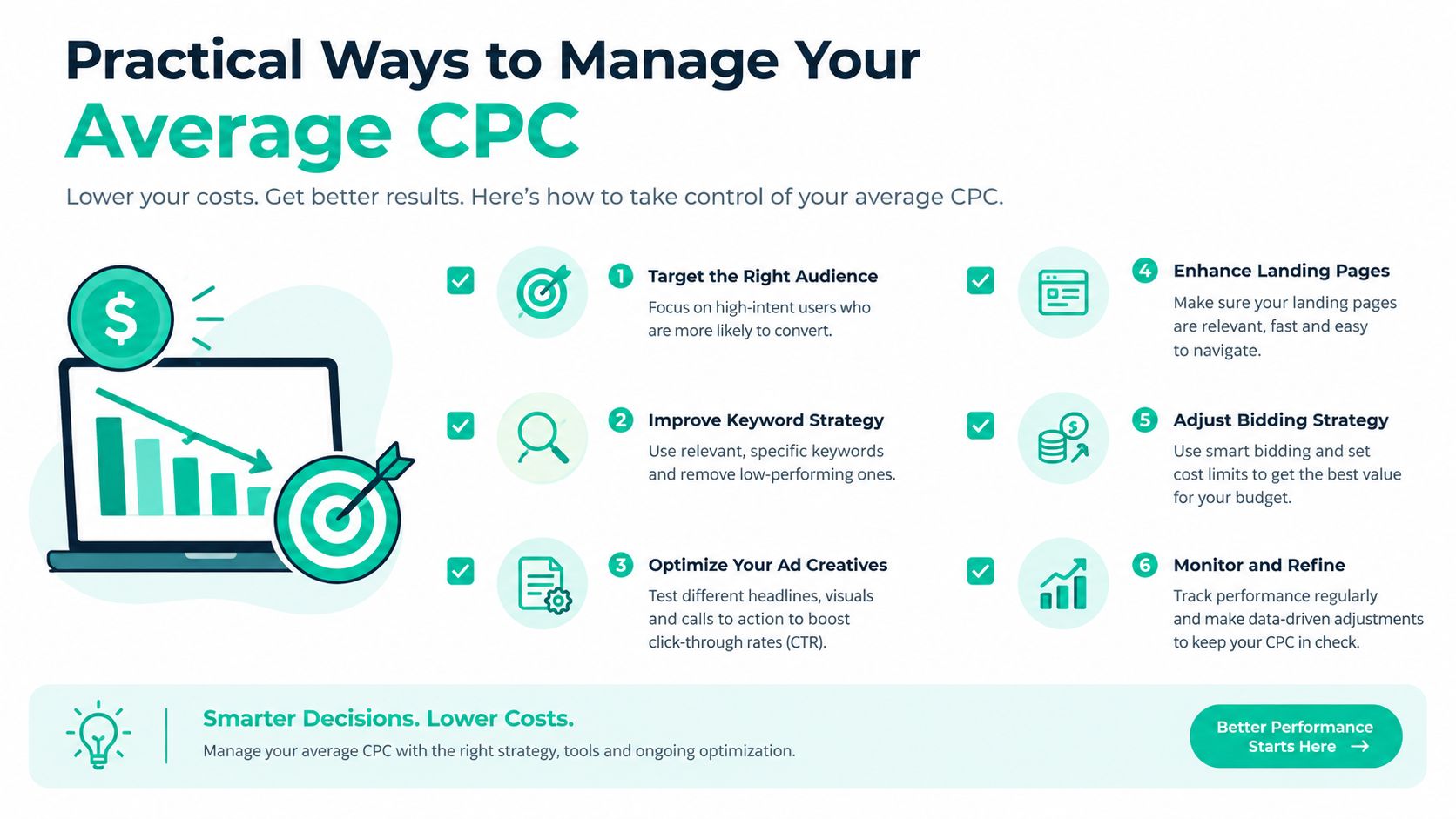
Lowering CPC is useful only when it doesn't remove the searches most likely to become customers. Apply these controls in order, then judge the result through qualified lead data.
- Refine keywords: Group urgent, service-specific searches separately from broad research terms. A plumber should distinguish a search for an emergency service from a general question about plumbing problems.
- Add negative keywords: Review search terms and exclude jobs, training, free information, unrelated products, and locations the business doesn't serve.
- Tighten geography: Target the actual service area instead of an entire region when the business only serves selected communities. Location settings should match where the team can respond.
- Adjust devices carefully: Compare calls, forms, and qualified leads by device before changing bids. More mobile traffic isn't automatically better, and lower mobile CPC isn't automatically more efficient.
- Use ad schedules: If calls are answered only during certain hours, align scheduling and messaging with operational capacity. Don't pay for demand the business can't handle.
- Improve the landing page: Match the headline, service, location, proof, and call to action to the search. Remove friction from forms and make phone contact easy for urgent services.
- Track the actual conversion: A form submission may be a lead, but it isn't necessarily a qualified lead. Import meaningful outcomes into Google Ads where possible so bidding can learn from business value.
- Review the account on a fixed cadence: Look for wasted queries, weak ads, poor locations, and conversion gaps consistently instead of making random bid changes.
Use a funnel view rather than a click-only view. This guide to marketing funnel examples can help connect search behavior to the stages that follow the click.
Assertive Agency offers PPC management across Google Search, Display, Shopping, remarketing, and YouTube, with reporting that includes CPC and other campaign metrics. Whether you manage campaigns in-house, use Google Ads tools directly, or hire an agency, the operating principle stays the same: protect qualified traffic before chasing a lower average.
Key Takeaways for US Advertisers
Average cost per click is a planning reference, not a fate. Industry, match type, platform, location, device, time, auction competition, ad relevance, and landing-page quality all shape what a US advertiser pays.
Use this checklist before setting a budget:
- Start with the category benchmark, then adjust for city, service area, and intent.
- Separate CPC from qualified lead cost in every report.
- Review search terms and conversion quality, not just clicks.
- Test targeting and landing pages before cutting valuable demand.
- Forecast from account history whenever reliable data exists.
The winning campaign isn't the one with the cheapest traffic. It's the one that buys enough qualified opportunities at a cost the business can support, then turns those opportunities into profitable customers.
Assertive Agency can audit your Google Ads structure, conversion tracking, landing pages, and lead quality to build a more realistic CPC and qualified-lead forecast. Visit Assertive Agency to request an initial audit and discuss a PPC plan for your US business.
