


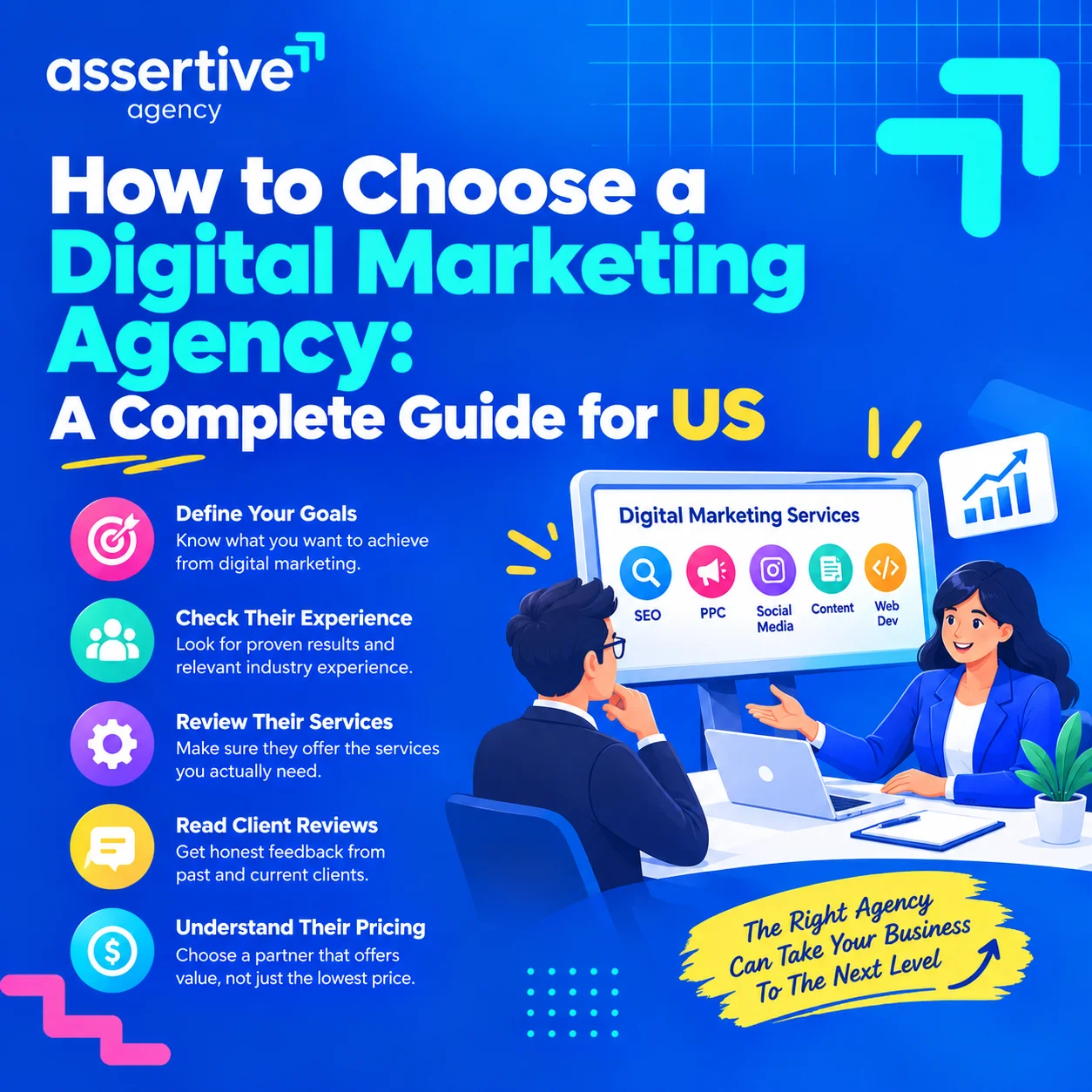
Knowing how to choose a digital marketing agency shapes how your brand grows online for the next year, maybe longer. The right partner turns ad spend into leads, leads into customers, and customers into repeat revenue. The wrong one burns your budget on vanity metrics while your competitors move ahead. This guide breaks down exactly how to choose a digital marketing agency: what to look for, what questions to ask, and which red flags mean you should walk away. You’ll learn how to evaluate experience, pricing, communication, and results before you sign a single contract, plus the difference between a full-service agency and a specialist, so you know which model fits a startup versus an established brand.
Start With Your Own Goals, Not the Agency’s Pitch
Before you contact a single agency, write down what you actually need. Do you want more website traffic, more qualified leads, higher sales, or stronger brand awareness? Each goal points toward a different service mix. A business chasing immediate leads usually needs Google Ads and PPC management. A brand playing the long game needs SEO and content strategy. Most growing companies need both.
Set numbers, not vague hopes. Instead of “more traffic,” aim for “20% more organic traffic in six months” or “a 15% drop in cost per lead by month four.” Clear targets like these do two things: they filter out agencies that can’t commit to measurable outcomes, and they give you a way to judge performance once the contract starts.
Also be honest about your internal marketing maturity. A brand-new startup usually needs an agency that can execute fast and pivot often. An established company with in-house staff might only need a specialist to fill a gap. Agencies that ask about your team and current tools before pitching a package are paying attention. Ones that skip straight to a proposal usually aren’t.
Full-Service Agency or Specialist: Pick the Right Model
Part of learning how to choose a digital marketing agency is understanding that agencies generally fall into two categories: full-service agencies and specialists.
A full-service digital marketing agency covers SEO, Google Ads, social media marketing, website development, content, and sometimes reputation management, all under one roof. This model suits businesses that want one point of contact managing every channel, with strategies that connect (an SEO content plan feeding a retargeting campaign, for example). It also tends to cost less overall than hiring five separate vendors.
A specialist agency focuses on one channel, like SEO or paid social, and goes deeper into that single discipline. This works well if you already have most of your marketing covered internally and just need expert help in one area.
Neither model is automatically better. A small business with a limited budget often does better with a full-service agency that offers bundled, affordable digital marketing services starting around $150 to $300 per month for foundational packages. A company with a dedicated marketing team might get more value from a specialist who can go deep on one channel without duplicating in-house work.
Check Experience and Industry Track Record
Experience is one of the clearest signals when you’re figuring out how to choose a digital marketing agency. Ask how long the agency has operated and how many clients they’ve served in your industry. An agency with five or more years in business and a portfolio spanning multiple sectors has weathered algorithm updates, platform changes, and shifting ad costs. That kind of experience matters more than a flashy website.
Look for certifications too. Google Partner status and SEMrush certification signal that the team has passed vendor-level training and manages live ad accounts to a certain standard. These badges aren’t everything, but their absence on an agency that claims deep PPC or SEO expertise is worth questioning.
Review third-party platforms like Clutch or Google Business Profile for client feedback. Genuine reviews mention specific outcomes, communication style, and project timelines, not just generic praise. A pattern of missed deadlines or vague complaints about reporting should raise a flag.
Ask for Real Case Studies and Measurable Results
A reputable agency should hand over case studies without hesitation. Push past the headline numbers and ask for context. “Traffic increased 40%” means little without knowing the starting point, the timeframe, and what specific actions drove the increase.
Look for a clear structure in every case study: the client’s starting problem, the strategy the agency built, and the measurable outcome, ideally tied to revenue or leads rather than impressions alone. A strong example reads something like this: a client’s cost per lead dropped by roughly a third within six months after the agency restructured their Google Ads campaigns and rebuilt their landing pages for conversion.
If an agency only offers vague wins with no numbers attached, ask directly for data. A team that hedges or changes the subject probably doesn’t have results worth sharing.
Understand Their Pricing Structure
Pricing models vary across the industry, and understanding them protects you from surprise costs. Common structures include:
- Flat monthly retainer: A fixed fee covering a defined scope of work each month. This is the most predictable option and works well for small businesses that want budget certainty.
- Performance-based pricing: Fees tied to results, like cost per lead or a share of ad spend. This can align incentives but works best when attribution is crystal clear.
- Hybrid pricing: A lower base retainer plus a performance bonus. This balances stability with accountability.
- Project-based pricing: A one-time fee for a defined deliverable, like a website rebuild or a single campaign launch.
Transparent agencies publish their starting price or share it early, with no hidden fees buried in the fine print. Expect entry-level packages for startups to start around $150 to $250 per month, with mid-tier plans landing between $250 and $400, and custom enterprise pricing above that. An agency that refuses to discuss numbers until after a lengthy sales call is worth a second look, though not an automatic dealbreaker.
Evaluate Communication and Reporting Habits
The best marketing agency for your business operates almost like an extension of your own team. Before signing anything, ask how often you’ll hear from them and in what format.
Weekly or biweekly check-ins work well for active campaigns. Monthly-only communication can leave you blind to problems for weeks at a time. Ask whether they provide live dashboards or static reports, and how quickly they flag underperformance.
A trustworthy agency also runs a free audit before proposing a strategy. This shows they’re basing recommendations on your actual website and market position, not a generic template applied to every new client. Agencies that skip this step and jump straight to a fixed package may not be tailoring anything at all.
Watch for Red Flags During the Sales Process
A handful of warning signs show up again and again in agency pitches that don’t hold up after signing:
- Buzzword-heavy decks with no metrics. Phrases like “growth hacking” or “omnichannel synergy” with no number attached deserve a follow-up question.
- No mention of core metrics. Cost per lead, conversion rate, and return on investment should come up naturally, not just impressions or followers.
- Cookie-cutter proposals. A pitch that reads like another client’s deck with your name swapped in signals a lack of real research.
- Pressure to sign quickly. A confident agency can wait a few days for you to compare options.
- Vague or missing contract terms. No defined scope, no revision limits, and no exit clause add up to risk you don’t need.
None of these disqualifies an agency on its own, but two or more together is a signal to keep looking.
Confirm Contract Terms and Onboarding Process
Before you sign, get clarity on three things: scope, timeline, and exit terms.
Scope should spell out exactly what’s included each month, how many revisions are covered, and what counts as an extra charge. Timeline expectations matter too. Paid ads can show early signals within 24 to 48 hours of launch, while SEO typically takes three to six months to show meaningful movement. An agency promising overnight SEO wins is either inexperienced or not being straight with you.
Exit terms protect you if the partnership doesn’t work out. A fair contract includes a 30-day termination clause rather than locking you into a full year. Ask what happens to your accounts and data if you leave. You should retain ownership of your ad accounts, analytics properties, and website access regardless of who manages them day to day.
A smooth onboarding process usually includes an initial audit, a documented roadmap tied to your goals, and a kickoff call where both sides align on KPIs before work begins.
Questions to Ask Before You Sign
Bring these questions to every discovery call:
- What specific KPIs will you track, and how do they tie to revenue, not just traffic?
- Can you share two or three case studies from businesses similar to mine?
- What’s included in the monthly fee, and what counts as an add-on?
- How often will we talk, and who is my direct point of contact?
- What’s your realistic timeline for early results versus long-term ROI?
- What happens to my accounts and data if I decide to leave?
An agency that answers these clearly, with specific numbers and named tools, has done this before. One that gives vague, reassuring answers without substance probably hasn’t.
Frequently Asked Questions
How much does it cost to hire a marketing agency in the US?
Pricing typically starts around $150 to $250 per month for small business packages and rises to $250 to $400 or more for mid-tier plans with broader service coverage. Enterprise engagements are usually custom-quoted based on ad spend, channel count, and reporting complexity. Always ask for a written breakdown of what each tier includes before comparing prices across agencies.
How long does it take to see results from a digital marketing agency?
Results depend on the channel. Google Ads and paid social can generate traffic and leads within 24 to 48 hours of launch. SEO and content marketing usually take three to six months to show meaningful ranking improvement, with the strongest gains often appearing between months six and twelve. A reliable agency sets these expectations upfront rather than promising instant results.
Should I choose a full-service agency or a specialist?
Choose a full-service agency if you need multiple channels working together and want a single point of contact managing SEO, ads, social, and web all at once. Choose a specialist if you already have most channels covered internally and need deep expertise in just one area, like technical SEO or paid search. Many small businesses start full-service and add specialists later as their team grows.
What’s the biggest reason agency partnerships fail?
Misaligned goals and an unclear scope of work. When success metrics aren’t defined before the contract starts, both sides end up measuring different things and losing trust. Locking in specific KPIs and a documented scope during onboarding prevents most of these breakdowns.
Do marketing agencies work with small businesses and startups?
Yes, many agencies build packages specifically for startups and small businesses with limited budgets, often starting under $200 per month. These entry-level plans usually cover basic SEO, a couple of social platforms, and initial ad account setup, with room to scale up as the business grows.
Final Thoughts
Knowing how to choose a digital marketing agency comes down to matching your specific goals with a team that can prove, not just promise, measurable results. Define what success looks like before you take a single sales call. Compare pricing structures honestly, ask for real case studies with numbers attached, and pay close attention to how an agency communicates before you ever sign a contract. The right agency turns ad spend into leads, leads into customers, and customers into repeat revenue, and that’s worth taking the time to get right.
