The phone is quiet, but the service trucks are still moving. Your technicians know the territory, customers are satisfied once the work is done, and the company has capacity. Yet when a homeowner searches for “AC repair near me” or “furnace service” in your market, another contractor appears in Google Maps first.
That gap usually isn't a workmanship problem. It's a local visibility and conversion problem. HVAC local SEO services connect your real-world service area, business information, reviews, website, and lead tracking so search systems can match the right customer with the right contractor at the right moment.
Table of Contents
- The Quiet Phone and the Local Search Reality
- What HVAC Local SEO Services Actually Are
- The Six Moving Parts of an HVAC Local SEO Program
- Google Business Profile and Citation Accuracy
- On-Page, Technical and Service Area Content
- Reviews, Local Links and Reputation Signals
- Pricing, Selection Criteria and KPIs That Actually Matter
- A Realistic ROI Sketch and Where to Start
The Quiet Phone and the Local Search Reality
A residential HVAC owner in a mid-sized USA city may notice the warning signs gradually. Calls flatten after a strong season. Paid search keeps producing leads, but the cost feels harder to control. Competitors with similar services appear in the Map Pack, while the owner's own profile is missing for nearby searches.
The frustrating part is that the company may already have everything needed to win the job: trained technicians, open appointment slots, a recognizable brand, and years of local work. Google does not present those strengths clearly enough to the person searching.
Local search behaves differently from broad informational SEO because location and urgency shape the result. Google says local rankings are mainly influenced by relevance, distance, and prominence. Relevance means the profile and page match the service requested. Distance reflects how close the business is to the searcher. Prominence reflects how well-known and trusted the business appears, influenced by signals such as reviews and links from other sites. The explanation is outlined in Google's guidance on local ranking factors.
Why the first call often starts in Maps
Google's consumer research found that 4 in 5 consumers use search engines for local information, including addresses, opening hours, availability, and directions. On smartphones, 50% of people who conducted a local search visited a physical business within one day, compared with 34% of those searching on a computer or tablet. Google also reported that 18% of smartphone local searches led to a purchase within one day, versus 7% of non-local searches. HVAC work is usually booked rather than purchased in a store, but the behavior is directly relevant to emergency repairs, replacement estimates, maintenance visits, and installations. These figures come from Google's local search research.
Practical rule: Treat every local result as a customer decision point, not as a directory entry.
A generic SEO package may improve a blog article while leaving the phone number, service area, emergency hours, review process, and landing page structure untouched. That wastes budget when the actual constraint is operational: Google can't confidently associate your company with a specific service, place, and customer need.
HVAC local SEO services work as an operating system for those signals. They keep the profile accurate, the website useful, the service area defensible, the reputation active, and the reporting tied to calls and booked work. Rankings matter, but they're only useful when the visibility reaches profitable areas and produces qualified conversations.
What HVAC Local SEO Services Actually Are
HVAC local SEO services improve how an HVAC company appears in Google Maps, local results, organic search, and increasingly AI-assisted search experiences. The work combines business-profile management, service-area content, technical SEO, reviews, local links, and measurement.
Google's local model gives the program a clear operating framework.
Relevance starts with the service
Google needs to understand whether your company fits the request. An accurate primary category, useful secondary categories, complete services, detailed page titles, and clear service descriptions all help establish that connection.
A company that handles emergency AC repair, furnace replacement, heat pump installation, and maintenance shouldn't force every offer onto one vague homepage. Each major service needs a page that explains what the company does, where it operates, what customers can expect, and how to make contact.
Distance sets practical boundaries
A contractor can't serve every city equally well. Google uses the searcher's location and the business's location or service area to estimate geographic relevance. Artificial city lists, duplicated pages, or unsupported virtual addresses may attract impressions but often bring poor leads and create credibility problems.
A useful local program maps service areas to actual dispatch capacity, technician coverage, emergency response expectations, and profitable work zones.
Prominence reflects trust and recognition
Prominence is built through legitimate reviews, relevant local mentions, links from industry or community organizations, and consistent business information. It isn't created by repeating “HVAC contractor” across a page or buying a batch of low-quality directory links.
The ongoing nature matters. A profile can be corrected once, but new services, changed hours, seasonal demand, reviews, locations, and customer questions require continuous attention.
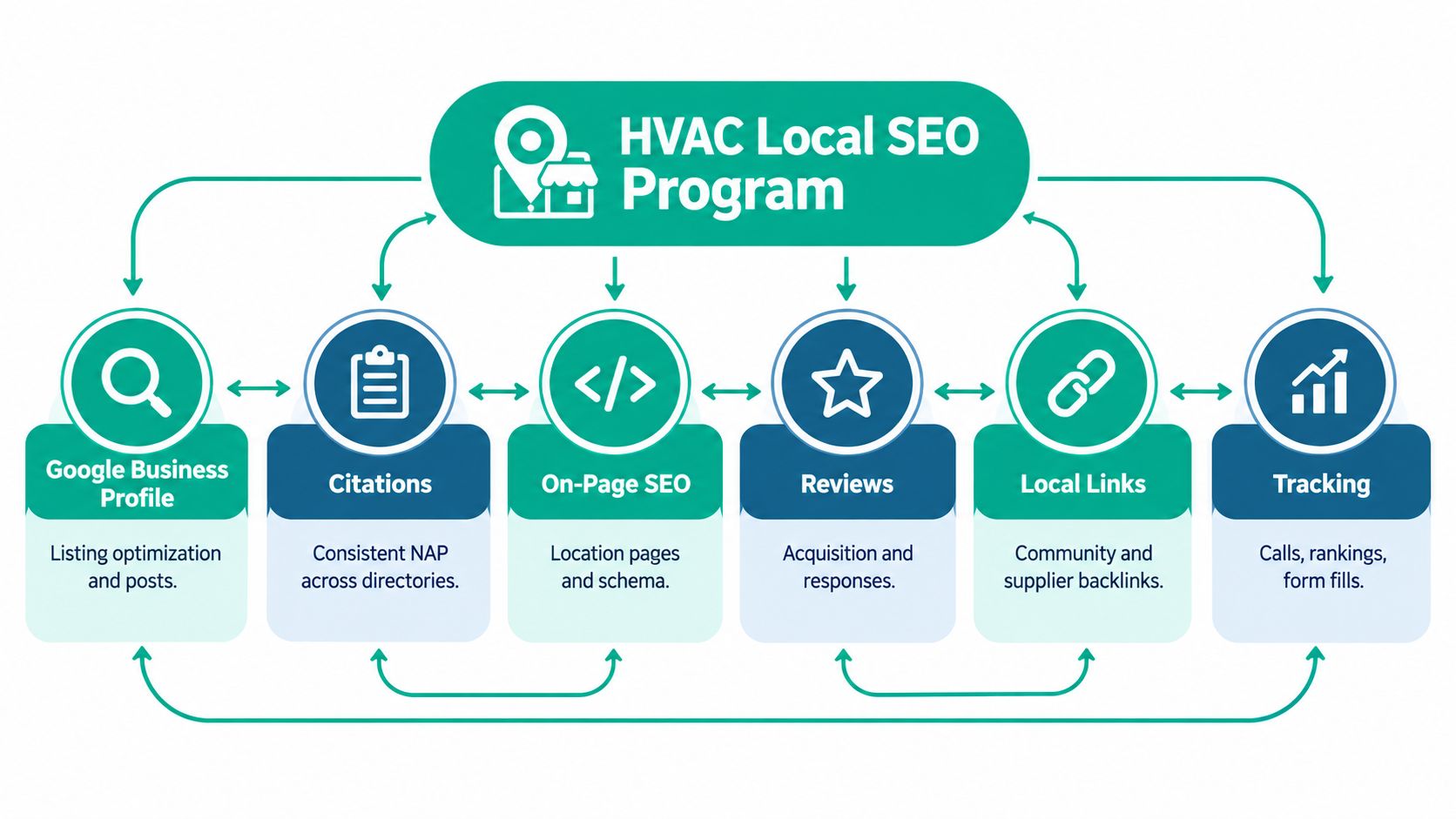
Traditional SEO may focus heavily on organic pages and backlinks. Local SEO adds a public business entity, map visibility, proximity, reviews, and service-area accuracy. That's why a backlink campaign alone rarely fixes a weak HVAC presence. The contractor needs a coordinated system that connects the profile, pages, citations, reputation, and conversion path.
The Six Moving Parts of an HVAC Local SEO Program
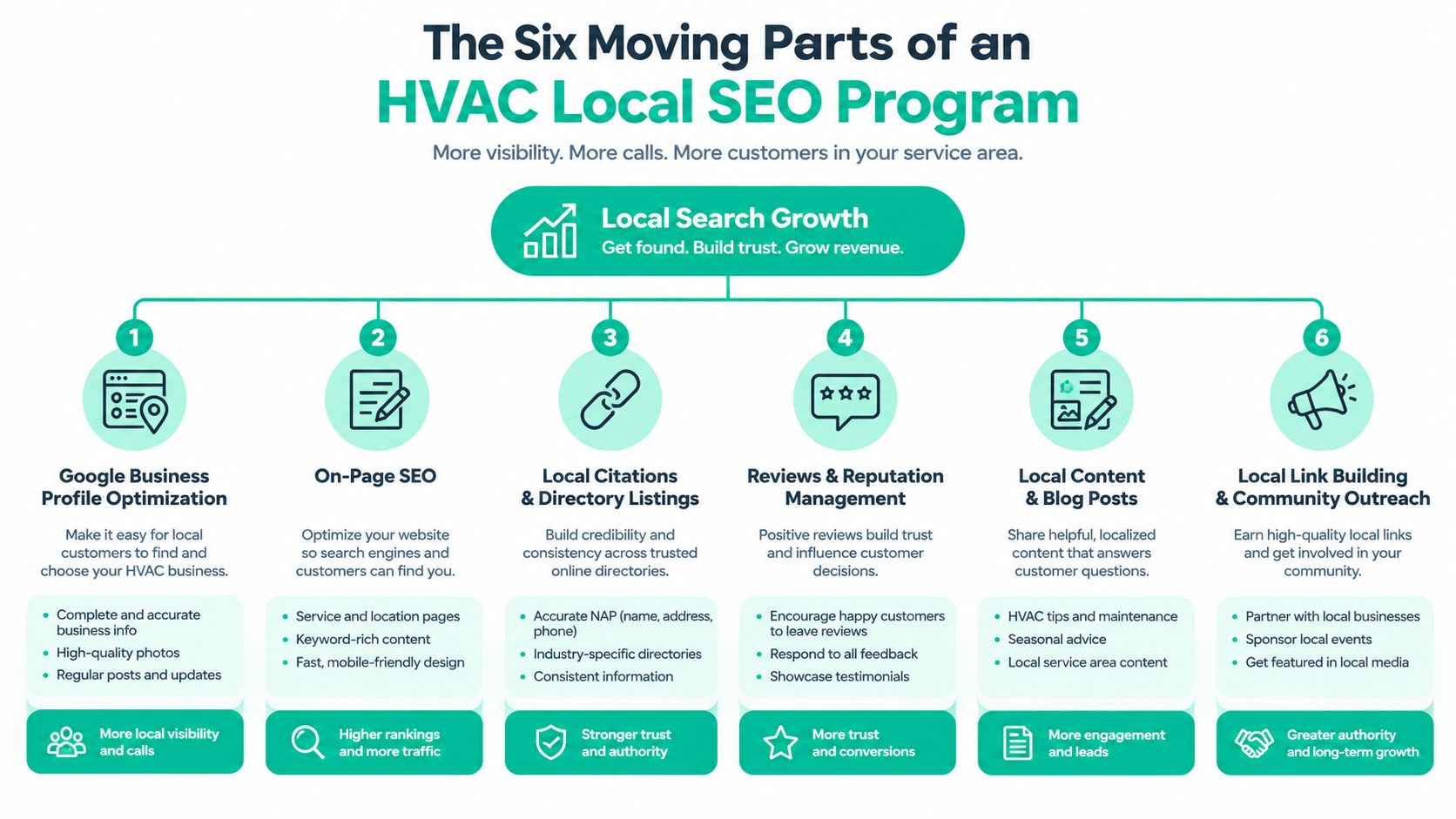
A working HVAC local SEO program has six connected parts. Each one supports the next, so skipping a component usually creates leakage rather than a clean saving.
1. Google Business Profile
The profile is the public operating record for the business. Categories, phone number, hours, emergency availability, services, photos, website URL, and service areas should reflect what the company provides.
2. Citations
Citations keep the business name, address, phone number, and service details consistent across important directories and industry platforms. They reinforce the profile rather than replace it.
3. On-page SEO
Service pages and location pages give Google and customers deeper context. A profile may earn the click, but a clear page often determines whether the visitor calls.
4. Reviews
A review program creates a continuing record of completed work. Requests should follow genuine repairs, installations, and maintenance visits, with responses to both praise and complaints.
5. Local links
Useful local links come from real relationships, such as manufacturers, suppliers, trade groups, chambers, community organizations, and relevant local publications. They're stronger when they confirm both geographic and industry relevance.
6. Tracking
Tracking connects impressions and rankings with phone calls, forms, qualified conversations, booked jobs, and completed work. Without it, an agency can report movement that doesn't improve the schedule.
Some tasks fit naturally in-house. A service manager can supervise review requests and verify hours. A technician can provide job photos and answer common customer questions. Technical audits, page architecture, schema implementation, competitive research, and local link development usually require more specialized time.
A practical SEO audit framework helps prioritize the work. Start with errors that block contact or misrepresent the business, then improve the pages and signals that support the highest-value service areas.
The six parts also form a feedback loop. Call recordings reveal customer language, which improves service pages. Page content clarifies profile services. Review themes reveal trust objections. Geographic lead data shows whether service-area pages attract profitable jobs or merely distant inquiries.
Google Business Profile and Citation Accuracy
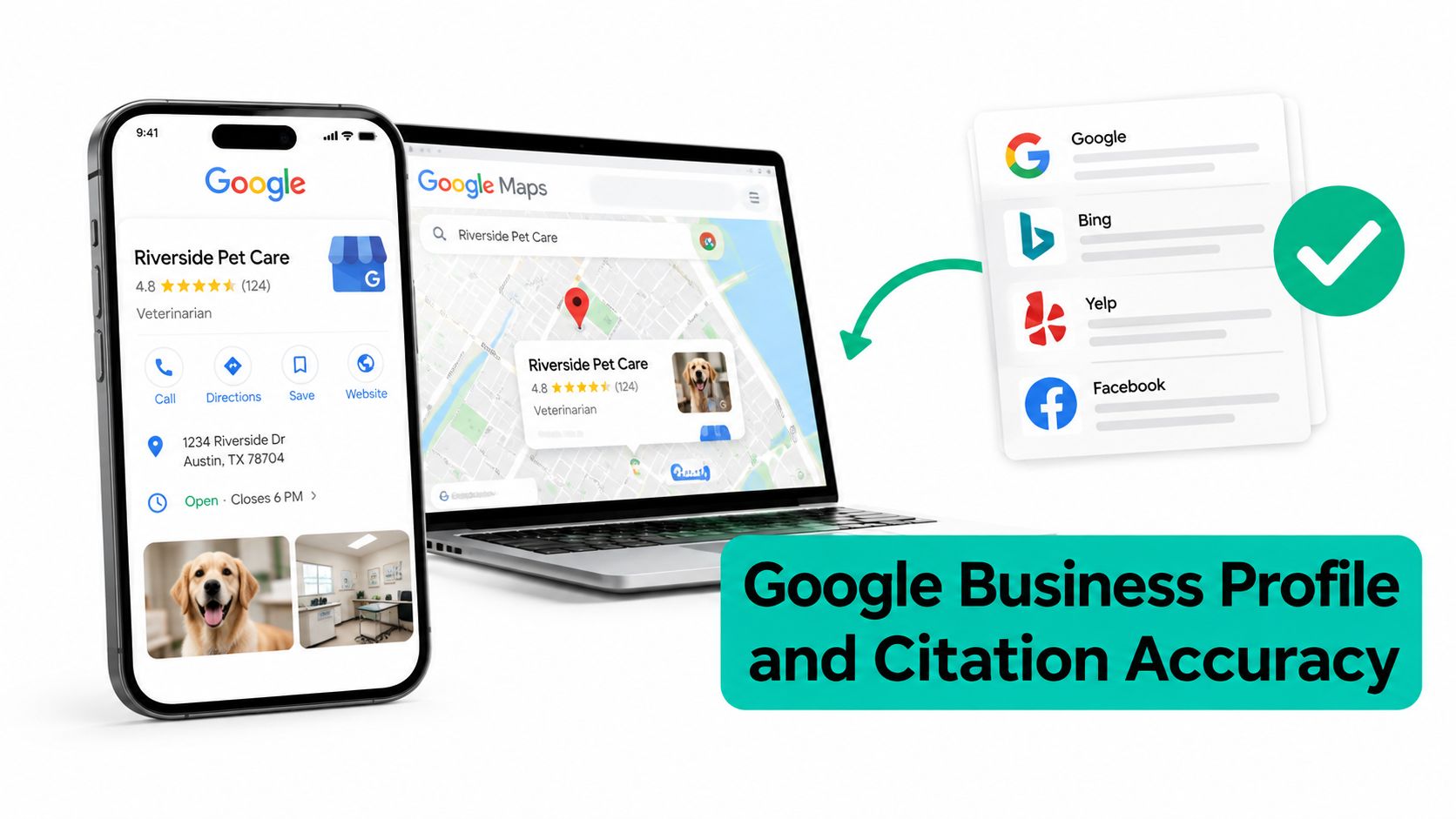
Start with the public facts customers use before they decide to call. A Google Business Profile should show the correct business name, primary category, relevant secondary categories, phone number, website, opening hours, emergency availability, services, photos, and legitimate service areas.
Google's LocalBusiness structured data documentation requires a business name and address for eligibility and supports details such as telephone number, URL, coordinates, hours, departments, and services. The markup should describe information already visible on the corresponding page. It doesn't guarantee rankings or rich results, but it makes the location's attributes easier for search systems to interpret.
Build one accurate source of truth
Create a simple business-information sheet before editing listings. Include the exact public name, staffed address, tracking or primary phone number, website URL, hours, emergency policy, services, and service-area boundaries.
Then compare that sheet against the Google Business Profile, website contact page, location pages, major directories, social profiles, and industry associations. Fix old phone numbers, inconsistent abbreviations, duplicate listings, closed locations, and addresses that don't represent staffed offices.
For a company with multiple legitimate branches, each staffed location should have:
- A distinct profile: Maintain a separate profile only when the location is eligible and genuinely staffed.
- A crawlable page: Give each location a page with its own address, phone number, hours, services, and useful local details.
- Matching entity data: Keep the name, address, and phone consistent across the page, profile, and directories.
- Visible marked-up information: Ensure structured data matches the address customers can see on the page.
- Clear internal navigation: Link location pages from the main site so users and crawlers can reach them.
Service-area businesses need particular discipline. Listing every nearby city may create visibility for searches the company can't serve promptly. Separate emergency coverage from installation territory when the operating model calls for it, and use real capacity rather than an artificial radius as the boundary.
The profile should answer a customer's first questions before the customer has to call.
A citation cleanup is valuable when it removes confusion. It isn't valuable when it produces hundreds of thin listings that no one uses. Prioritize authoritative platforms, local organizations, relevant trade associations, and profiles that customers consult.
On-Page, Technical and Service Area Content
A map listing can create the first impression, but the website has to convert attention into a call. Strong HVAC pages make the service, coverage area, hours, phone number, emergency option, trust evidence, and next step obvious on a mobile screen.
Industry HVAC research reports that roughly 71% of web traffic in home services is mobile and that city-name or “near me” queries convert 15% to 20% better than generic HVAC searches. These are benchmarks, not guarantees. The practical response is to measure the pattern in each market, then design around high-intent mobile behavior. The figures are reported in HVAC buyer-journey research.
Build pages around real intent
Emergency repair pages should lead with fast qualification and contact. Repair pages can explain diagnosis, common symptoms, service steps, warranty information, and what happens after the call. Installation and replacement pages need decision support, system options, financing context where applicable, and clear reasons to request an estimate.
Location pages shouldn't be city-name templates. They should explain which services are available in that area, how dispatch works, what hours apply, and how customers can reach the local team. If a page has no distinctive local or service value, it probably shouldn't exist.
Remove mobile friction
Prioritize the fixes customers feel:
- Compress hero imagery: Large banners can delay the first useful view.
- Reserve layout space: Prevent phone buttons, images, and forms from jumping as assets load.
- Reduce render-blocking assets: Remove scripts and styles that don't support the first interaction.
- Limit third-party tools: Chat widgets, trackers, and pop-ups can slow pages and distract from calling.
- Make tap-to-call persistent: Put the primary phone action where a mobile visitor can reach it quickly.
The goal isn't a perfect technical score in isolation. The goal is a page that loads reliably, stays stable, and lets a homeowner contact the company without hunting through menus.
A page with clear copy and a slow interaction path loses its advantage. A fast page with no service detail may earn a visit but not a qualified call.
For practical guidance on the conversion layer, review SEO-friendly website design.
Use JSON-LD for the appropriate business or service entity, and keep the marked-up content accurate and visible. Structured data supports interpretation. It doesn't replace useful pages, legitimate locations, or a working phone experience.
Reviews, Local Links and Reputation Signals
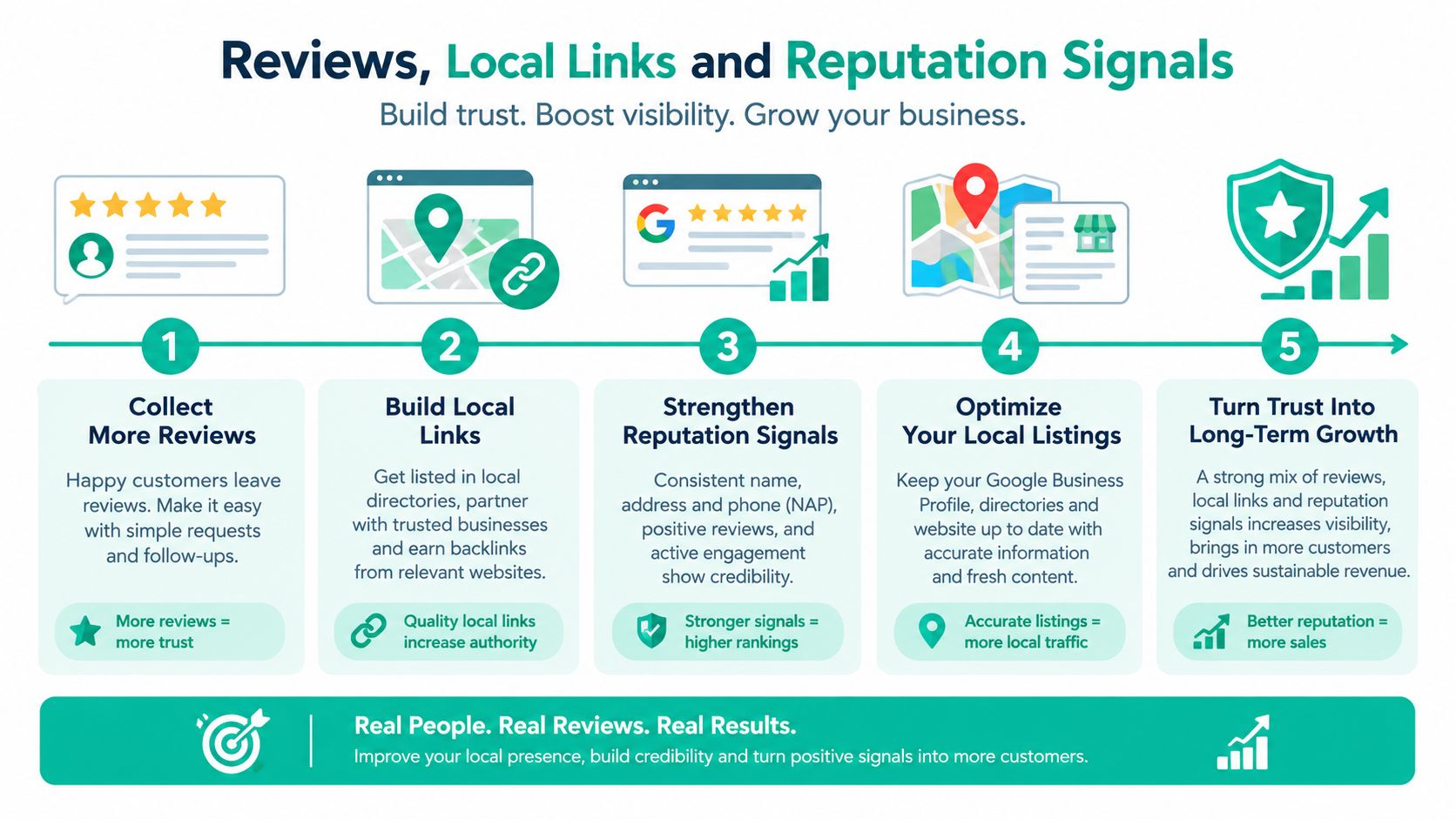
Reviews do two jobs. They help prospective customers judge whether a contractor is trustworthy, and they contribute to the prominence signals used in local search. BrightLocal's 2025 survey of a representative panel of 1,026 U.S. adults found that 85% consider contact information and opening hours important when researching local businesses. The same survey reported that 67% often or always look at reviews after a local search, while 74% check reviews on at least two platforms. See the BrightLocal 2025 Local Consumer Review Survey for the methodology and findings.
Quality beats a scripted request
A technician should invite feedback after a completed job, when the customer has had a chance to confirm the system works and the interaction is fresh. The request should be neutral and available to every eligible customer. Don't offer incentives, gate unhappy customers away from public platforms, or pressure people to include keywords.
A detailed review describing the problem, diagnosis, communication, and final result gives future customers more useful evidence than a bare rating. Respond to positive and negative reviews with the same professionalism. One summary of BrightLocal's research reports that 89% expect owners to respond to both positive and negative reviews, as documented by SearchLab Digital's review survey summary.
Trust has also become harder to assume. BrightLocal reported that review trust fell from 79% in 2020 to 42% in 2025, meaning customers may scrutinize recency, detail, platform consistency, and owner responses more carefully. Reviews still matter, but a large undifferentiated volume isn't a complete reputation strategy.
Local links should confirm reality
A link from a local chamber, equipment manufacturer, supplier, licensing association, community organization, or relevant publication can reinforce who the company is and where it operates. A mass submission to unrelated directories may create activity without adding meaningful prominence.
The choice is a trade-off. Sponsorships and memberships may require real participation, while low-quality directory placements appear faster. The former usually creates a stronger business relationship and a more credible local signal.
Set expectations by stage
Visibility changes before lead quality becomes clear. Early work often reveals profile errors, indexing issues, and service-area gaps. Later work can improve map presence and organic discovery, but lead volume still depends on season, capacity, response speed, and competition.
At roughly three months, assess whether the technical foundation, profile information, citations, and priority pages are correct. Around six months, compare query groups, qualified calls, and service-area coverage rather than relying on one ranking screenshot. By twelve months, evaluate whether organic visibility has become a dependable acquisition channel across emergency, repair, installation, and research intent.
This approach to suppressing negative search results should support genuine reputation repair, not bury unresolved customer problems.
Pricing, Selection Criteria and KPIs That Actually Matter
An HVAC local SEO proposal should explain the work, access required, reporting method, and commercial outcome. Be cautious with packages that promise rankings without asking about service areas, technician capacity, call handling, seasonality, or existing profile ownership.
The monthly investment should match the number of markets, services, pages, listings, reviews, technical issues, and reporting requirements. A low-cost package may be reasonable for a single-location company that needs cleanup and basic optimization. It becomes inadequate when a multi-location operator needs unique pages, local links, call tracking, content production, and ongoing technical work.
| Tier | Monthly Investment (USD) | Typical Inclusions | Best Fit |
|---|---|---|---|
| Foundation | Qualitative, based on scope | Profile cleanup, citation correction, basic on-page work, tracking setup | A focused single-market contractor |
| Growth | Qualitative, based on scope | Service and location pages, review workflow, technical improvements, local links, monthly reporting | An established company competing across several service areas |
| Expansion | Qualitative, based on scope | Multi-location architecture, territory analysis, content production, reputation management, CRM and call attribution | A growing regional HVAC brand |
Questions that expose weak providers
Ask who owns the Google Business Profile and website access. Ask whether the agency writes unique pages or swaps city names into a template. Ask which citations it will correct, how review requests will comply with platform policies, and whether reports include qualified calls and booked jobs.
A credible provider should show the work completed, the issues found, the next priorities, and the limitations of the data. Assertive Agency offers local SEO, technical audits, on-page optimization, citation work, content, link building, reputation support, and reporting as part of broader digital marketing engagements.
Track the operating outcome
Useful HVAC KPIs include:
- Qualified calls: Separate emergencies, repairs, estimates, maintenance, and spam.
- Booked jobs: Record whether the call became an appointment.
- Completed work: Close the loop with the CRM or dispatch system.
- Service-area penetration: Compare visibility and lead quality by city or coverage zone.
- Profile actions: Monitor calls, website visits, and direction requests from the profile.
- AI visibility: Track whether useful pages or brand information appear in AI-generated local answers.
Domain authority, raw impressions, and isolated ranking positions can provide context. They shouldn't replace revenue-linked measures.
A Realistic ROI Sketch and Where to Start
A useful ROI model starts with your own economics, not a generic agency case study. For a mid-size residential HVAC operation serving two service areas, separate the first-year view into emergency calls, repair inquiries, installation estimates, maintenance requests, and research-assisted conversions. Then connect each group to qualified calls, booked jobs, completed work, and the actual value of those jobs.
Seasonality can make a month look successful or weak for reasons unrelated to the quality of the campaign. Compare like service lines and demand periods, and don't call a ranking increase a win until the leads are qualified.
AI Overviews create another measurement gap. Recent local-search research found AI Overviews in 68% of sampled local-business queries, while simple local-intent searches appeared less likely to trigger them than informational or hybrid queries. The finding is reported in Search Engine Land's local search coverage. Track branded searches, assisted calls, qualified leads, citations, and mentions alongside Maps and organic rankings.
Start with a practical first 90 days:
- Verify profile ownership, categories, hours, phone numbers, services, and service areas.
- Correct inconsistent citations and remove duplicate or misleading location signals.
- Fix the highest-friction mobile issues and improve priority service pages.
- Create a compliant review workflow for completed jobs.
- Segment Search Console, call tracking, and CRM reporting by emergency, repair, and research intent.
HVAC local SEO services can't control proximity, weather, technician capacity, or every Google result. They can make the business easier to understand, easier to trust, easier to contact, and easier to measure.
Assertive Agency can audit your Google Business Profile, service-area pages, technical foundation, citations, reviews, and lead tracking, then build a local SEO plan around the jobs you want to book. Visit Assertive Agency to request an audit and discuss a practical growth program for your HVAC market.