


Have you ever wondered whether a link earned through outreach is still “white hat,” or whether asking for it automatically makes the tactic manipulative? The answer depends less on the email, guest post, or partnership and more on why the link exists, how it was obtained, and whether it helps the reader.
Table of Contents
- Why People Keep Asking What White Hat Link Building Really Means
- The Origin Story How Links Became the Web's Trust Currency
- White Hat Grey Hat and Black Hat The Side by Side Comparison
- What Google Actually Forbids Inside Its Link Spam Policy
- Core Tactics That Actually Earn Links the Right Way
- Rel Attributes and Why Misusing Them Still Gets You Penalized
- What AI Summaries Mean for the Value of an Earned Link
- Best Practices and a Simple Audit You Can Run This Week
Why People Keep Asking What White Hat Link Building Really Means
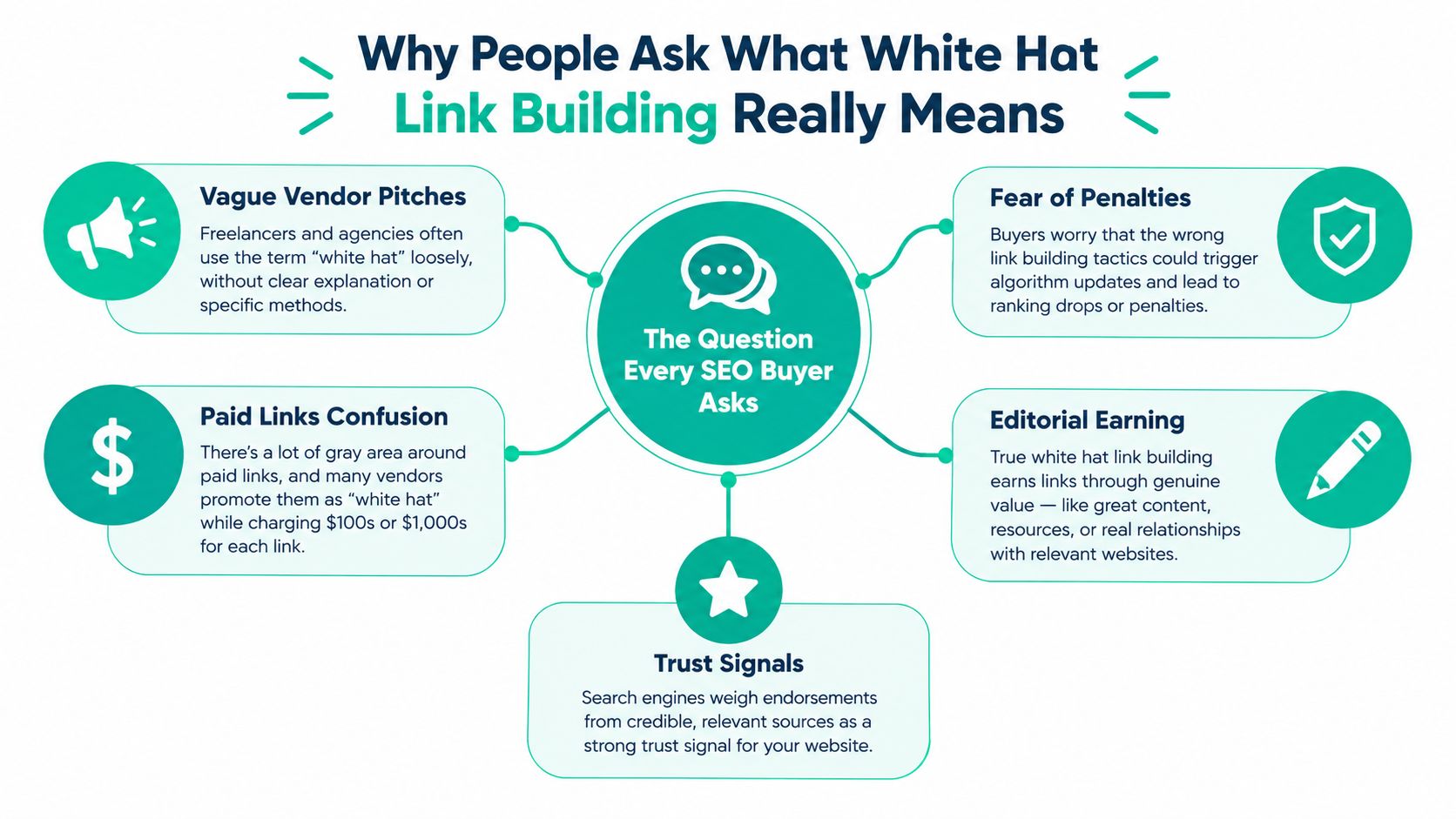
Why do smart business owners keep asking what white-hat link building really means? Because the phrase gets stretched until it stops being useful. One SEO vendor uses it to mean digital PR and original research. Another uses it for guest-post outreach, directory submissions, or paid placements dressed up as editorial mentions. Business owners are right to ask, because the same outreach email can be compliant or manipulative depending on the editorial arrangement behind it.
A practical definition helps. White-hat link building is earning or acquiring backlinks through legitimate, value-based methods rather than manipulating search rankings. The link should exist because it improves the page for readers, not because someone was paid or pushed to pass ranking value. That standard lines up with Google's guidance in Search Essentials.
The confusion gets stronger as Google improves spam enforcement and search results change. A link now does more than influence rankings. It can send qualified referral traffic, support brand trust, and help your page stay visible when AI summaries pull citations from sources they judge worth referencing. That shift makes editorial value more important, not less.
Two simple tests keep the idea grounded.
- Intent test: Are you helping readers reach a valuable resource, or are you trying to manufacture a ranking signal?
- Editorial test: Would the publisher still choose the link because it fits the page and serves its audience, or is the decision controlled by payment, pressure, or a prearranged exchange?
A good outreach email works like a librarian recommending a source that answers the exact question on the desk. A manipulative email reads more like instructions for gaming a system: use this anchor text, put the link on this page, make sure it passes authority. The channel is identical. The purpose is not.
Practical rule: If the publisher would remove the link the moment ranking value disappeared, the placement probably lacks real editorial value.
For a small or mid-sized USA business, this keeps link building manageable. Publish something worth citing. Offer a better replacement for a broken resource. Answer a journalist's question. Build a relevant partnership. You do not need volume. You need a clear reason for another publisher to trust, mention, and cite your page.
The Origin Story How Links Became the Web's Trust Currency
Why did links become such a strong ranking signal in the first place? Early search engines could not read a page the way a person does, so they needed outside clues. A hyperlink provided one. When one publisher chose to send readers to another page, that choice could suggest relevance, usefulness, or trust.
PageRank turned that idea into a system. A page could gain importance when other important pages linked to it, and that influence was not passed equally in every situation. If a page linked out to a short list of relevant resources, each link could carry more weight than a placement on a page stuffed with unrelated references. The original PageRank explanation shows why context and selectivity matter more than raw backlink totals.

A good working analogy is a network of librarians. One librarian recommends a book because it answers the question in front of them. Another librarian with a strong reputation in that subject recommends the same book. The second recommendation usually carries more weight because the recommender has already earned trust through careful judgment.
That logic still needs context. A mention from a respected publication is not automatically useful if the page has no topical fit or the link feels forced. A local contractor association linking to a building safety resource makes sense to readers. An unrelated site placing the same link because someone arranged it tells a much weaker story.
Links became trust currency because they helped search systems do three jobs at once. They could discover pages, map relationships between topics, and infer which sources publishers were willing to cite. That matters even more now. As Google keeps tightening anti-spam enforcement and AI summaries rely on sources they judge worth referencing, an earned link can support rankings, send referral traffic, and improve citation visibility at the same time.
This is why ethical link building starts with something worth citing. Original research, a practical tool, a clear guide, or a well-supported expert contribution gives a publisher a real reason to link.
Volume alone does not create that signal. A pile of unrelated placements can look busy without showing trust. A smaller set of relevant editorial links usually says more, because each one reflects an actual information relationship.
White Hat Grey Hat and Black Hat The Side by Side Comparison
The labels are useful only when they help you make a decision. White hat describes work built around reader value and honest editorial choice. Black hat describes tactics designed to manipulate rankings through deception, automation, or manufactured authority. Grey hat sits between them, often using a tactic that may look acceptable on the surface but becomes risky when payment, scale, or control changes its purpose.
Consider three examples. A business publishes a well-supported research report, and journalists cite it because it adds evidence to their stories. That's white hat. A company pays for a guest article on a relevant publication, the relationship is disclosed, and the link is properly qualified. The content may have promotional value, but the placement deserves careful classification and technical handling. A private blog network built mainly to create ranking links is black hat, even if the sites appear related.
Google's published spam policies draw the compliance boundary more clearly. Links created primarily to manipulate rankings are treated as link spam. The policy specifically addresses money or goods exchanged for links, excessive reciprocal linking, automated link creation, and optimized anchor text in articles, guest posts, or press releases.
| Category | Intent | Common Tactics | Risk Level |
|---|---|---|---|
| White Hat | Help readers discover a useful, relevant source | Original research, digital PR, expert commentary, genuine partnerships, superior broken-link replacements | Lower when editorial value and disclosure are clear |
| Grey Hat | Combine promotional exposure with ranking benefit | Paid guest content, controlled exchanges, scaled outreach, sponsorships with weak qualification | Moderate to high, depending on intent, scale, and tagging |
| Black Hat | Manufacture authority and manipulate rankings | Private blog networks, automated links, link farms, hidden links, spam comments | High |
Where grey hat becomes black hat
A sponsored article isn't automatically the same as a spam network. The risk increases when the buyer controls the anchor text, guarantees ranking credit, publishes similar content across many sites, or hides the commercial relationship. A relevant contribution can also drift into manipulation when a publisher accepts it only because the payment includes an unqualified link.
The right question isn't, “Has this tactic ever worked?” Ask instead, “Would this placement exist for readers if ranking credit weren't part of the deal?” If the answer is no, choose a different approach or qualify the link correctly.
What Google Actually Forbids Inside Its Link Spam Policy
Google's policy gives marketers a practical audit list. The issue isn't that outreach is forbidden. The issue is whether the link was created primarily to influence rankings rather than to serve users.
Six behaviors that deserve immediate scrutiny
- Money for links: Paying for a link that passes ranking credit is a prohibited pattern. Paid advertising can exist, but the link should be qualified appropriately.
- Goods or services for links: Offering free work, discounts, or another benefit in exchange for a ranking link can create the same problem.
- Free products for linked articles: Sending a product in return for an article and link becomes risky when the commercial arrangement is hidden or the link is expected to pass credit.
- Excessive reciprocal links: “You link to me, and I'll link to you” can be a legitimate relationship in limited cases, but systematic exchanges look like a scheme.
- Automated link creation: Software that creates links across comments, directories, profiles, or other sites removes meaningful editorial judgment.
- Optimized anchor text in contributed content: Repeated commercial anchor text in articles, guest posts, or press releases can signal an attempt to control ranking signals.
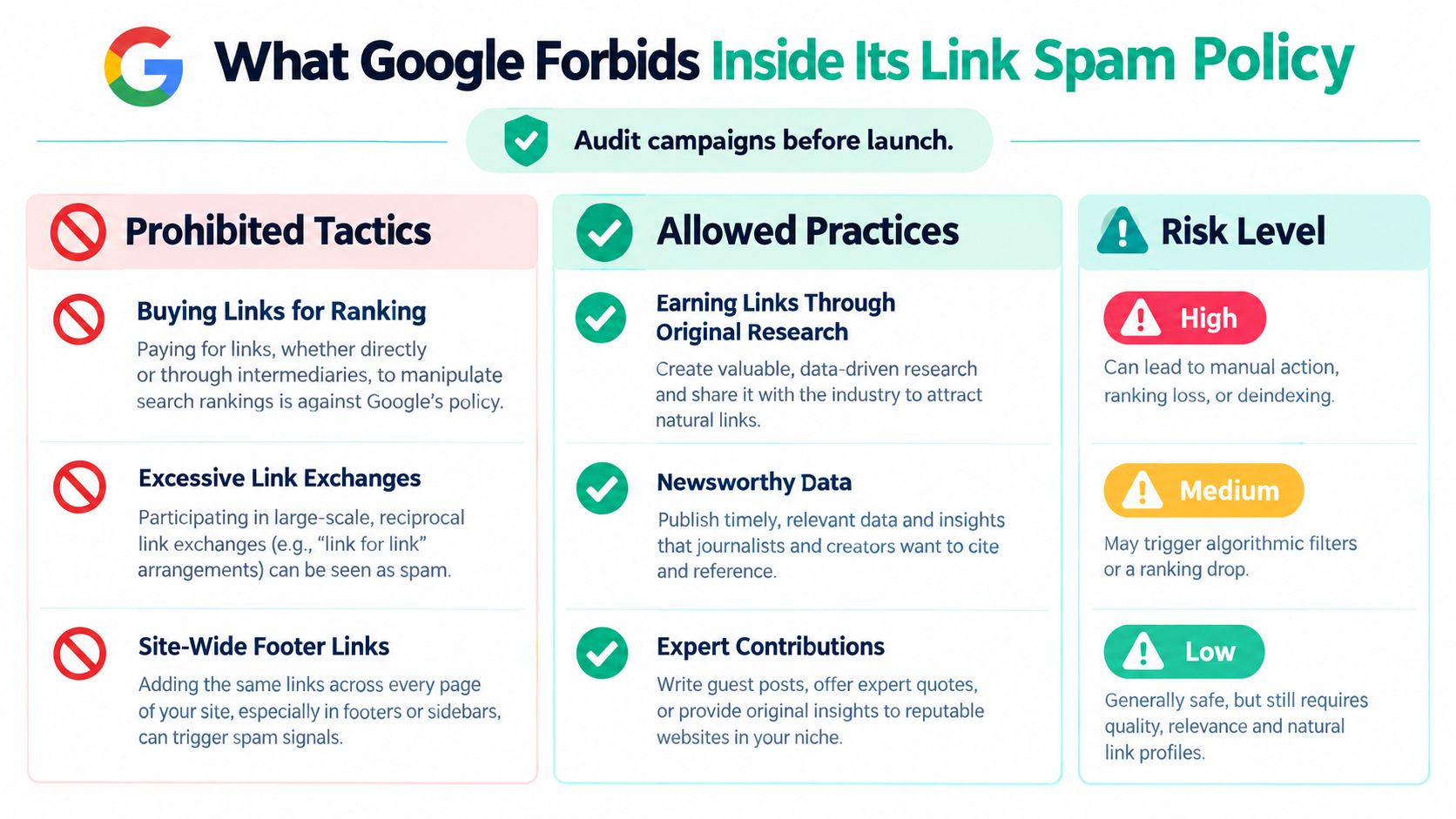
The compliant alternative is usually straightforward. Build something worth citing, make a relevant contribution, disclose compensation, and use the appropriate link attribute when the link is paid or user-generated. Don't disguise a commercial placement as an independent editorial recommendation.
Audit question: Could a publisher explain the link to a reader without mentioning search rankings?
Google has restated these principles for more than a decade. Its July 2021 link spam update expanded enforcement against excessive sponsored and guest-post links without proper tagging, with algorithmic and manual actions available for violations. Google's December 2022 link spam update also introduced an AI-based system to detect sites buying links and sites created to pass outgoing links. When unnatural links are neutralized, their ranking credit is lost, and recovery of the previous benefit isn't guaranteed.
A campaign review should examine both sides of the relationship. If your site acquires questionable links, you have a problem. If your site publishes paid or guest content without the proper qualification, you may also be participating in the pattern Google is trying to neutralize.
Core Tactics That Actually Earn Links the Right Way
White-hat link building starts with an asset another publisher can use. Outreach comes second. If your page doesn't add evidence, clarity, or utility, changing the email subject line won't create editorial demand.
Publish evidence others can cite
Original research works because it gives journalists, analysts, and industry writers something concrete to reference. A USA HVAC company might study local energy-cost patterns, explain the method, publish the findings clearly, and offer a short commentary section for reporters. A useful campaign could attract coverage from local news outlets and a state contractor association if those organizations find the data relevant to their audiences.
The key is not to promise coverage or invent outcomes. Build a defensible resource first. Show the source of the data, explain limitations, and make the findings easy to quote or link to.
Build resources that solve a narrow problem
A calculator, checklist, template, glossary, or maintenance guide can earn links when it saves someone time. A commercial roofing company could create a roof inspection worksheet for property managers. A software company could publish a migration checklist that addresses a specific platform change.
Resource pages work best when the page is complete on its own. Outreach should explain the exact section where the resource fits, not ask for a generic “high-authority backlink.”
Use digital PR and expert contributions
Journalists often need a qualified person who can explain a technical issue in plain language. Respond to relevant source requests with a direct answer, credentials, and a useful example. Don't attach a sales pitch to every comment.
Guest contributions can also be legitimate when the publication has real editorial standards and the article serves its audience. Google's guidance on the July 2021 update makes clear that excessive sponsored or guest-post links without proper tagging can lead to algorithmic or manual action. A contribution should earn its place through quality, while any compensated link must be handled transparently.
Replace broken resources and strengthen relationships
Find a broken link on a relevant page, create or identify a superior replacement, and contact the publisher with a specific explanation. The publisher retains the choice. You're offering maintenance help, not demanding a placement.
Partnerships can work the same way. Relevant vendors, trade associations, professional groups, and clients may have member or partner pages where a link helps users. Review the site's audience and the page's purpose before suggesting anything.
For the foundation beneath these campaigns, review SEO-friendly website design so your linkable assets are easy to crawl, understand, and use.
Rel Attributes and Why Misusing Them Still Gets You Penalized
Link attributes tell Google what kind of relationship a publisher has with a destination. They don't turn a manipulative campaign into a compliant one, but they help publishers disclose links accurately.
Google's link qualification documentation identifies three important attributes:
rel="sponsored"belongs on advertisements, paid placements, sponsorships, and other compensated links.rel="ugc"belongs on links placed in user-generated content, such as comments and forum posts.rel="nofollow"applies when the other values don't fit and the publisher doesn't want Google to associate the site with, or crawl the linked page from, its own site.
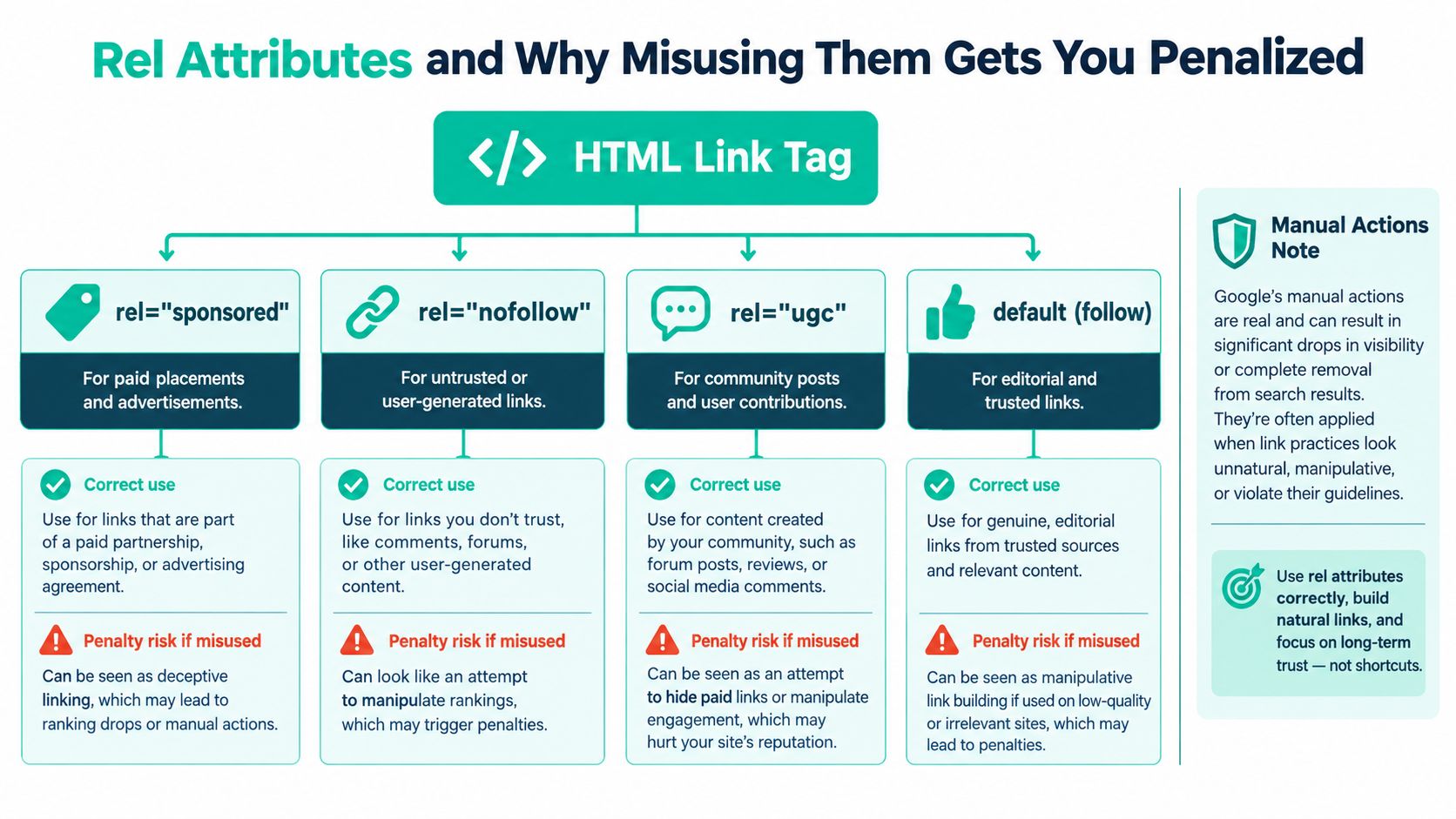
An editorial link from a publisher that independently chooses your research generally needs no special qualifying attribute. A paid review or sponsored article needs sponsored. A forum member's resource link belongs under ugc, especially when the site allows community contributions.
Why consistency matters
Suppose an outreach vendor sells sponsored placements but labels some links as editorial, uses inconsistent attributes, and repeats the same anchor text across publications. The tags won't erase the underlying intent. Google can still evaluate the campaign as a whole, including the content quality, payment arrangement, scale, and editorial control.
Don't use nofollow as a universal cover for unclear relationships. Choose the attribute that accurately describes the link, document the arrangement, and make sure the publisher understands what it is disclosing.
What AI Summaries Mean for the Value of an Earned Link
A quality backlink is no longer judged only by whether it sends a visitor immediately. Search results increasingly answer questions directly, which changes how marketers should value a citation.
Pew Research Center found that about 18% of Google searches in March 2025 generated an AI summary. When a summary appeared, users clicked a traditional result 8% of the time, compared with 15% without a summary. Sessions with a summary ended without a click 26% of the time, compared with 16% without one, according to Pew Research Center's analysis.
Those findings challenge a familiar assumption: every earned link must produce a direct referral visit to justify its cost. A source can still matter when it supports a search answer, reinforces a brand's credibility, or helps a customer recognize the business later.
Measure three kinds of value
- Ranking signals: The link contributes to how search systems discover and assess the destination, assuming it's legitimate and contextually relevant.
- Qualified referral visits: People click because the surrounding content gives them a reason to continue learning or take action.
- Entity and source visibility: Search systems cite or surface the business as a useful source, even when the user doesn't click immediately.
This broader view affects campaign planning. A useful linkable asset should answer a specific customer question, contain original evidence, and present information clearly enough for both people and search systems to understand.
Track assisted conversions, branded-search lift, mentions, referral engagement, and inclusion in answer-engine citations alongside ranking visibility. Digital marketing agencies using AI still need human review, because a citation that looks impressive may have little connection to the customers you want.
Best Practices and a Simple Audit You Can Run This Week
Start with assets worth citing, then document every outreach decision. Keep anchor text natural, qualify compensated placements correctly, and measure ranking, referral, and citation outcomes instead of counting links alone.
Run a quick audit:
- Review paid placements: Look for compensation, product exchanges, or sponsorships without an appropriate attribute.
- Check anchor patterns: Flag repeated commercial phrases that appear across contributed articles or press releases.
- Inspect relevance: Question links from unrelated directories, industries, or foreign-language sites that don't serve your audience.
- Read the surrounding page: Ask whether the link helps users or exists mainly to pass ranking credit.
- Record decisions: Keep the pitch, agreement, placement, and qualification details together.
A broader SEO audit can connect these backlink checks with technical issues, content quality, and internal linking.
Assertive Agency helps USA businesses plan ethical link acquisition, digital PR, SEO audits, and reporting around meaningful business outcomes rather than raw backlink volume. Visit Assertive Agency to review its SEO and white-hat link building services and request an initial audit.
