


Your website can look polished, your logo can feel current, and your service pages can sound convincing, yet the phone still stays quiet. That usually means the business is online, but not visible at the exact moment nearby customers are searching on their phones. In local online business marketing, that gap matters more than almost anything else.
The people most likely to call, ask for directions, or walk in usually aren't browsing for fun. They're looking for hours, pricing clues, availability, or a place they can trust right now. If your business doesn't show up with complete, accurate, and mobile-friendly information, someone else gets the lead.
Table of Contents
- Why Local Visibility Decides Whether the Phone Rings
- The Four Parts of a Local Marketing System
- Setting Up Google Business Profile the Right Way
- Local SEO Mechanics You Can Actually Influence
- Building a Review Engine That Compounds
- Paid Local Ads Without Burning the Budget
- A Practical Playbook for AI Mediated Local Discovery
- Measuring What Actually Counts in Local Marketing
Why Local Visibility Decides Whether the Phone Rings
A lot of owners think the problem is their website design. Sometimes it is, but more often the underlying issue is that the site isn't doing its job in local search. Google-commissioned research across nine verticals found that 4 in 5 consumers use search engines to find local information like addresses, hours, directions, and product availability, and 50% of smartphone local searchers visited a physical store within one day, compared with 34% on a computer or tablet, according to Google's local search research.
That's why the old “get a website and wait” mindset falls flat. The buying moment is compressed, especially on mobile, and local intent is tied to action. When someone searches on a phone, the business that answers the question fastest usually gets the call, the direction request, or the visit.
The real difference between local search and generic search
Generic search can be about learning, comparing, or killing time. Local search is usually about solving a problem nearby. A person searching for a dentist, plumber, roofer, or restaurant is often looking for a decision, not a long research project.
Practical rule: local visibility only matters when it connects to a measurable action, like a call, a booking, a direction request, or a store visit.
That's why rankings alone don't tell the full story. A business can sit on page one and still miss revenue if the profile is incomplete, the mobile experience is clumsy, or the business data doesn't match the searcher's intent. Local online business marketing works when the business shows up at the right distance, with the right details, on the right device, and with a next step that feels easy.
For local service companies, retailers, and restaurants, the opportunity is simple. Be useful in the exact moment the customer is ready to act. If that doesn't happen, the site is just decoration.
The Four Parts of a Local Marketing System
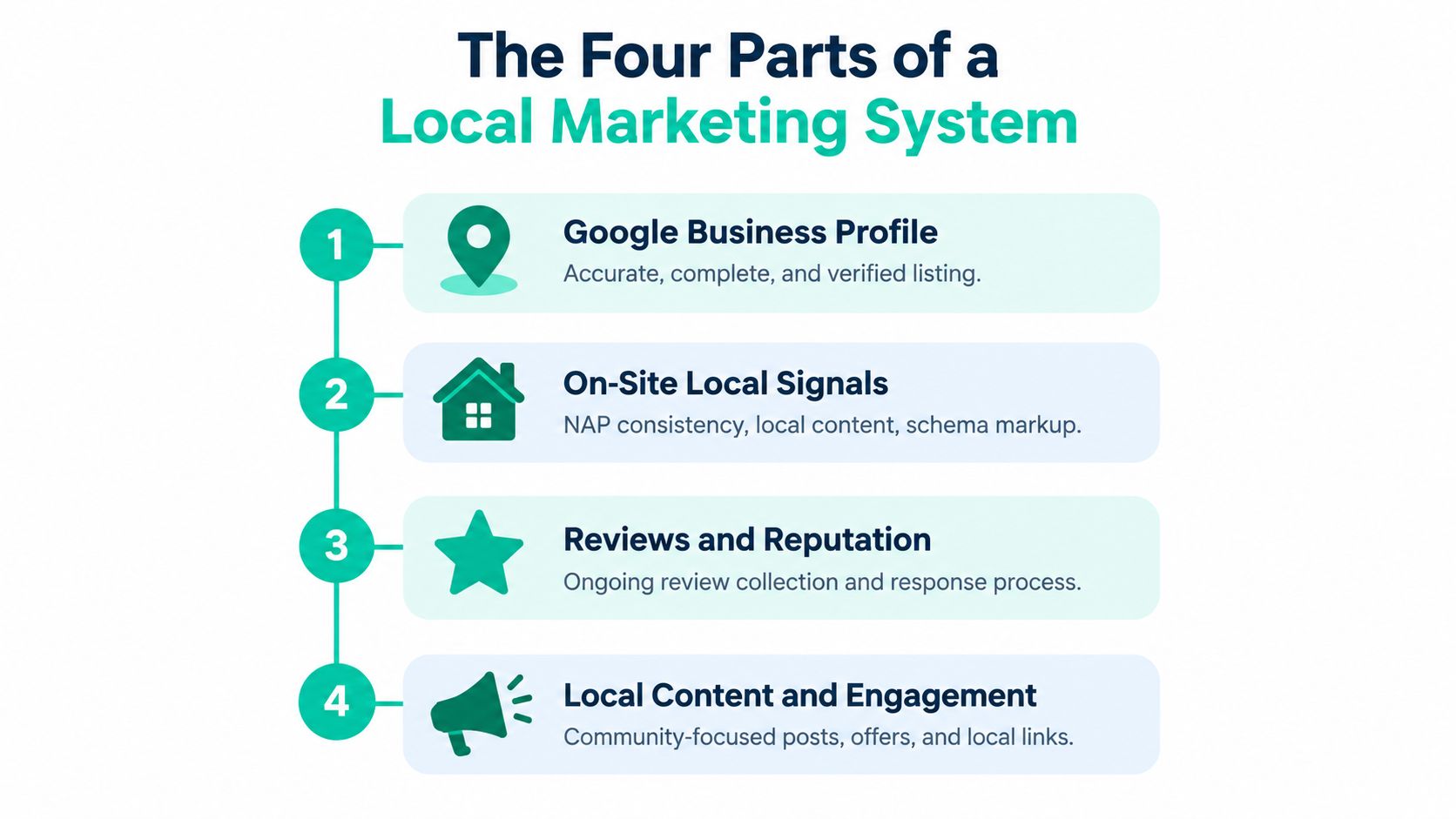
A local system works in layers, and each layer has a job. If one part is weak, the others have to carry the load, which usually means higher ad costs, weaker trust, or less visibility in the local pack.
Start with the profile, then make the rest match
The first layer is the Google Business Profile. It acts as the business card, map pin, and first trust check at the same time. Google says local rankings depend mainly on relevance, distance, and prominence, and prominence can be shaped by links, articles, and review count and quality, as explained in Google's local ranking guidance.
The second layer is the website. It has to confirm what the profile says, not contradict it. That means matching the name, address, phone number, service area, hours, and core services across the pages that matter.
The third layer is reviews. They build credibility, but only when they look real and recent. The fourth layer is paid amplification, which speeds up visibility when organic reach is slow or uneven. An HVAC company spending $2,000 a month on ads alone may pay $80 to $120 per lead, while the same spend layered over a complete profile and 40+ recent reviews often lands closer to $50 per lead.
A business that treats these layers as one system usually gets better lead quality, because each layer supports the next one.
The common mistake is trying to fix SEO before the profile and business data are in order. That usually spreads effort too thin. A stronger sequence is profile first, on-site signals second, reviews third, and ads where speed matters most.
Setting Up Google Business Profile the Right Way
The Google Business Profile is a structured data asset that feeds both search visibility and human trust. If the profile is vague, mismatched, or incomplete, the rest of the system has to do more work than it should. Google's ranking guidance makes the logic clear, relevance comes from fit, distance comes from location, and prominence comes from reputation and authority signals, as outlined in Google's local ranking factors.
Fill the fields that matter
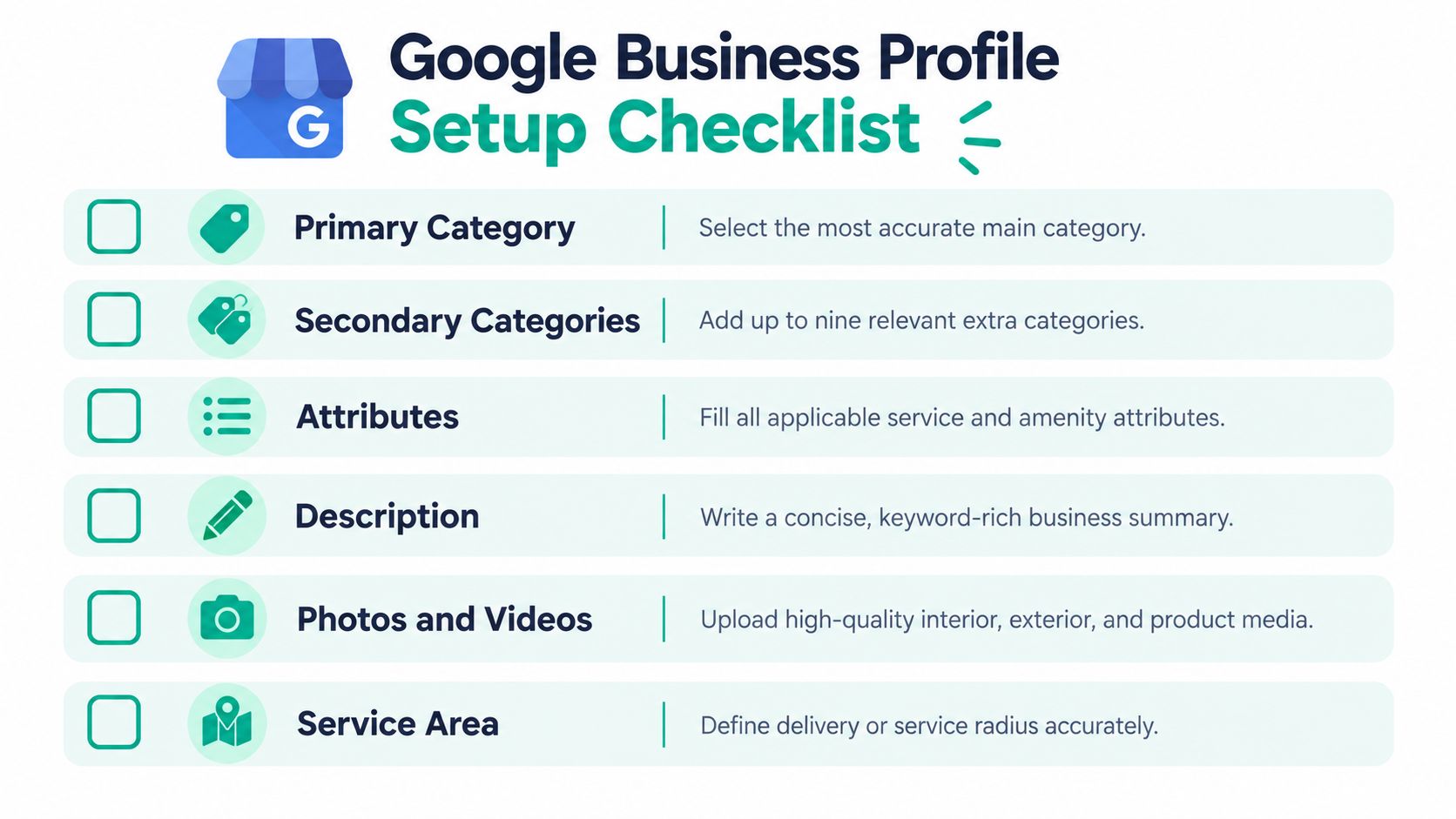
Start with the primary category, because it tells Google what kind of business you are. Then add only the secondary categories that match what you offer. From there, complete the fields customers use to decide, including hours, service area, phone number, accessibility details, payment options, and appointment links.
For storefront businesses, the address should be public and precise. For service-area businesses, the service area needs to reflect where you really work, not where you wish you worked. A wrong setting can suppress visibility or create poor lead quality because the business shows up for searches it cannot serve.
Write for real customers, not for keyword stuffing
The business description should sound like the language customers already use. If people call you for emergency repairs, same-day service, or weekend appointments, say that plainly. Photos should also be real and current. Exterior shots, interior shots, team shots, and work examples help customers trust the listing before they click.
Keep the profile aligned with what the customer would confirm if they called the front desk.
That matters even more now that Google's 2025 updates describe longer conversational searches and AI Overviews that can use information from across the web, including a business's Google Business Profile, as noted in Google's Business Profile help update. When the profile data is clean, both people and AI systems have an easier time interpreting it.
The fastest win is not adding more marketing language. It is reducing confusion. The more accurately the profile answers basic questions, the fewer leads you lose before the first click.
Local SEO Mechanics You Can Actually Influence
Local SEO is often sold as a mysterious ranking game, but the parts you can control are pretty plain. You're trying to make it easy for Google and customers to understand what you do, where you do it, and why you're credible. Google's ranking model still comes back to relevance, distance, and prominence, so the central question is how each signal supports those three factors.
| Local SEO Signals Mapped to Google's Ranking Factors | Relevance | Distance | Prominence | Priority |
|---|---|---|---|---|
| Accurate Google Business Profile data | Strong | Indirect | Medium | High |
| Location-specific landing pages | Strong | Indirect | Medium | High |
| NAP consistency across citations | Strong | Indirect | Medium | High |
| LocalBusiness schema | Strong | Indirect | Low | Medium |
| Reviews and reputation management | Medium | Indirect | Strong | High |
| Links from reputable local sources | Medium | Indirect | Strong | Medium |
Fix the signals in the right order
The first job is NAP consistency, meaning name, address, and phone should line up across the web. If that data wobbles, trust drops and conversions get harder. Next, build location-specific landing pages that match the services and areas you serve.
Schema markup helps search engines read the page more cleanly, but schema alone won't save weak content. The page still needs useful copy, service details, and clear contact paths. If the site feels slow on mobile, you're also leaking conversions. Google's mobile-page analysis found that when load time rose from one second to ten seconds, the probability of a mobile visitor bouncing increased by 123%, and when page elements rose from 400 to 6,000, the probability of conversion dropped by 95%, according to Google's mobile speed benchmarks.
That's why speed is not a “nice to have” for local businesses. It's a lead-quality issue.
If budget is tight, start with the page that answers the highest-intent query, then clean up the profile, then tighten citations. If you need a practical starting point for cleaner page structure, this guide to SEO-friendly website design is a useful reference.
Building a Review Engine That Compounds
Reviews used to be treated like a finishing touch. That thinking doesn't hold up anymore. BrightLocal's 2025 Local Consumer Review Survey found that only 4% of consumers never read online business reviews, that 27% use only one review website while 40% use at least two on average, and that 42% of consumers in 2025 said reviews were as trustworthy as personal recommendations, down from 79% in 2020, according to BrightLocal's survey.
Make the request process compliant and repeatable
The FTC's Consumer Reviews and Testimonials Rule took effect on October 21, 2024, and it prohibits buying or selling fake reviews, creating or distributing reviews you know or should know are false, and suppressing legitimate negative feedback, as explained in the FTC's rule guidance. That means the review process has to be honest from the start.
A compliant workflow is straightforward. Ask genuine customers shortly after a real service interaction. Don't gate the request based on whether they seem happy. Don't pay for praise. Don't hide honest criticism. If you use email or SMS, document consent and keep the request simple.
Respond like a business that expects to be read
Replying matters because customers cross-check reputation on multiple platforms, not just one. The response doesn't need to be long, but it does need to sound human and accountable. Thank the people who leave good feedback, and address the specifics in negative feedback without arguing.
The point isn't to “win” the review. The point is to show future customers how the business handles friction.
That's where review management becomes a revenue process instead of a vanity task. A steady stream of authentic reviews helps prominence, but the bigger upside is trust at the exact moment someone is comparing options. If you want a clearer breakdown of how customer feedback shapes buying decisions, this overview of customer reviews is a good companion piece.
The businesses that handle this well don't chase perfect ratings. They build a repeatable habit of asking, monitoring, and responding without crossing the FTC line.
Paid Local Ads Without Burning the Budget
Paid media can buy speed, but it's not a substitute for a healthy local foundation. It works best when the offer is tight, the landing page is fast, and the business can answer the phone quickly. Google research found that 18% of smartphone local searches led to a purchase within a day, versus 7% of comparable non-local searches, which means local paid traffic can convert at more than twice the rate of broader non-local traffic when the offer matches intent, according to Google's local conversion research.

Choose the channel based on urgency, not hype
Google Ads is usually the cleanest fit for high-intent searches because it captures demand that already exists. Performance Max can help when location signals and conversion tracking are set up correctly, but it needs good inputs. Microsoft Advertising can work for some local categories too, especially when the audience skews older or more desktop-heavy.
Paid social is different. Meta or TikTok can make sense for local offers that benefit from visuals, seasonal promotions, or community attention, but those platforms often create softer intent than search. If the business needs calls this month, search usually deserves the first dollar. If the goal is awareness around a neighborhood event, social can play a supporting role.
A useful budgeting rule is simple. Put the money where the intent already exists, then let organic work in the background.
| Channel | Time to First Lead | Best Fit | Main Reporting Metric |
|---|---|---|---|
| Google Ads search | Fastest | Service businesses, urgent requests, appointment-driven offers | Calls, forms, booked jobs |
| Paid social | Slower | Visual offers, events, seasonal promos, local awareness | Clicks, engaged visits, assisted conversions |
| Organic local SEO | Slowest to start, strongest compounding | Long-term local demand capture | Calls, direction requests, rankings, revenue |
If you're comparing spend by channel, this guide to average cost per click can help frame the discussion. The main mistake is funding too many channels before one of them is producing qualified leads reliably.
A Practical Playbook for AI Mediated Local Discovery
AI search changes how local customers find businesses, but it does not change the need for clean, consistent business data. The practical shift is that your hours, services, pricing language, and service area now have to hold up in conversational results as well as in traditional search. AI systems can pull from your Google Business Profile, website, and other structured listings, so sloppy details create confusion fast.
Map the facts first
Start with the questions customers ask before they call. For many local businesses, that means services, service areas, pricing ranges, appointment rules, hours, accessibility, emergency availability, and inventory.
Put those facts where both people and search systems are most likely to trust them, usually the Google Business Profile, the website, schema, and the third-party listings your industry depends on. The goal is consistency, not volume. If one source says you offer same-day service and another says you do not, AI-generated answers can drift or fail, and that means wasted leads.
Test the answers, not just the rankings
Run real customer queries and see what comes back. Try prompts such as “same-day AC repair in Round Rock,” “do you take walk-ins,” or “emergency plumber open now near me,” then log whether the answer gets your hours, service area, pricing language, and availability right.
Check the reply the way a buyer would. Does it match what your staff says on the phone? Does it reflect walk-in rules or after-hours service accurately? Does it mention the wrong city or a stale price range?
The job now is to audit what the machine says about the business, not just where the business appears.
If the answer is wrong, fix the source first. Update profile fields, revise service pages, and clean up third-party data. Then test the query again and note what changed.
Clean operations now pay twice, once in traditional local rankings and once in AI-generated answers. As covered in the Business Profile update cited in the setup section, businesses that keep their data synchronized give themselves a better shot at both kinds of visibility.
Measuring What Actually Counts in Local Marketing
Rankings can be useful, but they're not the score that pays the bills. A local business needs to know whether the marketing is producing calls, direction requests, bookings, qualified leads, and store visits. That's the only way to separate real growth from vanity traffic.
Build a monthly scorecard you'll actually read
Track the local signals that show buying intent. Google Business Profile insights can help with direction requests, calls, and website visits. Google Analytics should separate organic, paid, and direct traffic, but the more important split is mobile versus desktop and branded versus non-branded local queries. Mobile often behaves differently, and the earlier speed data makes that especially important.
Call tracking can help, but it has to be set up carefully so it doesn't break NAP consistency. Use it in a way that preserves the core business information on the website and profile. If the phone number changes everywhere just to suit the tracking tool, the cure becomes part of the problem.
A clean monthly review should answer a few questions. Are direction requests rising? Are calls from unknown ZIP codes increasing? Are review responses happening quickly? Is the site producing qualified leads, or just more visits?
If the business is getting more impressions but fewer qualified calls, the channel is drifting away from intent.
That's the warning sign. A compounding channel usually shows the opposite pattern, more useful local actions, better lead quality, and stronger response rates from people who weren't already familiar with the brand. Review the scorecard once a month, and make the next decision from the data, not from a ranking screenshot.
If your local presence needs to turn into more calls, direction requests, and booked jobs, Assertive Agency builds and manages the search, ads, site, and reputation pieces together. Visit Assertive Agency if you want a practical local marketing plan grounded in what drives leads in the USA.
