


Most sites see early signals within weeks, meaningful ranking movement in 3 to 6 months, and page one for moderately competitive keywords around 6 to 9 months. No calendar date is guaranteed, because Google has to find the page, store it, and then decide it deserves a click.
That spread is why a single "three to six months" line leaves owners stuck. A 2025 Yellowball survey found that 40% of respondents believed link-building results could appear within 2–3 months. Links can help on that kind of horizon, but they are only one stage. Crawling, indexing, rankings, and actual leads each have their own checkpoint. A page can be in Google's index and still bring in almost no business. If you run a shop, a law firm, or a startup in the USA, the useful question isn't "has SEO worked yet?" It's "which stage are we in, and what should we see there?"
Table of Contents
- Typical SEO Timelines at a Glance
- How Google Moves a Page From Publish to Results
- What Speeds Up or Slows Down Results
- How to Measure Progress in Search Console
- When Results Stall and What to Check
- Real-World Patterns for New, Local and Competitive Sites
- Start With a Free Audit and a 90-Day Checkpoint
Typical SEO Timelines at a Glance
Meaningful ranking improvements usually show within 3 to 6 months, and significant results tend to land by months 6 to 12. Those ranges describe a site that already publishes on a normal schedule, with pages Google can reach. They don't describe a brand-new domain, and they don't describe a site recovering from a penalty.
A 2024 Sales-Push study of more than 10,000 websites reported that sites took an average of 6–9 months to reach Google's first page for moderately competitive keywords. Use that average as a planning range. It isn't a promise that month nine will put your money terms on page one.
| Timeframe | Typical Milestone | What It Means |
|---|---|---|
| Weeks 1 to 2 | Crawling and first indexing | Pages become eligible to appear in Google results |
| Weeks 2 to 6 | First impressions and unstable early rankings | Queries begin to match your pages, positions move up and down |
| Months 3 to 4 | Clicks on lower-competition and local terms | Local and technical fixes often move first |
| Months 6 to 9 | Page one for moderately competitive keywords | Average time reported in a 2024 study of more than 10,000 sites |
| Months 6 to 12 | Steady organic traffic and leads | Gains compound as content, links and authority build |
How to read the rows
Weeks 1 to 2 are about access. Google has to download the page and store it before anyone can find it from a search.
Weeks 2 to 6 are noisy on purpose. Impressions mean a query matched your page. Positions bounce while Google tests whether searchers stay.
Months 3 to 4 are where a local service page or a narrow how-to often earns its first real clicks. Broad national terms usually aren't there yet.
Months 6 to 9 line up with that Sales-Push average for moderately competitive keywords. Months 6 to 12 are when traffic and leads stop looking like a spike and start looking like a pattern, as content, links, and trust stack up.
Practical rule: Check indexed pages before you judge rankings. A page Google hasn't stored can't win a click.
The milestone to look at first is simple. Are the target URLs indexed? Everything after that depends on competition, history, and how closely the page matches what the searcher wanted.
How Google Moves a Page From Publish to Results
Think of a new shop. Delivery drivers have to find the building, the city has to register it in the directory, and only then can it show up where customers search, before anyone walks in. A published URL works the same way. Until those steps finish, there is nothing to rank.
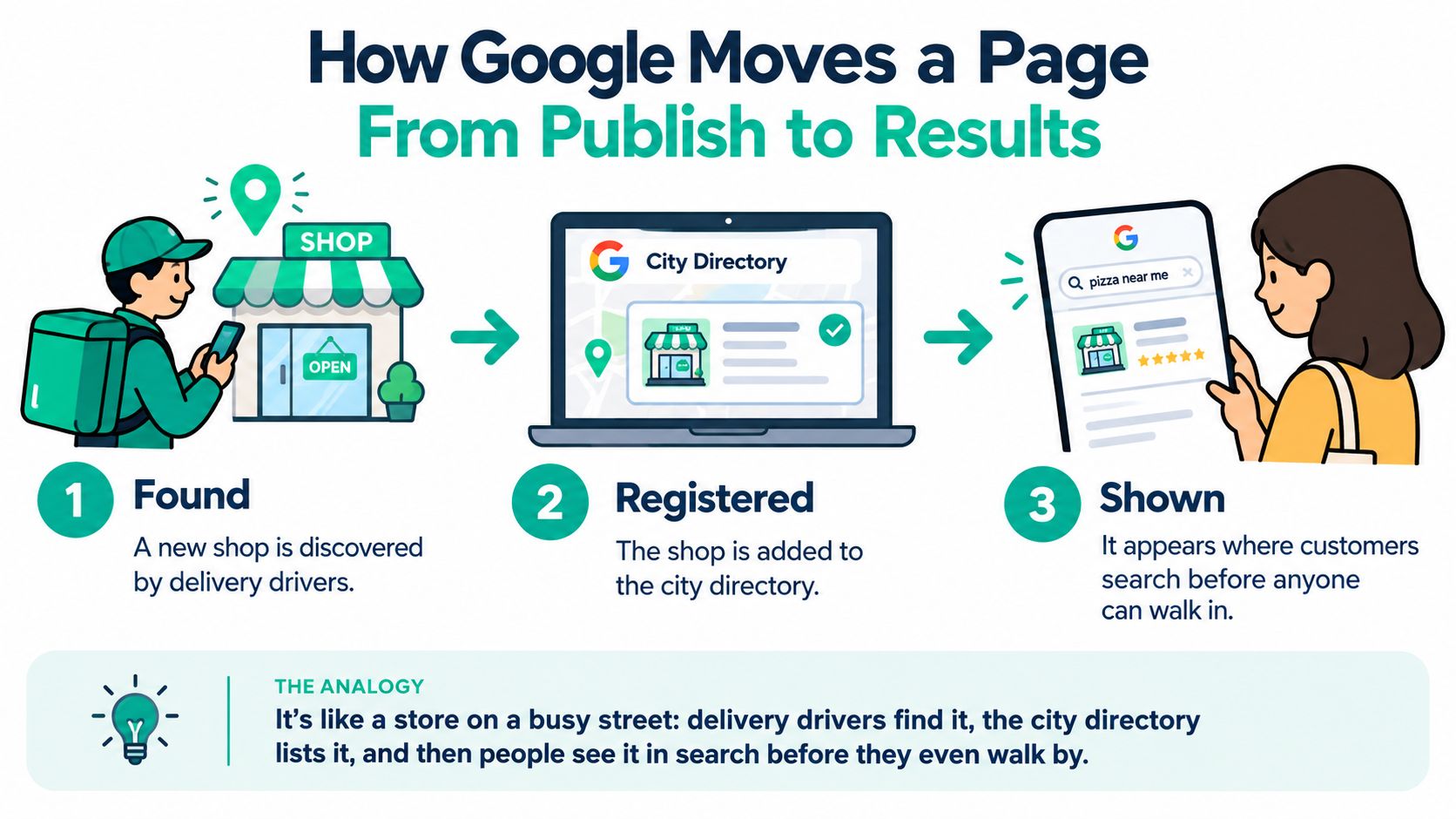
Google's own description of Search splits the work into three stages. Crawling downloads the page. Indexing analyzes the content and stores it. Serving picks pages from that index to answer a search. A page that isn't indexed isn't eligible to appear in ordinary results. Ranking then uses hundreds of factors, including relevance, language, location, and device, so a stored page still isn't owed a position.
The four steps in order
- Google discovers the URL. It finds the address through links on your site or on other sites, or through a sitemap. Google's crawling and indexing FAQ says a sitemap helps discovery, but it doesn't guarantee indexing and it doesn't improve rankings.
- Google crawls the page. Google's indexing and ranking FAQ says crawling may take anywhere from a few days to a few weeks. Asking for a crawl doesn't guarantee immediate inclusion, or inclusion at all.
- Google indexes the content. It reads the page, decides what it's about, and stores a version it can serve. Blocked URLs, a noindex tag, or a messy duplicate can stop this step cold.
- Google ranks the page against others. Relevance, language, the searcher's location, and the device all play a part. Indexing only means the page is allowed to compete.
Say you publish a new service page on Tuesday and submit the sitemap the same day. By the next week the URL might be crawled. Indexing can follow soon after, or it can sit if the page is thin or hard to reach from the rest of the site. Rankings are a later decision, not a bonus that comes with the index.
Before you read a ranking chart, open URL Inspection for that exact address and check the Index Status report. If the page isn't indexed, you're still in the directory step. Judging "SEO" at that point just measures a page Google can't show.
What Speeds Up or Slows Down Results
Four things set the pace: site health, site history, competition, and the pair of content and links. A clean, trusted site on an easy query can move while a new site on a crowded national term barely shifts.
| Factor | Speeds Results When | Slows Results When |
|---|---|---|
| Site health | Clean crawl, fast pages and a working sitemap | Broken pages, slow load times and blocked URLs |
| Site history | An established domain with a record of helpful pages | A new domain or a past penalty to recover from |
| Competition | Local or long-tail terms with few strong pages | National terms dominated by large brands |
| Content | Pages match search intent closely and add new value | Thin pages that repeat what already ranks |
| Links | Steady, relevant links earned over time | No links at all, or sudden spikes of low-quality links |
An Ahrefs analysis of 1 million newly published URLs found only 1.74% reached Google's top 10 within one year. A separate filtered sample of 2 million English pages reached a higher 6.11% one-year rate. Among pages that did hit the top 10, 40.82% did so within the first month. Timelines are uneven. "Three to six months" is a planning benchmark, not a law.
Site health and site history
Crawl errors, blocked URLs, slow pages, and weak Core Web Vitals keep Google from seeing the fix you just shipped. A working sitemap and a fast template remove that drag.
History matters just as much. An established domain with helpful pages and strong internal links can show early ranking signals. A new domain, or one climbing back from a penalty, usually needs months of cleanup, publishing, and links before competitive terms move.
Competition, content, and links
Local and long-tail terms have fewer strong pages in the way. A national term owned by large brands does not. Local SEO and technical fixes usually move faster than competitive national keywords, so start with whichever of those is weakest on your site.
Content speed comes from intent. A page that answers the query the way the results page already does, and adds something those pages lack, can move. A thin rewrite of what already ranks mostly waits.
Links work when they're relevant and steady. None at all leaves the page with little outside support. A sudden pile of low-quality links can look like spam. White hat link building is the slow, relevant version, earned over time rather than bought in a burst.
If a target page is still outside the top 10 after about six months, don't just wait. Review depth, intent, how easy the page is to reach from important internal links, how crowded the results are, and whether the domain has real authority. Read those cohorts apart: new pages versus refreshed pages, branded versus nonbranded queries, and low-difficulty versus high-difficulty terms. An average of every keyword hides the pages that are moving.
How to Measure Progress in Search Console
Search Console doesn't update the minute you hit publish. Google's Search Console documentation says performance data is typically available after 2 to 3 days. Checking on day two can make a real fix look like a dud. The same tool keeps a 16-month history of clicks, impressions, click-through rate, and average position, so you can compare a month with the same month a year earlier instead of reacting to a three-day swing.
Keep indexing status separate from ranking movement. A page can be indexed and still sit on page four. Those are different reports, and they answer different questions.
What to watch at each stage
In the first weeks, count indexed pages. That's the only honest score while Google is still storing URLs.
From about weeks two to eight, impressions tell you whether queries are matching those pages. Average position is jumpy here, so don't treat a one-day drop as a verdict.
From month three, average position becomes the useful read, especially on the queries you meant to win. Clicks and click-through rate usually follow from months three to six, once titles match what people expected. Conversions and leads are the number that matters from month six onward. Traffic that never calls or buys is a visibility story, not a business result.
Averages hide the plot. Split the report before you celebrate or panic.
- New pages versus refreshed pages: A rewrite of an old URL and a brand-new post don't share a clock.
- Branded versus nonbranded queries: Your company name can rise while the services you want to sell stay flat.
- Low-difficulty versus high-difficulty terms: Easy local phrases move first. National head terms lag.
A monthly routine you can finish in one sitting
- Open the performance report and filter by one segment at a time. Don't stack every query into one chart.
- Compare that segment with the previous month and with the same month a year earlier, using the 16-month history so a holiday week doesn't fool you.
- Write down one change you made and one result you saw. A title rewrite, a new internal link, or a speed fix should have a note next to it.
Agree on these metrics before the work starts. Then a quiet month is a data point, not a feeling that "SEO isn't working."
When Results Stall and What to Check
A stall isn't always a failure. Google's Search Central guidance on core updates says some website changes can take effect within a few days, while its systems may need several months to learn that a site consistently offers helpful, people-first content. If improvements have produced no effect after several months, you may need to wait for a later core update. Smaller algorithm updates run continuously, so movement can still happen between the big ones. Google doesn't guarantee that an optimization will create a noticeable ranking change, and positions aren't static.

Judge the wait with leading indicators: indexed pages, impressions, clicks, rankings, and conversions. Early signals can show in days or weeks. Broader proof of traffic and leads takes several months, and it still depends on history, competition, content, technical work, and algorithm changes.
Checks in the order that saves time
- Confirm the pages are indexed in URL Inspection. A healthy sign is "URL is on Google." A warning sign is "discovered, not indexed," excluded, or blocked. That stall is technical, not a ranking mystery.
- Check impressions for the target queries. Impressions mean the page is eligible to appear for those searches. A warning sign is an indexed URL with zero impressions on the phrases you wrote it for.
- Split new pages, refreshed pages, branded queries, and nonbranded queries. A healthy sign is movement in at least one of those groups. A warning sign is a sitewide average that looks flat while one group is dropping.
- If a page is still outside the top 10 after about six months, review depth and intent. A healthy sign is a page that covers what the current results reward, in a similar format. A warning sign is a sales pitch sitting where searchers wanted a guide, or the reverse.
- Check internal links. A healthy sign is links from prominent pages, not only from a buried blog footer. A warning sign is an orphan URL that almost nothing on the site points to.
- Review authority and how competitive the results are. A healthy sign is relevant links arriving steadily and rivals you can realistically match. A warning sign is a results page owned by national brands while your page has no outside support.
An indexed page with no impressions usually points to content or intent. A page that isn't indexed at all is a technical problem, and waiting for a core update won't fix a block.
Work the list from the top. Skipping to "we need more links" while the URL isn't indexed just adds months.
Real-World Patterns for New, Local and Competitive Sites

These are examples, not promises. Your market, your domain, and how fast you publish will move the dates.
A new company blog. Picture a startup with six articles and no links from other sites. Indexing can happen within weeks, and a handful of early impressions is normal. Ranking gains still depend on steady publishing and links, so six to twelve months is a realistic horizon before you judge the project. Publishing the posts isn't the same as being found.
A local service business. Picture an HVAC company or an auto repair shop in the USA that fixes its business profile, speeds up the site, and rewrites location pages. Local and technical fixes often show movement within a few months, sooner than broad national terms. That's the pattern behind local online business marketing: the map and the nearby queries tend to respond before "best in the country" style phrases do.
An online store on crowded product terms. Category and product pages need a clear match to search intent, product schema, and internal links from collections that already get visits. The timeline stretches toward the long end of the range, because you're asking Google to prefer you over stores it already trusts.
A study cited by Ahrefs reported that 96.55% of web pages received no organic traffic from Google, which is a blunt way of saying publication alone rarely creates visibility. The same body of research includes a landing page, rewritten to match searcher intent, that saw a 516% traffic increase in less than six months. One well-aimed fix on a page people already look for can move faster than a pile of new URLs nobody links to.
Find the story that matches your site and set a range from it, not a single date. Tie rankings back to qualified traffic and leads. A top-10 badge that never turns into a call is the wrong finish line, and a page that moves in week three doesn't prove the competitive terms will do the same.
Start With a Free Audit and a 90-Day Checkpoint
Set the checkpoint this month, before anyone argues about whether it's "working." Write the metrics in this order: indexed pages first, then impressions, average position, clicks, and leads. Ranges beat fixed dates. If month three looks quiet, check indexing and search intent before you decide to wait longer.
For a fast read on one URL, the Free SEO Audit Tool checks any page in under a minute. You get a PDF covering on-page SEO, page speed, and AI search readiness. That's enough to see whether the page is even in shape to be crawled and understood.
When you want the full picture, our SEO Audits & Strategy work includes a technical and content audit, competitor and keyword gap analysis, a prioritized action plan, and a 90-day roadmap. The team reviews your rankings and competitors before the plan is written, so the timeline matches your market instead of a generic blog post. An SEO audit is the right first pass when you don't yet know if the stall is technical, a content mismatch, or just normal lag.
A clear 90-day checkpoint turns a slow-looking project into one you can measure. You'll know which stage you're in, and what to fix if that stage hasn't shown up.
Assertive Agency plans SEO around the stages that move, from indexing and local visibility through rankings, calls, and leads, with monthly tracking so you aren't guessing. If you want a timeline built from your site and your competitors, visit Assertive Agency and ask for a free SEO growth plan.
