Reputation monitoring software can cost roughly $0 to $110 per month for one location, while managed repair and suppression work commonly runs about $500 to $7,000 per month and full-service programs about $1,500 to $10,000 per month. The cost of online reputation management depends on whether you're buying monitoring or intervention.
That distinction matters more than the package name. A dashboard that alerts you to a complaint isn't the same purchase as a team that investigates it, coordinates a response, and works on the search results customers see.
For a small business in the USA, the right question isn't whether a monthly fee looks affordable. It's whether the provider has priced the work your business needs.
Table of Contents
- Why Online Reputation Management Costs Vary So Widely
- The Three Main Pricing Models Explained
- What Actually Drives Your Quote Up or Down
- Comparing Software, Freelancers, and Full-Service Agencies
- Why Reputation Work Is a Recurring Cost, Not a One-Time Fix
- How to Estimate Your Own Reputation Budget
- The Hidden Cost of Choosing the Cheapest Option
- Your Next Step Toward a Fair Reputation Quote
Why Online Reputation Management Costs Vary So Widely
A survey of more than 250 marketing and sales professionals in the USA found that 72% of businesses paid between $100 and $10,000 monthly for reputation-related services. That range, reported in this reputation management pricing comparison, shows why a package label alone cannot tell you whether a quote is fair. Compare the work included and who is responsible for completing it.
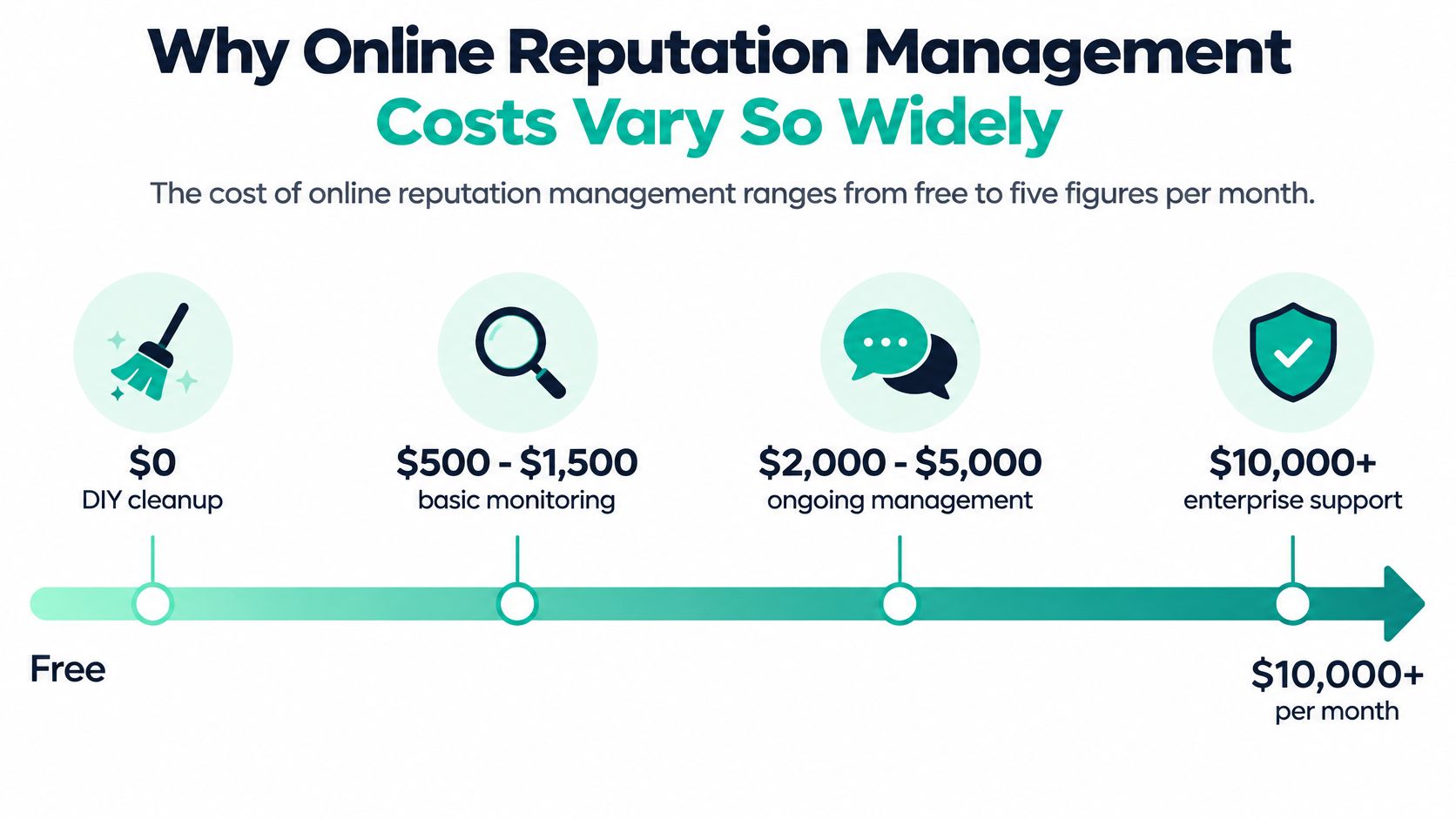
Monitoring tells you what's happening. Intervention means someone takes responsibility for acting on it. Those are different workloads, and they should not be priced as if they were the same service.
Buy a defined workload
A dentist with a healthy review profile may need alerts, customer feedback requests, and help answering complaints. A law firm facing damaging search results may need writers, SEO specialists, public-relations support, and careful approval of public statements. The second assignment involves more people, coordination, and judgment.
Managed work can include review generation, sentiment analysis, content creation, SEO, outreach, and negative-result suppression. Ask providers to list what they will do. The phrase “reputation management” does not guarantee that every service is included.
Break the quote into four responsibilities:
- Observation: Which profiles, search queries, and mentions will someone monitor?
- Execution: Who writes responses, fixes information, produces content, and submits reports?
- Escalation: Who handles a serious allegation, a sudden complaint surge, or a sensitive employee issue?
- Accountability: What records will show that the agreed work was completed?
Practical rule: Compare assignments before you compare monthly fees.
Company size matters, but workload matters more. A small business dealing with a public crisis may need more intervention than a larger company with stable reviews. Ask for recurring monitoring and any one-time crisis or suppression work to be priced separately, so you can see what drives the total.
Choose the smallest clearly defined scope that addresses the current problem. Require a written process for expanding it if the situation changes.
The Three Main Pricing Models Explained
Quotes make more sense when you separate the recurring work from one-time repair. Monitoring software tracks activity. Managed services add people to handle reviews. Crisis response and search suppression require a separate workload, so ask providers to price those tasks clearly.
Software tracks activity, your team does the work
DIY monitoring software collects reviews, sends alerts, displays dashboards, and may draft replies. Your staff still has to review the alerts, decide how to respond, and follow through.
Published comparisons put single-location software plans at about $0 to $110 monthly, and plans for 10 locations at about $131 to $800 monthly. Treat those as software costs, not the price of having someone manage a reputation problem.
Choose software when a staff member has time and authority to act on its alerts. If no one owns that work, the subscription will track problems without resolving them.
Managed services add hands-on support
A managed provider can monitor feedback, prepare replies, coordinate legitimate review requests, and flag sensitive issues for your approval. Confirm which tasks are included and how much work the fee covers.
Full-service ORM may also include content production, SEO, public-relations outreach, and search-result repair. Published ranges put repair and suppression programs at $500 to $7,000 monthly, and broader full-service programs at $1,500 to $10,000 monthly. These are recurring program costs, not a universal price for a one-time crisis.
Reputation Management Pricing Models Compared
| Pricing Model | Typical Monthly Cost | What Is Included | What Is Usually Excluded |
|---|---|---|---|
| DIY monitoring software | Single-location plans: about $0 to $110; plans for 10 locations: about $131 to $800 | Alerts, dashboards, review monitoring, response drafting | Staff execution, crisis coordination, search repair |
| Managed review and reputation services | Quote-dependent; repair and suppression programs: $500 to $7,000 | Assigned monitoring, responses, legitimate review workflows | SEO, outreach, or content unless specified |
| Full-service ORM | About $1,500 to $10,000 | A coordinated mix of reviews, content, SEO, outreach, and suppression | Legal representation and third-party expenses unless included |
The ranges overlap because providers package services differently. Pricing data does not establish a reliable standalone average for freelancers or review responses, so reject quotes that present one as an industry standard.
For a fair comparison, ask the provider to connect each fee to defined work: monitoring frequency, response volume, content production, or suppression tasks. Price one-time crisis support separately from ongoing monitoring. If a higher package adds only a dashboard or a longer report, ask what extra work the fee covers.
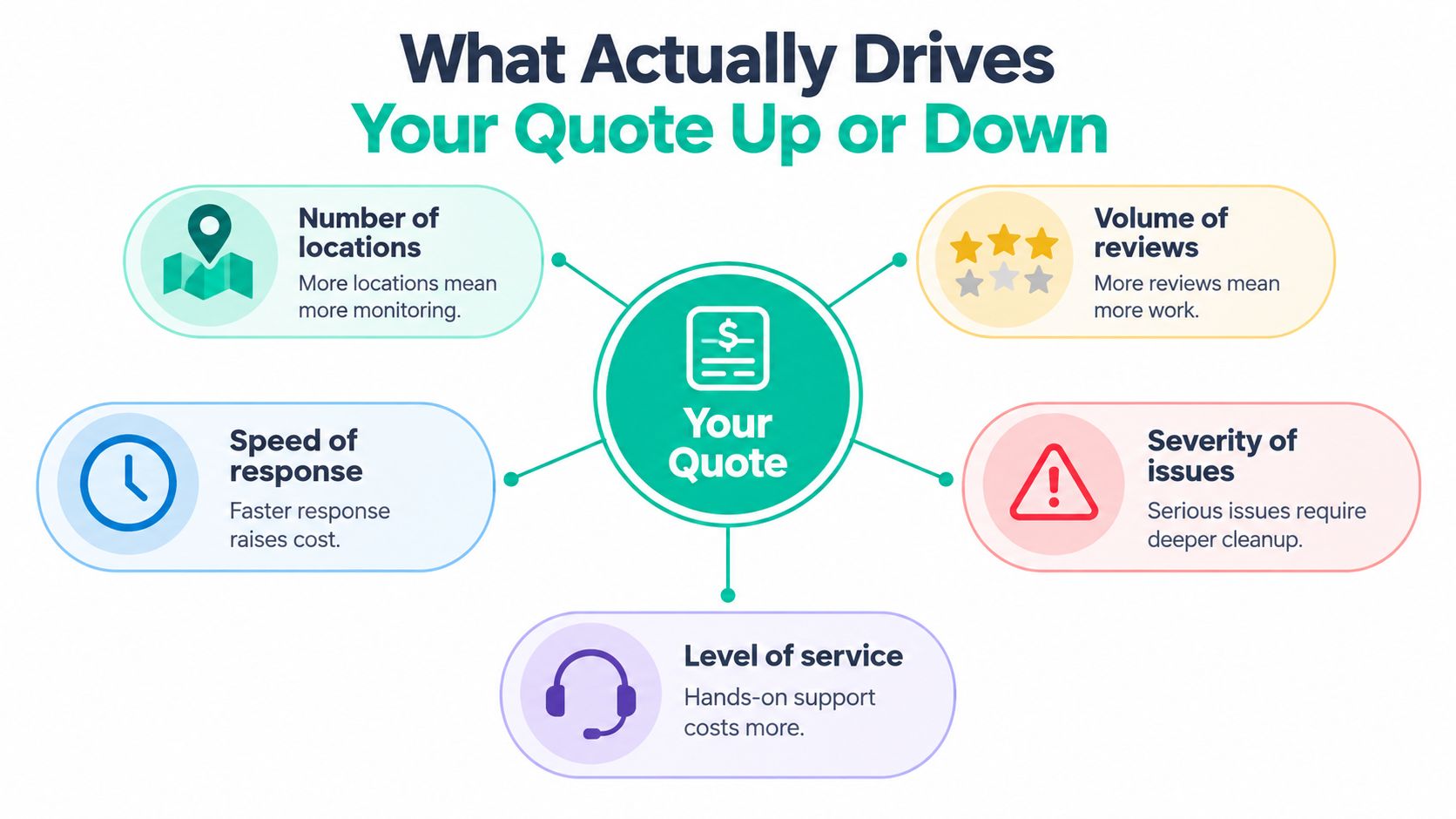
What Actually Drives Your Quote Up or Down
Your quote should change when the provider's workload changes. A higher fee needs a practical explanation, such as additional profiles, more incoming complaints, or a broader content assignment.
Use these factors to examine the proposed scope.
Translate complexity into tasks
More locations mean more profiles to check and more local managers to coordinate with. More review platforms mean additional queues, permissions, and response requirements.
Review volume matters, but so does urgency. An occasional service complaint needs a different process from a fast-moving allegation requiring management approval.
Ask for these workload explanations:
- Locations and platforms: List the covered profiles rather than accepting broad language about your online presence.
- Review activity: Specify how the provider handles normal volume and unexpected increases.
- Content severity: Separate customer-service complaints from disputed allegations requiring evidence or legal coordination.
- Search competition: Identify the target queries, competing results, and proposed content work.
- Additional audiences: Price executive reputation and employer-brand work separately when they require distinct research and messaging.
These are the practical variables described in this reputation management cost breakdown. Each should connect to a task, an owner, or a deliverable.
Separate operations from intervention
Request a recurring operating scope for routine monitoring, response management, reporting, and profile upkeep. Then request a separate project scope for crisis response, evidence collection, or intensive search work.
Don't confuse a separate project with an instant fix. A provider should explain the proposed phases and reassessment points without promising control over platforms or rankings.
Before approving search work, understand how to suppress negative search results and ask which assets the provider intends to improve.
If cash is tight, defer work that doesn't address the immediate risk. Keep urgent response duties funded, and require approval before the provider adds optional content, additional audiences, or expanded monitoring.
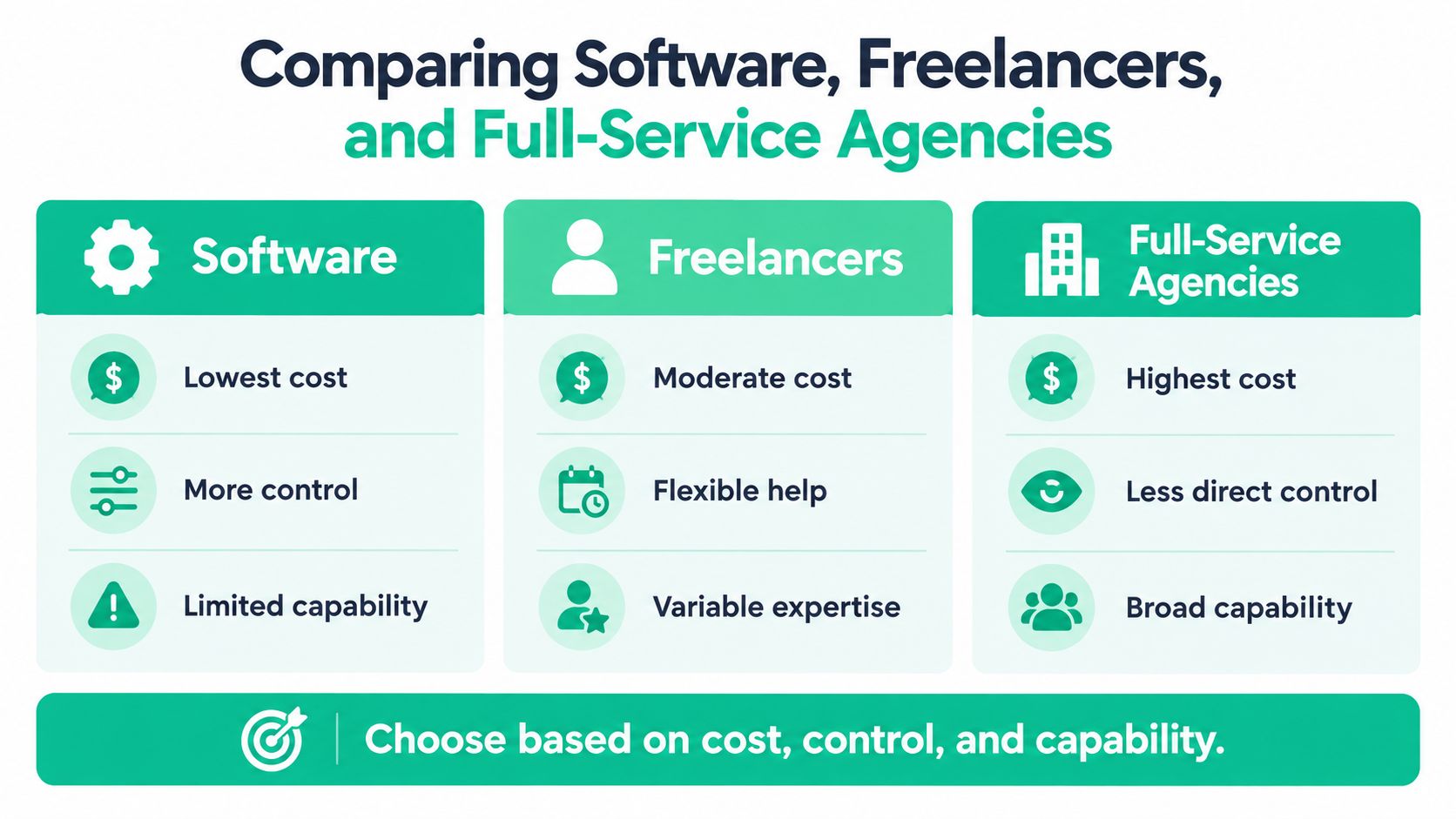
Comparing Software, Freelancers, and Full-Service Agencies
Choose the delivery model around the problem and your team's capacity. The cheapest invoice isn't necessarily the lowest total cost once you include the work your employees must complete.
This comparison is a useful starting point, not a substitute for checking the actual scope.
Match responsibility to capacity
Software fits a startup with a manageable reputation workload and an available owner. You retain direct control over responses and decisions, but somebody must turn notifications into action.
A freelancer can fit a contained assignment, such as review-response support or profile cleanup. Evaluate the individual rather than assuming moderate pricing means broad expertise; ask about availability, backup coverage, and the limits of their role.
For a multi-location service business, coordination may be the deciding factor. Ask who gathers facts from local teams and prevents conflicting responses across profiles.
| Option | Control trade-off | Capability question |
|---|---|---|
| Software | Your team controls execution | Who will act on alerts? |
| Freelancer | You coordinate with an individual | What happens when work exceeds their availability or expertise? |
| Agency | You delegate more execution | Which specialists actually work on the account? |
A full-service agency makes more sense when reviews, search results, content, and public communication need coordinated attention. Still, an agency label doesn't prove that every capability is included.
Assertive Agency is one option offering review generation and monitoring, search engine results page cleanup, negative-content suppression, real-time sentiment tracking, and employer-brand optimization through tiered monthly plans and bespoke engagements.
Use this guidance on choosing a digital marketing agency to examine staffing, reporting, ownership, and scope before signing.
Examine the delivery process
Ask to see a sample work plan, not just a sales presentation. You should be able to identify who approves replies, who publishes content, and who handles sensitive issues.
Use the video as another prompt for discussing the provider's approach.
Keep access to your profiles and business assets. Delegating work shouldn't mean losing the ability to change providers.
Why Reputation Work Is a Recurring Cost, Not a One-Time Fix
A BrightLocal survey cited in online review research found that 75% of consumers always or regularly read reviews before choosing a business, while 71% wouldn't use a business rated below three stars. The same research reported that 41% consult at least three review platforms and 36% consult two.
Those findings support ongoing attention, not a guaranteed revenue calculation. They don't tell you what a particular complaint will cost your business.
Maintain a credible customer record
Customers continue having experiences after a cleanup project ends. Your team still needs to request legitimate feedback, answer criticism, investigate recurring complaints, and maintain accurate business information.
Understanding what customer reviews represent helps keep the assignment grounded in customer experience rather than cosmetic score improvement.
A reputation program shouldn't make the business look different from reality. It should help the business respond to reality.
Compliance belongs in that recurring process. The Federal Trade Commission's Consumer Reviews and Testimonials Rule took effect October 21, 2024, and addresses fake or false reviews, undisclosed insider reviews, and company-controlled sites misrepresented as independent, as explained in the FTC's final-rule announcement.
The rule also covers AI-generated reviews that misrepresent genuine customer experiences. Knowing violations can expose businesses to civil penalties, so review-request templates, disclosures, and approval procedures deserve attention.
Pay for a process, not promised deletion
Google allows businesses to report reviews, but only policy-violating reviews qualify for removal, according to its Business Profile review-removal guidance. If Google confirms a violation, it removes the review from Maps and Search.
A legitimate negative review isn't removable just because the business dislikes it. A provider may still need to investigate, preserve evidence, submit a report, or pursue an appeal without controlling the result.
That distinction should shape your contract:
- Routine work: Maintain feedback requests, responses, profile accuracy, and complaint escalation.
- Policy work: Assess potentially violating content and document removal submissions.
- Business improvement: Route recurring service failures to someone who can fix them.
Budget for those responsibilities. Don't pay a recurring fee built around a promise to erase every unhappy customer's account.
How to Estimate Your Own Reputation Budget
Start with a written inventory, not a sales call. Record your active profiles, recent complaints, inaccurate listings, and the searches where customers encounter damaging information.
Then classify the work using the risk categories below.

Select the appropriate spending category
Low risk means a generally healthy profile with manageable feedback. Use the single-location or multi-location software range established earlier, then account for the employee time needed to operate it.
For moderate risk, such as unresolved complaints or inaccurate listings, obtain a managed-service quote. Require active execution rather than paying a premium for alerts your team already receives.
High risk means damaging search results, a public controversy, or work requiring coordinated content and communication. Use the repair or full-service range as your starting reference, then request a separately scoped intervention proposal.
Don't assign yourself the most expensive category because a salesperson uses alarming language. Ask them to show the specific public content and explain the required work.
Turn the scope into contract questions
Before signing, get written answers to these questions:
- Coverage: Which locations, profiles, platforms, and search queries are included?
- Volume: What review and mention workload does the fee cover?
- Response cadence: When will someone review alerts, prepare replies, and request approval?
- Deliverables: Which content assets, profile corrections, or submissions will the team complete?
- Reporting: How will you distinguish completed work from observed changes?
- Escalation: Who takes responsibility when a complaint becomes sensitive or urgent?
- Exclusions: What requires additional approval, outside spending, or a revised quote?
A fair contract should also address account access, ownership of published assets, cancellation terms, and approval responsibilities. Ask how the provider handles unused capacity and work that exceeds scope.
Before signing: You should be able to explain what the provider will do, what your staff must do, and what neither party can guarantee.
That's a usable budget. A package name and a monthly payment aren't.
The Hidden Cost of Choosing the Cheapest Option
A cheap monitoring plan is sensible when monitoring is what you need. It's poor value when your actual problem requires action nobody has agreed to take.
An auto repair shop doesn't solve an incorrect listing by watching sentiment. A service business doesn't resolve repeated scheduling complaints by drafting polite replies. Software can support the process, but someone must own the correction.
Fund credibility, not just review volume
Consumer research reports that 33% frequently encounter reviews that appear fake or AI-generated, another 47% encounter them occasionally, and 29% believe AI will worsen review spam, according to GatherUp's review-authenticity research.
The same source discusses a 2025 analysis of more than 30,000 Amazon product reviews in which 3% were AI-written, 74% of those AI-written reviews received five stars, and 93% displayed a Verified Purchase badge. Those findings don't establish that a particular business's reviews are fabricated, but they show why a badge alone doesn't settle authenticity concerns.
Your budget should support:
- Genuine feedback workflows: Invite customers to describe their own experiences without supplying invented praise.
- Human-quality responses: Check facts and address the specific complaint instead of posting interchangeable replies.
- Evidence retention: Preserve relevant records when suspicious activity needs investigation.
- Anomaly monitoring: Review unusual patterns without automatically accusing customers of misconduct.
- Crisis preparation: Define who can approve and publish sensitive responses.
Cheap manipulation can create more work
Google's Fake Engagement enforcement guidance describes possible profile restrictions, including blocking new reviews, temporarily unpublishing existing reviews, and displaying a warning that fake reviews were removed. Businesses can appeal and submit additional context.
That makes manufactured praise a liability, not a budget shortcut. You may end up paying for remediation while customers see a warning on your profile.
Evaluate qualified review volume, recency, response quality, and complaint-resolution rate alongside average rating. Also examine whether customer feedback identifies problems your team has corrected.
The cheapest provider isn't automatically a bad choice. The wrong choice is a provider whose deliverables leave your main problem untouched.
Your Next Step Toward a Fair Reputation Quote
Request a free initial reputation audit before committing to a monthly plan. Give the reviewer your business name, locations, known profiles, and the search queries that concern you.
Ask for findings you can verify yourself. An audit should identify what customers can currently see, rather than assign an alarming reputation score.
Require a usable diagnosis
A useful audit should surface:
- Review condition: Current ratings, review recency, unanswered complaints, and gaps in profile coverage.
- Listing problems: Inaccurate contact information, duplicates, and access issues.
- Removal candidates: Specific content that may violate platform policy, with an explanation of the relevant issue.
- Search exposure: The queries and visible results that need attention.
- Recommended work: A clear division between routine operations and a separately scoped intervention.
Bring that inventory to each provider you interview. Comparable assignments make quotes easier to judge than proposals built around different assumptions.
Ask providers to mark each recommendation as necessary, optional, or dependent on further investigation. That gives you room to control spending without pretending every task has equal urgency.
Reject promises the provider can't control
A blanket guarantee to delete legitimate negative reviews should end the sales conversation. So should an offer to manufacture positive reviews or conceal who supplied them.
Don't confuse genuine customer outreach with purchased sentiment. The policy and compliance boundaries discussed earlier should appear in the provider's working process, not just in reassuring sales language.
Your immediate action is straightforward: collect the public evidence, request an audit, and ask for a written scope tied to the appropriate spending category. Approve the work only when you understand who's responsible, what you'll receive, and which outcomes remain outside the provider's control.
Assertive Agency offers review generation and monitoring, sentiment tracking, and search-result suppression through monthly plans and customized engagements. Visit Assertive Agency to request a free initial audit and discuss a reputation-management scope tied to your business's workload and budget.