


You're posting between customer calls, recycling the same graphic across platforms, and checking likes at the end of the week. The account looks active, but the phone isn't ringing and your website isn't bringing in more buyers. That's a familiar problem for small businesses, law firms, local services, and e-commerce brands across the USA.
The fix isn't automatically to post more. A social media strategy should help you make business decisions: who you need to reach, what each platform should do, what content earns attention, and how to tell whether that attention leads to revenue. Treat the calendar as the operating plan, not the strategy itself.
Table of Contents
- Why Most Social Strategies Fail Before They Start
- Set One Business Objective and Reverse Engineer Your Social Goals
- Research Your Audience and Pick Platforms With Purpose
- Build Content Pillars That Match the Customer Journey
- Design a Weekly Calendar That You Can Actually Run
- Add Paid Amplification to the Posts That Already Work
- Measure What Matters and Connect Posts to Revenue
Why Most Social Strategies Fail Before They Start
A founder posts every day on four networks, resizes the same video for each, and waits for leads. A few posts get likes. Most disappear from the feed. After a while, the founder decides social media doesn't work, even though the problem is that no one decided what “working” meant.
Publishing before planning creates activity without direction. If a post has no defined audience, platform role, or business purpose, you can't tell whether it succeeded or what to change next.
A useful strategy has five connected parts:
- Business objective: Choose the result the company needs, such as qualified leads, ecommerce revenue, bookings, or local-service calls.
- Audience: Describe the buyers you need to reach, including their needs, location, decision process, and likely objections.
- Platform roles: Decide where each audience segment is reachable and what job each channel will perform.
- Content pillars: Set repeatable themes that answer questions, demonstrate value, build trust, or invite action.
- Measurement: Track outcomes that connect social activity to website behavior, leads, sales, and revenue.
These parts have to fit together. A local HVAC company trying to get service calls needs useful seasonal advice, proof of local expertise, and a clear way to request service. A Shopify brand seeking product sales needs content that helps customers discover, understand, and choose the product. The same posting schedule won't serve both businesses.
Practical rule: If you can't say what a post should help the business achieve, don't put it on the calendar yet.
A strategy also gives you permission to say no. You don't need every platform, every trend, or a new format every week. You need a plan that makes it easier to choose what to create, what to test, and what to stop doing. That's how to create a social media content strategy that supports business decisions instead of becoming another task list.
Set One Business Objective and Reverse Engineer Your Social Goals
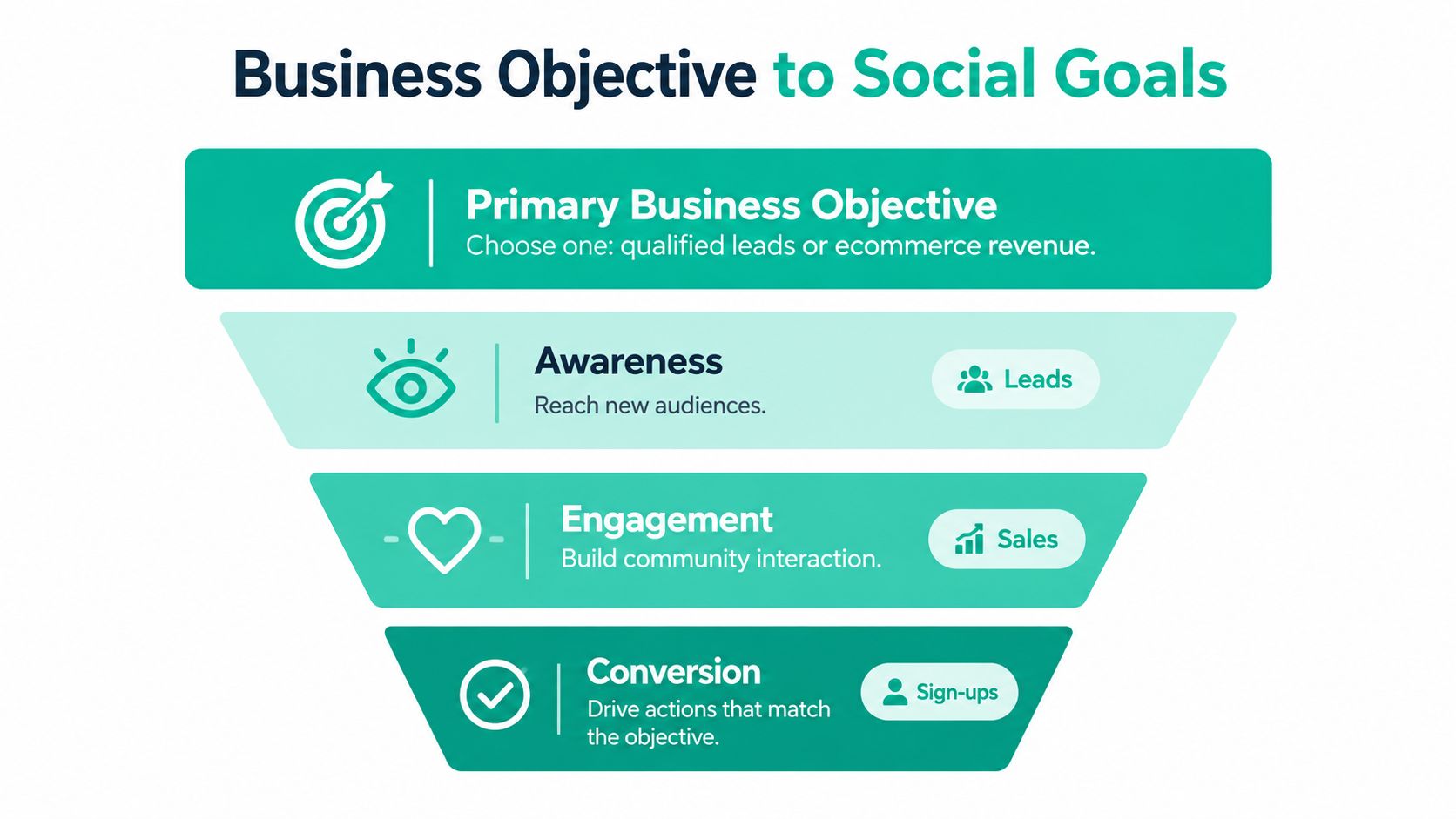
Start with the business outcome, not the social metric. Choose one primary objective for your planning period: qualified leads, ecommerce revenue, local-service calls, or bookings. If you try to make one social plan serve every business goal equally, you'll struggle to prioritize content and know what deserves more investment.
Then write down what a useful result looks like. A law firm might aim to generate qualified consultations from people seeking help with a specific legal issue. A Shopify store might focus on sales of a particular product line. A local service company might want more calls from customers in its service area. These are business outcomes. Reach, saves, clicks, and form submissions can help explain how social contributes, but they aren't interchangeable with revenue.
A good target is specific, measurable, relevant, and time-bound. Write a sentence that names the intended outcome, the audience or offer, and the review period. Don't invent a target just because it sounds ambitious. Use the business's current performance and capacity to decide what would count as meaningful progress.
Assign each channel a job
Platforms shouldn't compete to do the same thing. A law firm could use LinkedIn to demonstrate professional expertise and Facebook to reach local communities. A Shopify store could use Instagram and TikTok to introduce products through demonstrations and creator-compatible content. Those are starting hypotheses, not guaranteed outcomes. Confirm them using your audience and campaign data.
Write down the objective, the social action that could support it, and the business measure you'll use to judge the result:
| Business objective | Social role | Business evidence |
|---|---|---|
| Qualified leads | Explain a problem and invite a relevant next step | Qualified inquiries and consultations |
| Ecommerce revenue | Demonstrate products and answer purchase objections | Tracked purchases and revenue |
| Local-service calls | Show local expertise and make service options clear | Calls and qualified service requests |
Before content production begins, answer: What would winning look like by the end of the review period? Be specific about which business result matters and which supporting metrics will help diagnose performance. That decision keeps a post with broad reach from being mistaken for a post that brings in qualified customers.
Research Your Audience and Pick Platforms With Purpose
A platform is valuable when it helps you reach the people who can buy, book, or refer. Start by writing a simple audience profile: who makes the decision, what problem they're trying to solve, what information they need, and which platforms they already use. Check your customer conversations and platform analytics, then compare your assumptions with reliable audience research.
The 2024 Pew Research Center survey found that 83% of U.S. adults had ever used YouTube, 68% Facebook, 47% Instagram, and 33% TikTok. TikTok use had risen from 21% in 2021 to 33% in 2024. Age differences matter too: Instagram use reached 78% among adults ages 18–29 and 35% among adults ages 50–64, while TikTok use was 62% and 24% in those age groups, respectively, according to Pew Research Center's survey of U.S. social media use.
Those figures don't tell you where your specific customers are. They show why “everyone's on this app” isn't a strategy. A younger audience shopping for a visually demonstrable product may be a better fit for Instagram or TikTok. A business serving adults across age groups may find YouTube or Facebook worth evaluating. A law firm or HVAC company should use actual customer patterns and local market needs to make the call.
Rank channels by role
Choose a primary channel where you'll concentrate consistent effort, a secondary channel that serves another useful role, and a test channel only if you can run a meaningful experiment there. Give each one a reason to exist. For example, YouTube might hold searchable educational videos, while Instagram supports product discovery and customer interaction.
Choose fewer channels well. A platform that gets neglected because the team is stretched thin isn't an asset.
Skip a platform if your audience isn't there, if its format doesn't fit your strengths, or if you can't maintain useful content and respond to people. Write a role beside every channel in your plan. If you can't explain how that channel supports the business objective, it doesn't need to be in the mix yet.
Build Content Pillars That Match the Customer Journey
A content pillar is a repeatable theme, not a slogan. It gives your team a reliable subject to develop while keeping the post connected to what the customer needs. Choose three to five pillars that support the business objective and cover different moments in the decision process.

Useful pillars might include problem-solving education, customer evidence, product or service demonstrations, local expertise, and direct offers. Each should have a clear audience, a suitable platform format, and a job in the customer journey.
Consider an e-commerce brand selling kitchen tools. Its educational pillar could show how to solve a common cooking problem. Product demonstrations can show the tool in use, while customer stories address questions about fit and usefulness. A direct offer gives shoppers a clear next step. For a local HVAC business, educational posts could explain common comfort issues, service demonstrations could show how the team approaches a job, and local expertise could address weather-related needs or service coverage. Customer proof can support trust, while an offer can invite a service request.
Match the measure to the pillar
Don't judge every post by the same number. An awareness video should be evaluated for whether it reaches and holds the intended audience. A consideration post might earn saves, shares, or qualified questions. A conversion post should be judged by the action it asks for and what happens after the click.
A 2024 peer-reviewed study of Facebook Pages across industries found that content characteristics, including format, appeal, publication day, and service orientation, were associated with different engagement outcomes. That's a reason to test creative choices in context, not to copy a supposed universal formula. The study of Facebook content and engagement also measured engagement using reactions, comments, and shares relative to the Page's fan base. When you compare your own posts, declare the denominator you use, such as reach or followers, and keep it consistent.
For a practical way to connect these themes to journey stages, use this guide to marketing funnels and customer journeys. Then write each pillar with its purpose and format, such as “local expertise, short explainer video” or “customer evidence, testimonial creative.”
Before keeping a pillar, ask whether it answers a real customer question, supports a stage in the journey, and gives the audience a sensible next step. If it does none of those things, it's filling space.
Use the video below as a prompt for thinking about how content can move from discovery to action.
Design a Weekly Calendar That You Can Actually Run
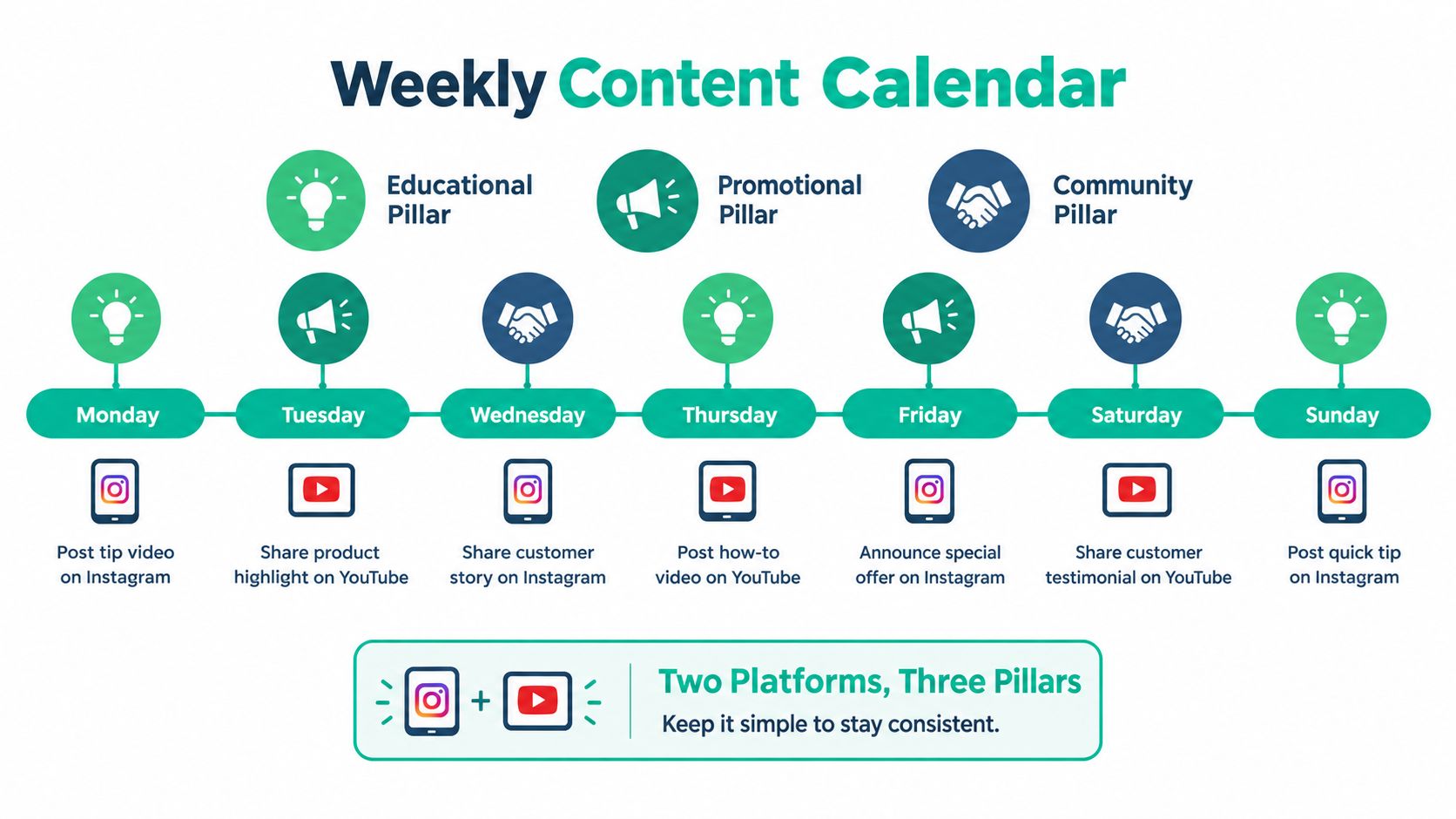
A calendar should match the team's real capacity. If one person handles customer service, sales, and social, a demanding schedule will collapse as soon as business gets busy. Start with two platforms and a manageable mix of pillars, then adjust when the workflow is stable.
Take a local service business that chooses Instagram and YouTube. It could publish a short Instagram tip early in the week, then develop a related YouTube explainer that answers the same customer question in more depth. Later in the week, Instagram can share a customer story or a clear service offer. That gives the team a repeatable rhythm without requiring every idea to become a separate production.
Give every post a working brief
For each planned post, record the platform, pillar, journey stage, opening hook, creative asset, call to action, owner, and measurement goal. A hook should name a recognizable problem or deliver a specific reason to keep watching. “Three signs your air conditioner needs attention” is clearer than a broad post about home comfort.
Create related assets together when it saves effort, but adapt the edit and message to the platform. A vertical video can be repurposed, but the caption, opening, and call to action should suit where it appears. Reuse the idea, not an identical post dropped everywhere.
Leave room for timely content without letting every trend hijack the calendar. A 2025 survey of consumers who followed brands found that 93% considered it important for brands to keep up with online culture, while one-third said brands jumping onto viral trends could look embarrassing; 27% said trend participation was effective only within 24 to 48 hours of a trend's lifespan, according to Sprout Social's research on trend-chasing. Set a short review path: someone checks brand fit, audience relevance, and any legal concerns, then approves or rejects the idea quickly. If it's already stale by the time it clears review, skip it.
Add Paid Amplification to the Posts That Already Work
Paid distribution can extend a strong post's reach, but it won't rescue weak creative or an unclear offer. First decide what “strong” means for the post's job. A useful educational video may earn attention and saves; a conversion post should produce relevant clicks or leads. Compare each post with similar content aimed at a similar audience, rather than treating a high like count as proof of commercial value.
When a post shows promising results, test paid delivery with a clear audience, a defined action, and a way to track the outcome. Use the platform's campaign tools when you need more control over objectives, placements, creative variants, and conversion tracking. Boosting can be a simpler option for extending a post's reach, but it offers less control than a campaign built in Meta Ads Manager, TikTok Ads Manager, or LinkedIn Campaign Manager.
Keep the test disciplined
Give the test a defined budget and review window based on what the business can afford to learn. Keep the audience, offer, and creative conditions clear enough to understand why results changed. If qualified leads cost too much or the traffic doesn't convert, pause and revise the audience, message, or landing page before spending more.
Don't scale a post because it looks popular. Scale it when it contributes to the business outcome you chose.
Creators, testimonials, affiliates, and gifted products need clear disclosure when there's a material connection. The Federal Trade Commission says that can include payment, free or discounted products, employment, or personal or family relationships. Place the disclosure with the endorsement itself. For Instagram, the FTC advises that it should appear before a user has to tap “more,” as explained in its social media disclosure guidance for influencers. Build that step into approval, not as an afterthought.
Use a paid social process that connects distribution, creative, and tracking rather than treating ads as a separate project. Assertive Agency's social media advertising service combines paid social with campaign planning and performance analysis.
Measure What Matters and Connect Posts to Revenue
Likes are visible, but they don't tell you whether a post generated a qualified lead or sale. Build a measurement system around the business objective, then use platform data to diagnose how the content performed. Start with a consistent naming convention for campaign links and apply UTM parameters for source, medium, campaign, content, and audience.
The UK Government's social media playbook recommends UTM tracking and exporting platform data directly rather than retyping it, since transcription errors can undermine analysis. Store the resulting data in a shared reporting view, and record a lead's source in your CRM. For local businesses, call tracking can help connect social campaigns to phone inquiries. Ask new customers how they heard about the business, too, since analytics won't capture every offline or word-of-mouth touchpoint.
Read results without overstating attribution
Track the measures that fit your objective: qualified clicks, landing-page conversion, lead quality, cost per qualified lead, assisted conversions, and revenue. Use platform-native measures such as reach, video completion, saves, and shares to understand which creative earns attention. Keep engagement-rate calculations consistent; the guide to calculating social media engagement rate can help teams define what they're comparing.
Last-click reporting gives credit to the final tracked interaction, not necessarily to every post that helped someone decide. Social content may introduce a brand, answer questions, or build trust before a customer later converts through search, email, or direct traffic. Record assisted conversions and customer-reported sources where possible, and treat platform-reported conversions as one view rather than a perfect match for analytics or CRM data.
Small businesses have a measurement gap to close: 78% consider sales and revenue metrics very important, and 73% prioritize return on investment, while only 38% of small and midsize businesses use any attribution model and 14% use attribution beyond a single touchpoint, according to reporting on small-business marketing measurement. Start with a CRM source field, UTMs, and call tracking if needed. Build more complex attribution only when the business can use it to make better decisions.
Set a review rhythm
Use a 30-60-90-day review rhythm as an operating practice, not a guaranteed performance benchmark. At each review, check whether the audience and offer remain relevant, which formats earned meaningful attention, which posts brought qualified traffic, and what led to revenue. Collect data consistently before declaring a normal performance range. Change one variable at a time when testing a hook, format, call to action, or posting window, so you can understand what influenced the result.
Move budget and production toward content that contributes to qualified actions. Keep useful awareness content even if it doesn't get last-click credit, but don't keep funding posts that generate attention without helping the business move forward.
Assertive Agency plans, creates, and optimizes platform-specific social media programs, including content calendars, paid media, and performance reporting tied to business outcomes. If your social activity isn't translating into qualified traffic, leads, or revenue, visit Assertive Agency to discuss a strategy built around your business.
