


The usual HVAC PPC advice is to bid harder when temperatures rise and chase a lower cost per lead. That can leave you paying for more calls without booking more profitable work. A click isn't a customer, and a cheap lead isn't a bargain if your dispatcher can't book it or your technicians can't serve it.
Judge paid search by cost per booked job and revenue per advertising dollar. Then use call tracking and CRM outcomes to decide which campaigns deserve more money.
Table of Contents
- What HVAC PPC Is and Why It Pays Off
- HVAC PPC Benchmarks You Should Expect
- Keyword, Location, and Budget Setup
- Ad Copy and Landing Pages That Get the Call
- Tracking Calls and Booked Revenue Instead of Clicks
- Seasonal Bidding and Budget Pacing
- Common HVAC PPC Mistakes and How to Fix Them
- Launch Your First HVAC PPC Test
- Get Help Building Your HVAC PPC Setup
What HVAC PPC Is and Why It Pays Off
HVAC PPC is paid search advertising where a contractor pays each time someone clicks an ad, usually on Google, after searching for a service such as AC repair near me or furnace replacement. Think of a yard sign on a busy road, except you only pay when someone walks up to ask about the work. You still have to turn that conversation into a job.
Say a homeowner's air conditioner stops cooling. They search on their phone, see an ad offering repair in their area, and tap through. You've bought an opportunity to help, not a guaranteed service visit.
How the auction works
Google runs an auction when an eligible search happens. Your bid matters, but so do ad relevance and the landing page experience. A focused account can compete against a neglected account without just offering more money for every click.
That means the whole path needs to match. An emergency repair search should lead to an emergency repair offer, not a general homepage that makes the homeowner hunt for a phone number.
This diagram shows the basic connection between the search, ad, and inquiry.

Separate the reasons people search
HVAC suits paid search because installed equipment needs repairs, failures create urgency, and replacement work can carry substantial value. But those buyers don't all need the same response.
- Emergency repair: AC repair near me signals someone looking for a prompt answer and available service.
- Planned replacement: Furnace replacement cost signals comparison shopping, financing questions, and an estimate before a decision.
- Maintenance: AC tune-up signals routine care that can usually be scheduled around availability.
Across the USA, HVAC represents an established equipment market with further growth projected. That makes paid search a serious competitive channel, but market size alone doesn't make your campaign profitable.
Before choosing keywords, list which demand type produces the most profit for your company. Include labor, equipment, travel, callbacks, and available capacity, not just the invoice amount. Start with the work you can deliver profitably, rather than the search term that looks busiest.
HVAC PPC Benchmarks You Should Expect
HVAC Google Ads benchmarks by campaign type
| Campaign type | Average cost per lead | Booked-job rate |
|---|---|---|
| Branded search | $34 | 55.3% |
| Non-branded search | $149 | 37.6% |
| Performance Max | $72 | 32.2% |
| All campaigns blended | $104 | Not reported |
These figures come from SearchLight Digital's January 2026 benchmark, covering 816 HVAC and plumbing contractors, 8,077 campaigns, and approximately $14.9 million in Google Ads spending; the analysis also reported $472 per paying customer against an average ticket of $2,465.
The blended lead cost hides the most important difference: who was searching. Someone typing your company name already knows you. Someone searching for furnace replacement might be comparing you with every contractor available in the area.
Branded search can help capture existing demand, but its results shouldn't stand in for new-customer acquisition. Likewise, Performance Max's lower lead cost doesn't automatically make it a better investment than non-branded search. Look at what those leads become.
Put click costs in perspective
LocaliQ reported an average $9.68 cost per click for USA air-conditioning installation and repair search campaigns from April 2024 through March 2025, as cited in Surfside PPC's HVAC cost guide.
That's spending before a conversation, qualification, or booking happens. Use average cost per click to understand auction expense, not to declare a campaign successful.
Practical rule: A more expensive click can be the better purchase if it produces a serviceable, profitable booked job.
Calculate what your campaign actually returns
Use these calculations for each service campaign:
- Cost per booked job: Monthly campaign spend divided by attributable booked jobs.
- Booked revenue per dollar: Attributable booked revenue divided by campaign spend.
- Completed revenue per dollar: Revenue from completed, attributable work divided by campaign spend.
Compare your lead cost and booking rate with the matching table row. Don't compare cost per booked job directly with cost per lead, and don't treat a booked appointment as a paying customer.
Use the benchmark ticket as context for your own average sale, not as a revenue target for every repair. A maintenance campaign and a replacement campaign have different economics. Revenue per dollar is a ratio, while average ticket is a dollar amount, so they aren't directly comparable.
Finally, subtract delivery costs before calling the return profitable. Equipment, labor, financing costs, and cancellations can change the result considerably. These are averages across many contractors, not guarantees for your company.
Keyword, Location, and Budget Setup
Group keywords by buyer intent, not just equipment. Emergency repair needs a dispatch-focused campaign, replacement needs an estimate-focused campaign, and maintenance needs a scheduling offer. Keep branded searches separate so familiar customers don't disguise weak acquisition results.
This checklist keeps the setup focused.
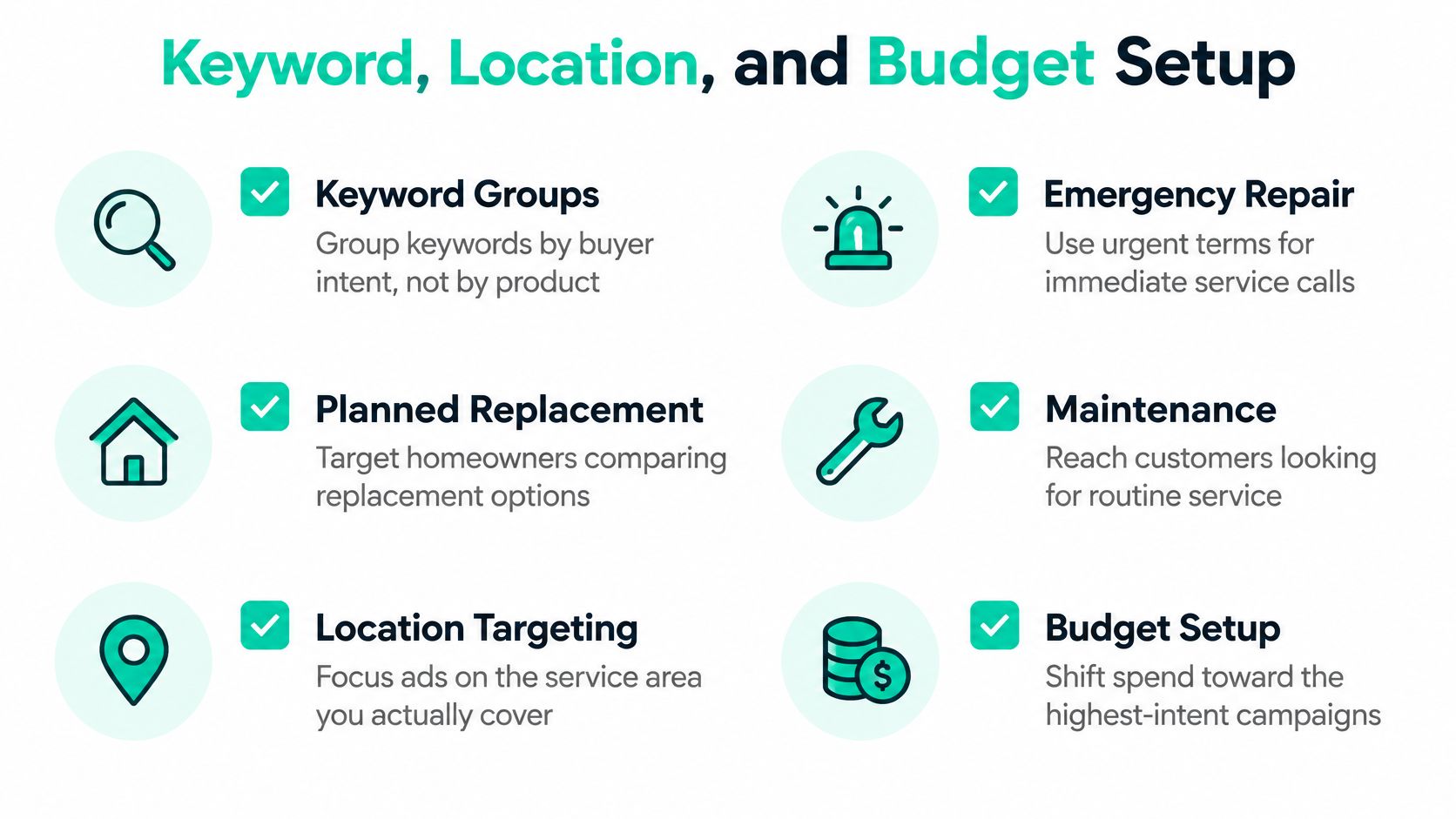
Target your real service footprint, exclude towns you won't serve, and select the location option focused on people present in your area. Build around dispatch coverage, not an attractive-looking radius. Coordinate that coverage with your HVAC local SEO so paid and organic visitors see consistent service information.
Example monthly budget split for a 3000 dollar HVAC plan
This is a hypothetical allocation, not a required minimum.
| Campaign | Sample keywords | Primary goal |
|---|---|---|
| Emergency repair search, $1,500 | AC repair near me, no cooling | Qualified calls that book same day |
| Replacement search, $900 | new furnace cost, replace AC unit | Booked in-home estimates |
| Maintenance search, $300 | AC tune-up, duct cleaning | Maintenance plan sign-ups |
| Branded search, $300 | company name, company reviews | Calls from known customers |
| Performance Max, $0 at launch | service area audiences | Calls and booked jobs after tracking is validated |
Most local service businesses start between $1,500 and $5,000 per month in ad spend. A smaller account shouldn't spread money across every available campaign type.
- Block irrelevant intent: Start negatives with DIY, parts for sale, how to fix yourself, free, and jobs. Review context before blocking legitimate estimate searches.
- Review the allocation: Schedule an initial review after about a month. Move money toward profitable bookings, not campaigns that merely generate conversations.
- Write your own split: Use the same rows, but prioritize the services your crews can fulfill.
Ad Copy and Landing Pages That Get the Call
Put the service and area first in the headline. Same-day AC repair in your city is useful only if you can provide it. Support the offer with genuine licensing details, financing availability, warranty terms, and emergency hours.
The same information should be easy to find across devices.
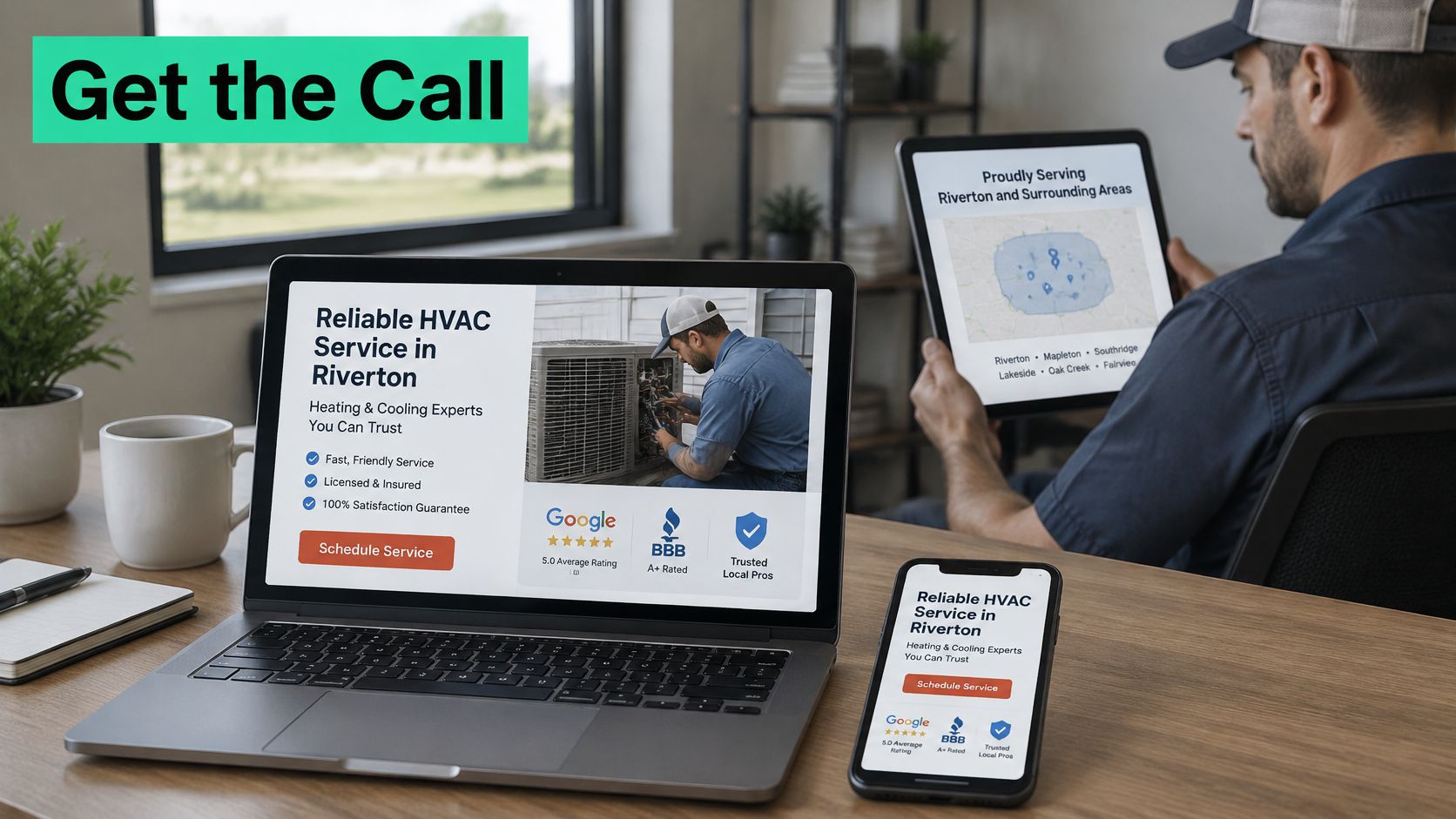
Make the next action obvious
- On the ad: Add a call asset and test alternative headlines or offers without changing everything at once.
- On mobile: Put a click-to-call button near the top, alongside service coverage and availability.
- For replacement requests: Offer a short estimate form and explain when someone will respond.
- For emergencies: Keep the phone prominent and align advertising with staffed coverage.
Avoid the landing page optimization mistakes that make visitors work to understand the service or contact you.
Don't confuse funnel stages
Ryn Digital's HVAC statistics guide reports approximately 7.8% website-visitor-to-lead conversion, phone-lead conversion near 46%, and 3–7% lead-to-customer rates for HVAC and roofing. These measure different stages, not a clean comparison proving that one channel sells at the other's rate.
Keep that distinction in mind when reviewing conversion advice.
For replacement-page visitors who haven't contacted you, test a limited remarketing window with financing or a genuine free-estimate offer, subject to audience eligibility and consent requirements. Exclude people who've already booked so you aren't paying to repeat an offer they've accepted.
Tracking Calls and Booked Revenue Instead of Clicks
Phone calls reportedly represent 70–80% of home-service leads and convert to booked jobs at two to three times the rate of form submissions, according to Snow Media's home-services benchmarks; the same source suggests investigating missed-call rates above 15%, a starting hypothesis rather than a universal rule.
That makes call quality central to HVAC PPC measurement. A dashboard full of conversions can include duplicate inquiries, warranty requests, unserviceable locations, and people seeking free troubleshooting.
Use this workflow to connect the inquiry to its commercial outcome.
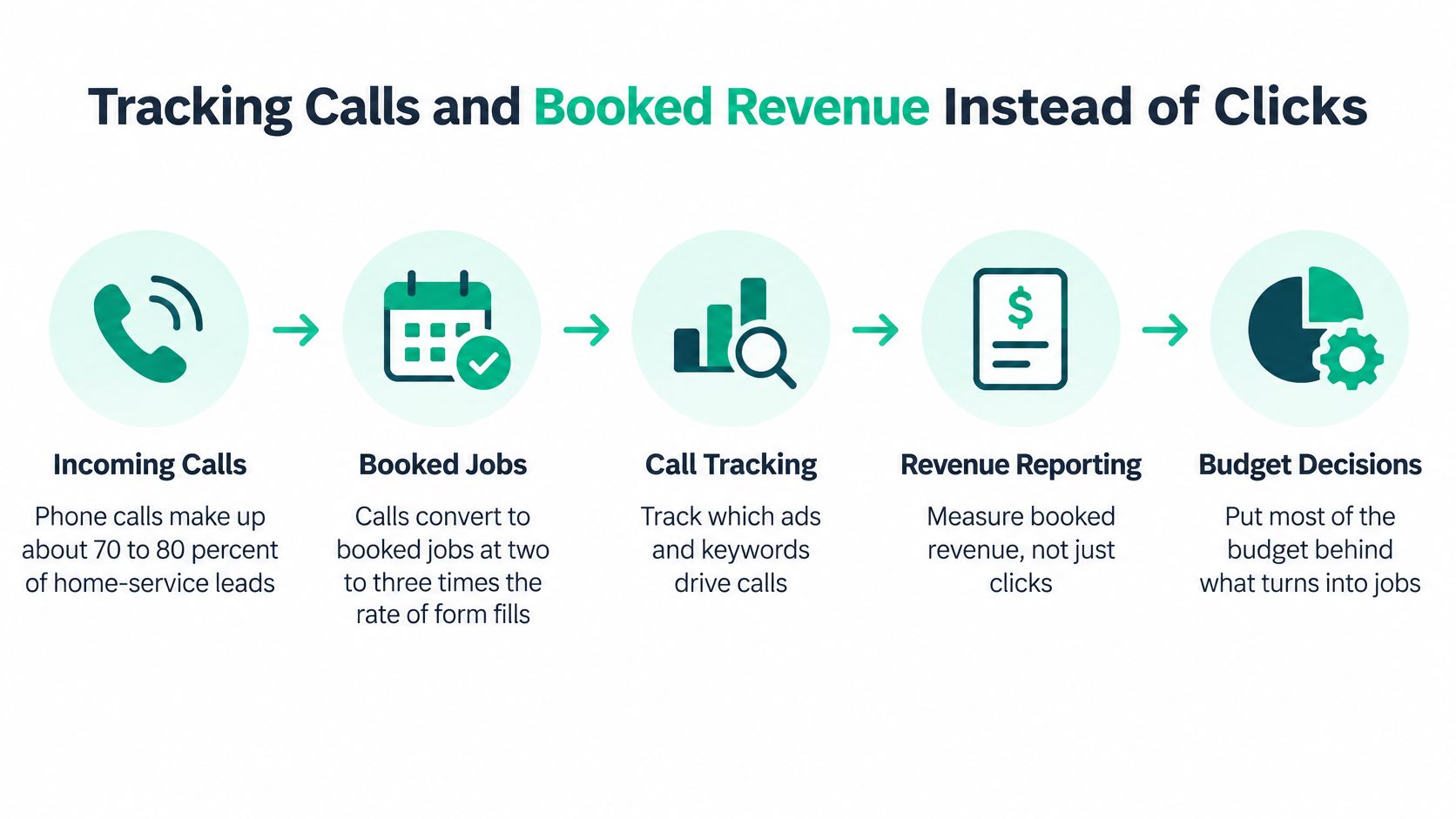
Connect the phone to the job record
Enable call reporting and website-call tracking. Install the Google tag and the required website event snippet. Google's phone-call conversion documentation explains how forwarding numbers connect eligible website calls to ad interactions. Test the number replacement and routing before launch.
Choose a minimum call duration. Google's call-conversion settings list 60 seconds as the default for an ad-call conversion, with an adjustable threshold. Use duration as an initial filter, then validate it against call outcomes. A long call can still be irrelevant.
Import offline outcomes. Record qualified, booked, completed, and sold stages in your CRM or call system. Google's offline call-conversion import guide explains how recorded sales or valuable actions can be matched to tracked calls. Prevent duplicate imports and preserve campaign attribution.
Assign values that reflect expected economics. A booked replacement estimate can deserve more value than a basic information request, but it isn't worth the full installation price before it sells. Base values on your close rates and job contribution. Keep early-stage actions secondary when reliable downstream outcomes can support bidding.
Review outcomes by service and territory. Schedule a recurring review of campaign, available search-term, service-type, and technician-territory results. Use qualified bookings to guide acquisition bids and completed sales to check whether those values remain realistic.
Fix unanswered calls before buying more
More budget won't repair a phone-coverage problem. It can simply send more paid callers to voicemail.
Review missed calls alongside dispatch capacity and callback handling. If the office can't answer or the crews can't accept the work, tighten scheduling and geography before increasing spend.
Attribution also needs restraint. Don't assign full revenue to both a qualified-call conversion and its eventual sale when that would count the same job twice.
Seasonal Bidding and Budget Pacing
AC-repair searches rise about 266% from February to the July peak, while emergency AC-repair queries can approach a 400% increase during hot weather, according to AdGenius's HVAC buyer-journey analysis. That doesn't mean you should set every bid to maximum when the forecast gets hot.
During a surge, you may face more competition while dispatchers and technicians are already stretched. A higher budget only helps if you can answer, book, and complete the additional work.
Set the ceiling from job economics
Start with expected collected revenue, subtract delivery costs and the profit you need to retain, then establish an allowable acquisition cost. Adjust the booked-job target for cancellations and appointments that don't become paid work.
- During spikes: Favor core service areas, available appointment capacity, and emergency campaigns that remain economically sound.
- During slower periods: Promote tune-ups, maintenance agreements, ductwork, financing, and replacement planning.
- For planned work: Evaluate eventual booked gross profit over the buying cycle, not just immediate inquiry volume.
The broader market supports year-round planning: Grand View Research estimated the USA HVAC systems market at approximately $31.7148 billion in 2025, with a projection of $54.0210 billion by 2033. That's an equipment-market projection, not a forecast of your advertising returns.
At Assertive Agency, we tune bidding to calls and booked jobs rather than clicks. Seasonal changes should follow those outcomes and available capacity, not temperature alone.
Put a peak-season budget review date and a slow-season campaign launch date on the calendar before demand changes. Attach a daily budget ceiling to each service, and monitor actual spend rather than assuming the platform will spend evenly each day.
Common HVAC PPC Mistakes and How to Fix Them
The costliest mistake is counting every inbound call as a lead. Require a meaningful conversation and service classification before treating the inquiry as useful bidding feedback.
HVAC PPC symptoms, causes, and fixes
| Symptom | Likely cause | Fix |
|---|---|---|
| Many calls, few booked jobs | Short or wrong-service calls counted as conversions | Raise minimum call duration and tag calls by service |
| Rising cost per lead, unqualified leads | Broad match keywords pulling in DIY and job seekers | Add negative keywords and move to phrase or exact match |
| Calls going to voicemail | Ads running outside staffed phone hours | Match the ad schedule to phone coverage |
| Spend spikes with no jobs | One campaign absorbing the budget during a heat wave | Set daily caps per service and review search terms daily |
| Branded campaign looks like it wins every sale | Existing customers counted as new | Report branded results separately |
| Cheap form fills that never book | Bidding only on form submits | Shift bidding to calls and offline imported outcomes |
Diagnose in a fixed order
Check call quality, search terms, phone coverage, budget allocation, then branded and form-fill reporting. For branded bookings, distinguish returning customers from new customers.
Review search terms frequently during launch and after demand shifts. Broad match isn't automatically wrong, but it needs trustworthy conversion feedback and active exclusions.
Keep a change log: Record what changed, why you changed it, and which booked-job metric should improve.
Make isolated changes where practical, then allow enough relevant bookings to judge the result. Don't call a fix successful because a few cheaper clicks arrived.
Launch Your First HVAC PPC Test
Choose a high-value service you can fulfill reliably. Build a focused campaign, a matching landing page, working call tracking, and a booked-call outcome. Don't launch the entire service catalog just because the account allows it.
For a hypothetical test, use the emergency-repair or replacement allocation in the sample budget. Plan an initial month of observation, but don't force a verdict if the campaign hasn't produced enough meaningful opportunities or replacement sales haven't had time to close.
Write the pass rule before launch
Your test needs a target cost per booked job based on your ticket, delivery costs, expected close rate, and required margin. Also record available appointment capacity so a promising campaign doesn't overwhelm the office.
- Below target with acceptable job quality: Keep the campaign, confirm completed-job economics, then consider adding another service.
- Above target: Inspect missed calls, search terms, geography, and booking outcomes before changing bids.
- Too little evidence: Narrow the test or extend observation within an affordable spending limit.
The free Google Ads Budget Calculator estimates monthly clicks, leads, and cost per lead from a chosen budget for HVAC, Plumbing, Roofing, Legal, Dental, and Home Services. Use those estimates to size a starting test, not as a promise of results.
Replace planning assumptions with actual account outcomes as they accumulate. Record campaign spend, qualified inquiries, booked appointments, completed work, and collected revenue in the same reporting view.
A successful test doesn't prove that unlimited spending will work. It proves that a defined service, offer, geography, and operating setup can acquire work within your chosen economics.
Get Help Building Your HVAC PPC Setup
You don't need a complicated dashboard to start, but you do need agreement between whoever manages ads, answers calls, and records sales. If each person uses a different definition of a lead, bidding decisions won't reflect what the company earns.
For a setup discussion with our team, bring your average ticket, target margin, current spend, service-area boundaries, and available appointment capacity. Include access to existing campaign results and a sample of call outcomes where appropriate.
Keep the scope tied to decisions
The useful questions are practical:
- Campaign structure: Which services need separate budgets and offers?
- Measurement: Can a paid inquiry be connected to a booking and completed sale?
- Customer response: Do the landing page and phone coverage support the promise in the ad?
- Reporting: Can you identify cost per booked job by service and territory?
Our approach is to direct budget toward campaigns that bring in jobs, with the numbers behind changes available for review. You keep the decision about what to test and how much risk the business can afford.
Assertive Agency offers a free Google Ads audit, reviewing your account or market and sending a plan to lower cost per lead. Visit Assertive Agency and bring your current spend, average ticket, and booking results so the conversation starts with what your HVAC PPC needs to return, not just how many clicks it can buy.
