


You've set aside money for advertising, but every option comes with another decision. Google Ads, Facebook, video, a better website, someone promising cheaper leads. Meanwhile, you're answering customer calls and wondering whether the money will produce actual work or just another dashboard.
Learning how to advertise online starts with connecting advertising to a business result you can verify. For a small business in the USA, that means building a measurable path from the ad to the inquiry, the sale, and the decision about what to spend next.
Table of Contents
- Start With the Business Outcome
- Define Your Goal and Success Metrics
- Choose Channels That Fit Intent
- Build the Message and Audience Match
- Set a Budget You Can Learn From
- Track Results and Improve the Campaign
- Launch, Review, and Scale With Confidence
Start With the Business Outcome
Consider an HVAC owner deciding how to fill open appointment slots. A social campaign showing the company's technicians might attract attention. A search campaign might reach homeowners looking for a repair. Neither choice is useful until the owner decides what the business needs and whether the team can deliver it.
Booked repair appointments, replacement estimates, and maintenance inquiries require different offers. They also create different demands on scheduling and follow-up. Starting with a platform skips those decisions.
Choose the result before choosing where to advertise. An auto repair shop might need inquiries for a particular service, not every possible vehicle problem. A law firm might need consultations reviewed for practice-area fit. An online retailer might need completed purchases rather than newsletter subscribers.
Write a campaign brief people can actually use
Keep the brief short enough that the owner, campaign manager, and person handling inquiries will read it. Include:
- Audience: Who needs the offer, and which locations can you serve?
- Offer: What are you asking someone to consider, book, or buy?
- Destination: Which page will explain the offer and handle the next action?
- Conversion: What business result will determine whether the campaign worked?
- Budget: What can the business afford to spend while learning?
- Decision owner: Who approves changes and checks what happened after the inquiry?
For the hypothetical HVAC campaign, that might mean homeowners within the service area, an appointment request page, and booked service visits as the desired result. The scheduling team would report whether inquiries became appointments and why others didn't.
Practical rule: If the person answering the phone can't explain what a good advertising inquiry looks like, the campaign brief isn't ready.
Use marketing funnel examples to map the steps between initial interest and becoming a customer. Then remove any unnecessary steps from the paid campaign's path.
This also prevents conflicting expectations. An awareness campaign shouldn't be judged as though every viewer requested service. A campaign intended to generate bookings shouldn't be declared successful because people watched its video.
Define Your Goal and Success Metrics
A form submission isn't a signed contract. A phone call isn't necessarily a customer. A purchase has a transaction value, while an inquiry needs qualification before anyone knows what it's worth.
Build your measurement plan around those differences. Name the primary conversion, define exactly what qualifies, and record the supporting actions separately. Avoid treating every interaction as equally valuable just because the advertising platform can count it.
Define what counts before launch
For a service business, a qualified inquiry might require a relevant service need, a serviceable location, and usable contact details. A law firm could require intake review before accepting an inquiry as a qualified opportunity. Write those conditions down so staff members don't apply different standards.
Google explains that conversion tracking connects ads and keywords with valuable activity and supports bidding; its guidance distinguishes Primary actions used for bidding from Secondary actions used for observation in its conversion-tracking documentation. Use that distinction deliberately, rather than accepting every tracked event as a business outcome.
Campaign Goal and Measurement Map
| Business goal | Primary conversion | Supporting signals | Review measure |
|---|---|---|---|
| Fill local service appointments | Confirmed booking | Relevant calls, appointment requests | Cost per booked job |
| Attract suitable legal matters | Intake-qualified consultation | Submitted forms, connected calls | Cost per qualified consultation |
| Sell products online | Completed purchase | Product views, cart activity | Purchase value and acquisition cost |
| Validate startup demand | Sales-qualified inquiry | Demo requests, pricing-page visits | Cost per qualified opportunity |
Assign values only when you can explain them. For purchases, pass transaction revenue and assess profitability separately. For leads, use a defensible estimate based on qualified outcomes and expected gross profit, not arbitrary values that make reports look better.
Keep the review window honest
Record the source alongside the customer record: campaign, relevant ad information, inquiry date, qualification status, and final outcome. Choose a review window that gives customers time to take the action you're measuring.
An auto shop booking routine work may learn sooner than a startup selling something that requires internal approval. Comparing their newest inquiries as though both have finished buying would produce misleading conclusions.
Finally, check operational readiness. Does someone answer calls? Are forms delivered to a monitored inbox? Can staff update lead status? Advertising shouldn't send paid inquiries into a process nobody owns.
These definitions become your decision filter. A cheaper ad isn't better if it attracts unsuitable customers, and a higher acquisition cost isn't automatically unacceptable if the resulting business is worth more.
Choose Channels That Fit Intent
Search and social advertising solve different problems. Search reaches someone expressing a need through a query. Social gives you a chance to introduce an offer while someone is doing something else.
Search generated $102.9 billion, or 39.8% of digital advertising revenue in the USA in 2024, according to the IAB internet advertising revenue report. That scale establishes its importance, not its suitability for every business. Your starting channel still needs to fit the buying situation.
Use intent as the starting comparison.
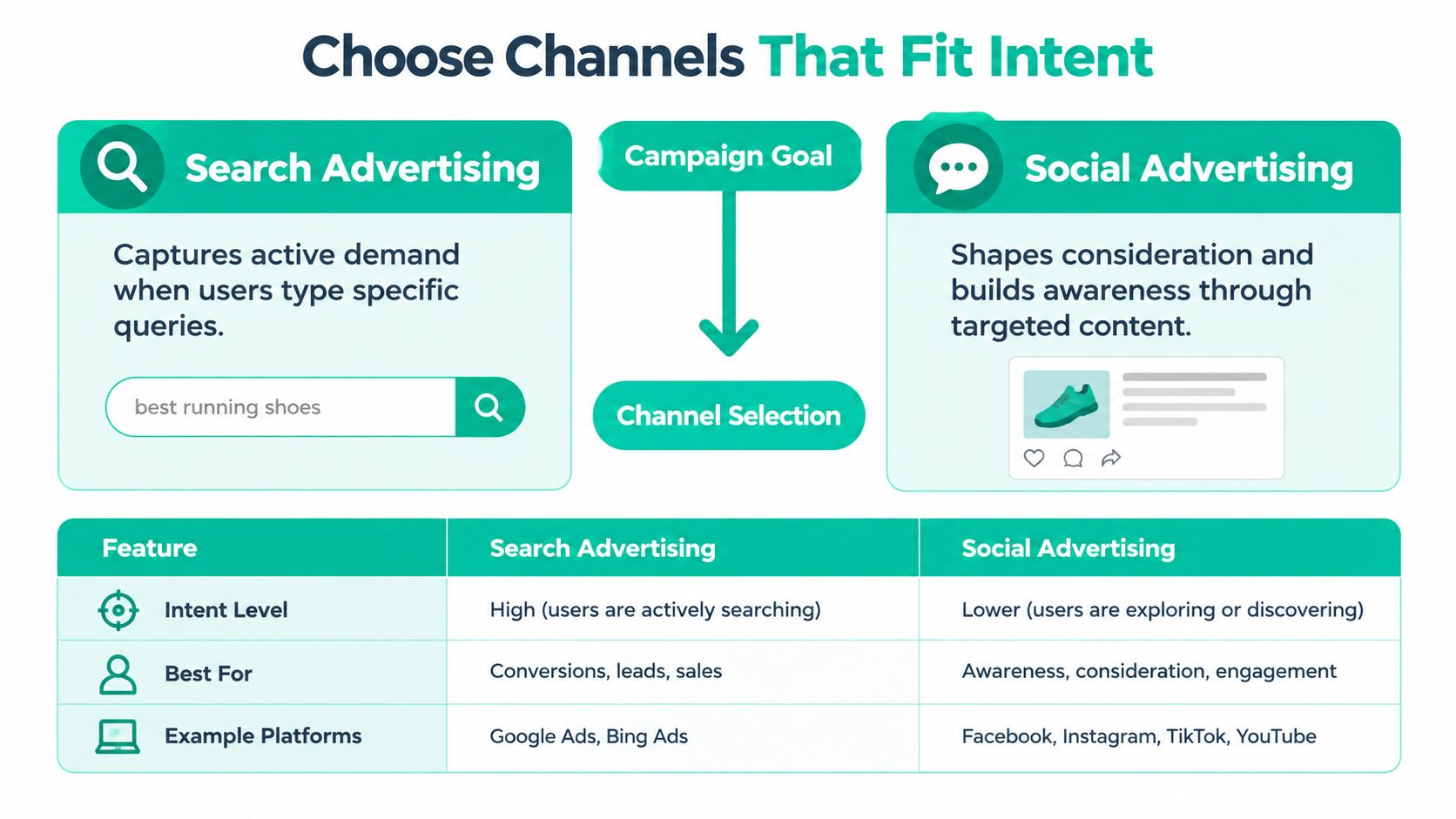
Compare the job each channel can do
Online Advertising Channel Selection
| Channel | Primary role | Best fit | Measure this |
|---|---|---|---|
| Search | Capture active demand | Specific service or product searches | Qualified inquiries and purchases |
| Social | Introduce an offer and develop interest | Visual products, demonstrations, relevant prospecting | Qualified outcomes by audience and creative |
| Display | Support awareness and remarketing | Simple reminders and repeat exposure | Verified conversions and incremental contribution |
| Video | Explain or demonstrate | Products or services that need context | Downstream qualified actions |
| Retailer or commerce advertising | Reach shoppers near product decisions | Products available in the advertised shopping environment | Sales value and product profitability |
A criminal defense law firm could begin with narrowly relevant searches and consultation-focused pages. An HVAC company could prioritize service-specific local demand. Both should avoid paying for inquiries outside their actual service scope.
An auto shop promoting planned maintenance has a different choice. Search may reach drivers already looking for the service, while social can introduce the offer to eligible local drivers who aren't currently searching. The trade-off is the amount of explanation and persuasion required before booking.
For an ecommerce retailer, a product demonstration may communicate something a text ad can't. Commerce advertising may fit shoppers comparing products, provided the listing, stock availability, and economics support the campaign.
Match the channel to your available assets
Search needs relevant keywords and a useful destination. Social needs creative that makes the offer understandable without assuming prior interest. Display needs a clear reason to remind someone, and video needs something worth showing.
A guide to advertising on social media can help clarify formats, but format selection shouldn't replace deciding why the audience would care.
Programmatic buying is a purchasing method, not a substitute for that strategy. Automated placement still requires decisions about audience fit, acceptable inventory, and meaningful outcomes.
For a constrained budget, start with the channel that offers the clearest path to your chosen result. That may be tightly bounded search for an established local need or focused social prospecting for a demonstrable product. Don't launch everywhere just to appear established.
Build the Message and Audience Match
A visitor searching for brake repair needs a different introduction from someone watching a product demonstration. A returning shopper needs a different message again. Using identical creative for all of them ignores what they already know.
Start with the customer's immediate question. For search, it may be whether you provide the service nearby. For a social browser, it may be what the product does. For a returning shopper, it may be an unanswered concern about suitability, delivery, or returns.
Check how the ad, audience, and destination work together.
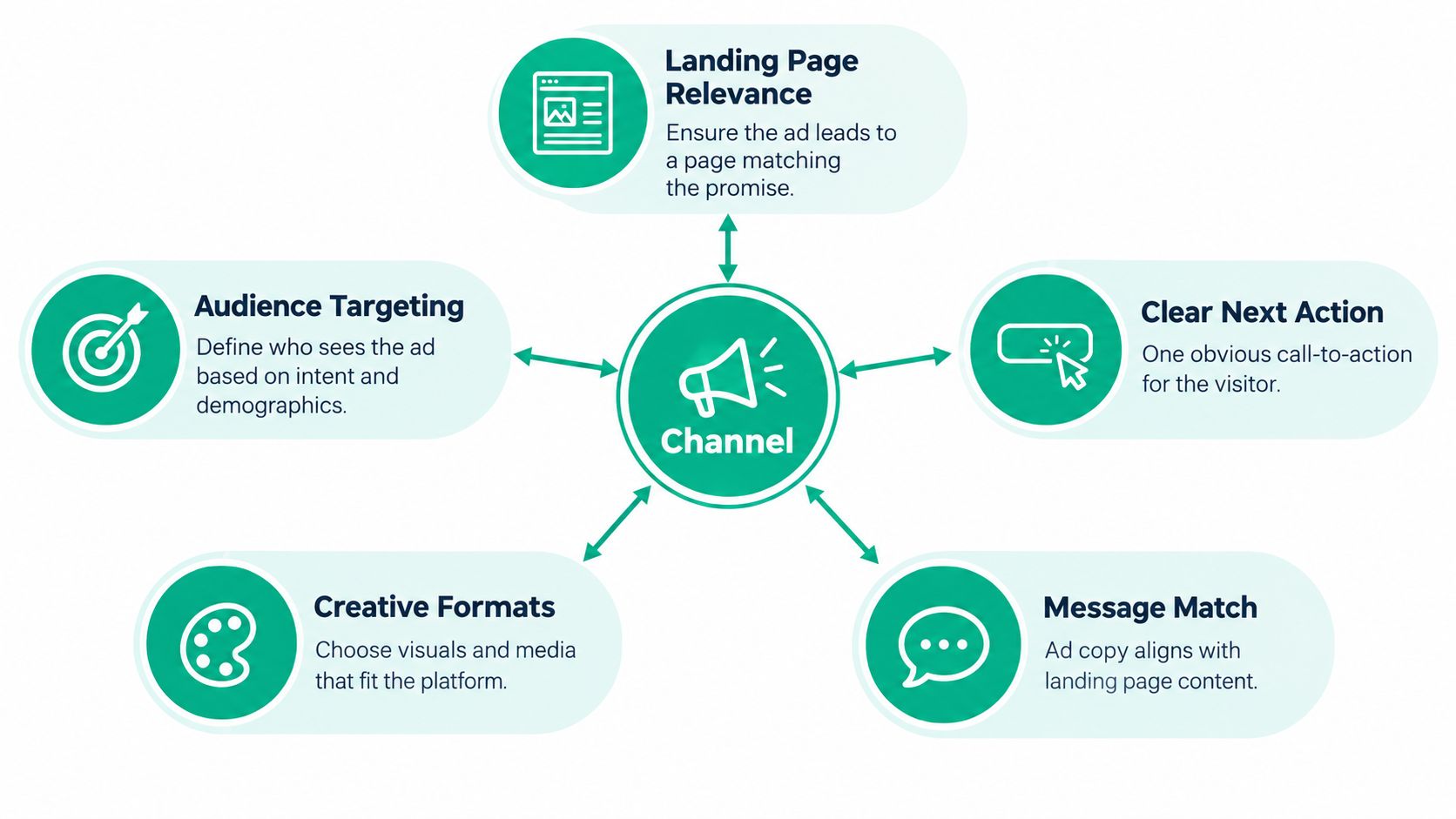
Keep the promise consistent
A direct-response search ad for a particular service should lead to a page about that service. Don't make visitors find their way to a general homepage to rediscover the offer.
A local service page should explain what you do, where you work, and how to request help. A product demonstration should lead to the demonstrated product, with purchasing information readily available. Only advertise availability, credentials, discounts, or service promises that the business can substantiate.
Develop distinct creative ideas rather than cosmetic variations:
- Problem-led message: Explain the customer's need and the relevant service.
- Demonstration: Show how a product works in a recognizable situation.
- Decision support: Address a genuine concern that prevents someone from acting.
- Relevant reminder: Reintroduce an offer without implying knowledge you shouldn't have.
Give each idea an explicit test question. Are visitors responding to the convenience of booking, the product's function, or the clarity of the offer? Changing everything together won't answer that.
Strong creative is specific enough to match the customer's moment and honest enough that the landing page can deliver its promise.
Target responsibly and exclude deliberately
Targeting defines who may see an ad. Exclusion removes people or situations that don't fit, such as locations you can't serve or existing purchasers when the offer is only for new customers.
Don't collect personal information merely because a tool allows it. Ask for what the business needs, explain its purpose, record relevant consent, and limit access.
The IAB Consumer Privacy Report found that 80% of consumers surveyed in the USA preferred advertising-supported free internet, while more than 70% were willing to share data to support it. That isn't blanket permission for every targeting practice.
Use consented first-party information where appropriate, and follow applicable requirements. If remarketing isn't suitable or available, choose contextual relevance rather than trying to recreate hidden personal profiles.
Set a Budget You Can Learn From
A small budget needs focus more than it needs an elaborate channel split. In a 2025 survey of 266 small-business professionals, 41% reported spending less than $500 per month on advertising, according to the small-business marketing survey.
That constraint makes simultaneous tests across unrelated channels hard to interpret. My starting recommendation is to fund a coherent campaign, not a collection of underfunded experiments.
Use concentration, testing, and expansion as your budget sequence, not a fixed percentage formula.
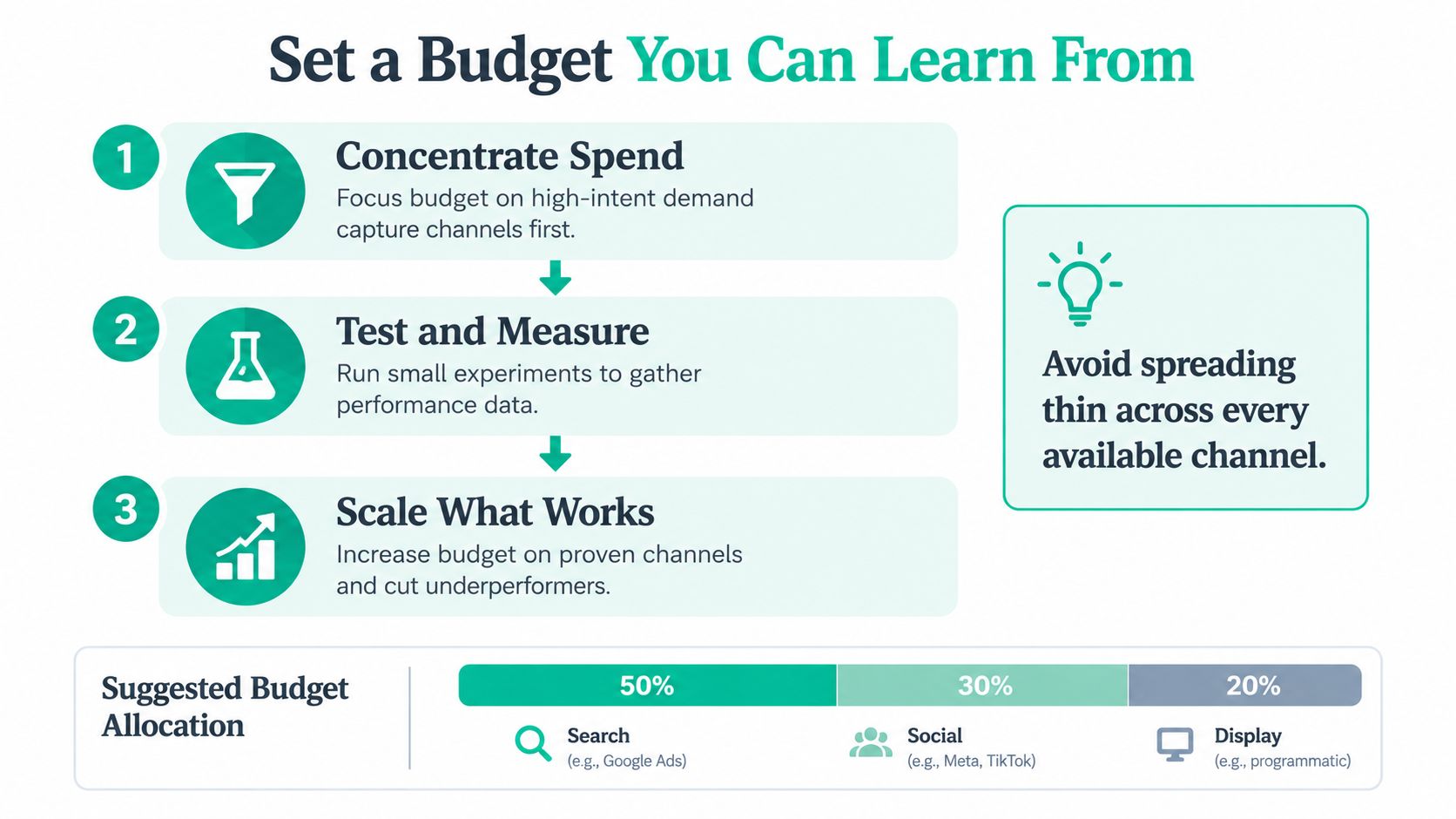
Separate affordability from buying conditions
Start with what you can afford to risk while learning. Then assess whether that amount can buy relevant opportunities in your chosen audience.
Review average cost per click considerations alongside customer value and qualification requirements. Cheap traffic has little value when it can't become suitable business.
For established local demand, concentrate on relevant searches and service areas. For an unfamiliar product, focused prospecting may be more useful. Fund remarketing only when there's an appropriate, eligible audience to reach.
Keep the offer and destination stable while collecting evidence. If the budget can't support useful delivery, narrow the campaign rather than adding another channel.
Understand what the daily setting means
Google states that a campaign can spend up to twice its average daily budget on a high-traffic day, with a monthly charging limit of the average daily budget multiplied by 30.4; its example uses $10 daily, up to $20 on an individual day, and a $304 monthly limit in its budget and overdelivery guidance.
Plan cash flow around those mechanics instead of expecting identical daily charges. When changing settings, check how the change affects the applicable limit.
Use the video below as a companion to your written allocation plan.
Expand when qualified outcomes support the economics and staff can handle additional business. If results remain unclear, improve the evidence before increasing the commitment.
Track Results and Improve the Campaign
Before launch, complete the conversion journey yourself. Submit a test inquiry, complete a test purchase where practical, and check whether the intended event appears correctly. Confirm that refreshing a page or resubmitting a form doesn't create misleading duplicates.
Use Google Tag Manager or an equivalent setup to manage implementation, but don't confuse installing a tag with validating measurement. Someone must check what triggers it, what information it passes, and whether consent settings operate as intended.
Keep the launch-to-review routine visible to everyone responsible for the campaign.
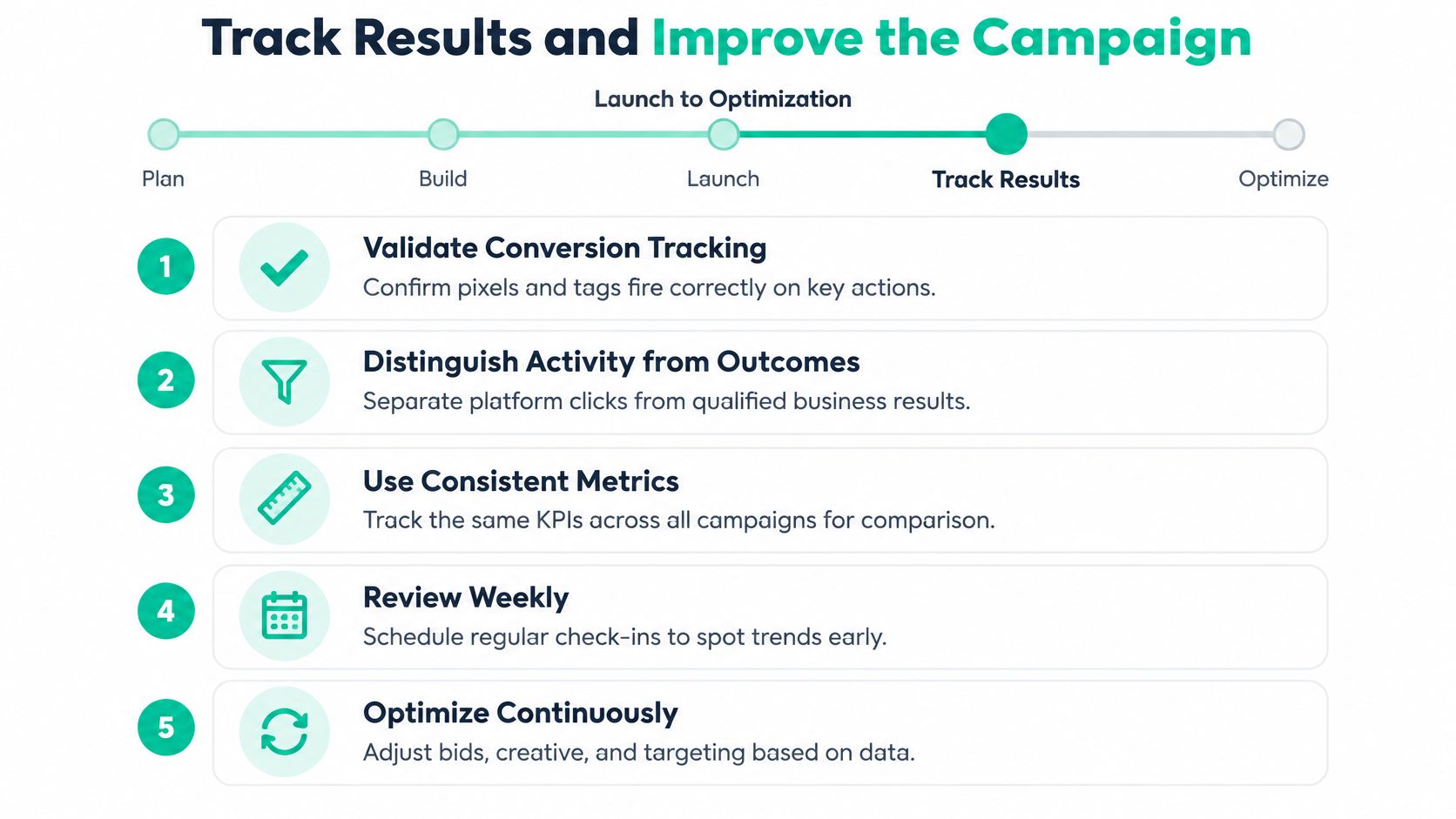
Close the gap between advertising and customer records
For lead generation, connect CRM outcomes through offline conversion imports where appropriate. Match the original inquiry to its later qualification or sale using the supported implementation and applicable privacy safeguards.
An HVAC business should be able to distinguish a booked job from an unanswered call, an unsuitable inquiry, or a duplicate customer record. Otherwise, the campaign manager might increase spending on ads that produce activity but little usable work.
Build a consistent reporting view across campaign, audience, keyword where available, creative, device, geography, and landing page. Compare platform reports with customer records rather than assuming either is complete.
When attribution is uncertain, consider a holdout or geographic comparison if the business can support a meaningful test. Platform-reported conversions alone don't establish that every sale happened because of advertising.
Treat a reporting discrepancy as a reason to investigate, not as permission to choose whichever dashboard looks better.
Give automated bidding a controlled test
Choose a reliable optimization goal with a manageable conversion delay. Launch with stable targeting, creative, destination, and budget, then allow learning before judging the strategy.
Google's Smart Bidding guidance describes a typical 7–14-day learning phase and warns that frequent changes to budgets, targets, or conversion goals can delay stabilization. The same supplied guidance recommends at least 15 monthly conversions for a value-based optimization goal and frequent lead-outcome uploads, ideally daily.
Those thresholds don't guarantee success. Clean inputs and a business-relevant evaluation window still matter.
Use a repeatable operating rhythm:
- Monitor daily: Check tracking failures, rejected ads, broken pages, and unexpected delivery.
- Diagnose at scheduled reviews: Examine qualification, booked work, sales value, and differences between audiences or messages.
- Change deliberately: Adjust a major variable only when you have a clear reason, then record the date and hypothesis.
- Evaluate after outcomes mature: Include conversion delay and use a consistent attribution window.
Don't wait to repair broken tracking. Do resist rewriting the strategy whenever a quiet day makes you nervous.
Launch, Review, and Scale With Confidence
Before pressing publish, make sure someone owns every part of the customer journey. The campaign manager can't judge lead quality if intake staff never update records, and the owner can't approve expansion without knowing what the acquired business was worth.
Use a compact launch checklist:
- Confirm the outcome: Agree on the qualification standard and responsible reviewer.
- Select the starting audience and channel: Keep the campaign narrow enough to evaluate.
- Prepare the experience: Check the offer, creative, landing page, and next action together.
- Validate measurement: Test the journey and its customer-record handoff.
- Approve spending and review timing: Set expectations before results arrive.
Troubleshoot the cause, not just the symptom
For low delivery, inspect eligibility, targeting restrictions, bids, and available demand. For poor lead quality, examine search relevance, audience fit, offer wording, and intake feedback.
For misleading platform results, investigate event definitions and record matching. For budget volatility, inspect delivery and billing settings before assuming the campaign has malfunctioned.
Endorsements and reviews need care, too. The FTC says material connections, including payment, employment, personal relationships, or free products, should be disclosed with the endorsement; its influencer disclosure guidance cautions against hiding disclosures below Instagram's “more” button.
Make disclosures noticeable and understandable through prominence, presentation, placement, and proximity, consistent with the FTC Endorsement Guides. The agency's updated guidance on reviews and endorsements also warns against manipulating reviews and relying solely on platform disclosure tools.
Your next move is practical: finish the campaign brief, test the customer journey, and set the review date. For small businesses in the USA, focused advertising with verifiable outcomes is a more defensible starting point than broad exposure without accountability.
Assertive Agency offers paid media management, landing-page development, conversion tracking, and reporting for businesses that want to connect advertising with qualified leads and revenue. Visit to request a free initial audit and discuss a focused campaign roadmap built around your offer, budget, and customer journey.
