If a termite call, a rodent sighting, or a bed bug scare lands in your inbox today, the customer isn't comparing vendors for fun. They're on a phone, they want an answer fast, and they're usually searching for someone nearby who can show up soon and solve the problem without making it worse. That's why pest control company SEO is less about chasing broad traffic and more about winning the exact local searches that turn into booked inspections and service revenue.
Table of Contents
- Why Local Search Matters for Pest Control Businesses
- Local SEO Foundations Every Pest Control Website Needs
- Service Area Pages That Actually Convert
- Review Generation and Reputation Management Strategy
- Content Optimization for AI Overviews and Local Answers
- Measuring SEO Success for Pest Control Leads and Revenue
Why Local Search Matters for Pest Control Businesses
Pest control is one of those services where the search begins after the problem starts. A homeowner notices droppings in the attic, a restaurant manager sees activity near a prep area, or a renter spots a trail in the kitchen, then they search locally and act quickly. Google's research says 4 in 5 consumers use search engines to find local information, including addresses, hours, availability, and directions, and 50% of smartphone local searches lead to a store visit within one day, compared with 34% on computer or tablet search, according to Google's local search research.
For pest control, that behavior matters even if you don't run a storefront. People still search by place, judge who can come out fast, and choose the business that looks available, trustworthy, and easy to contact. The same research also found 18% of smartphone local searches led to a purchase within one day, versus 7% of non-local searches, which is why emergency pest control, termite treatment, and exterminator near me pages deserve real attention.

What to measure instead of vanity rankings
Rankings matter, but they don't pay payroll. A pest control company should watch calls, quote requests, direction requests, booked inspections, and revenue by service area, because those are the actions that show the site is pulling in real demand. A page can sit in a decent position and still underperform if the phone number is hard to tap, the form is clunky, or the service area doesn't match what people need.
Practical rule: if a keyword brings traffic but not inspections, it's the wrong keyword or the wrong page.
That's why local SEO for this niche works best when it mirrors the way customers buy. Search behavior is urgent, mobile, and tied to location, so the site has to answer quickly and make the next step obvious. A strong local program doesn't just “rank,” it helps a worried customer make a decision in minutes.
For a useful comparison of how local service businesses structure this kind of work, see this HVAC local SEO framework.
Local SEO Foundations Every Pest Control Website Needs
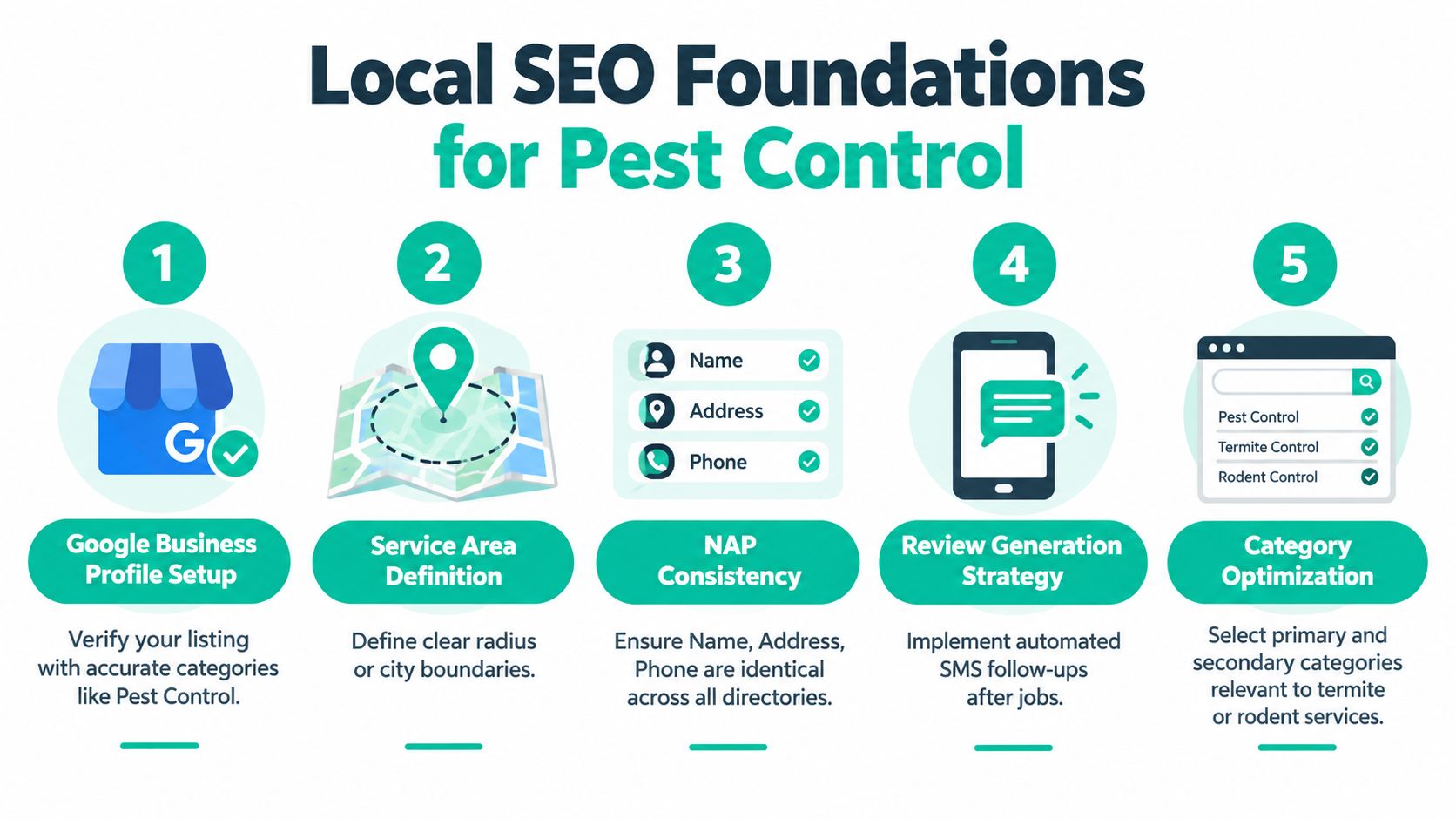
Start with the basics that Google can verify and customers can use. Your Google Business Profile should match the business, use the most accurate category setup available, list the correct service areas, and keep hours, descriptions, and contact details current. Google's Local Pack system weighs relevance, distance, and prominence, so if the listing is incomplete or inconsistent, you're hurting the one part of local SEO you can control.
Structured data matters next, but only when it reflects the truth. Google's guidance for LocalBusiness structured data says each location should use the most specific subtype available, and it recommends validating markup with the Rich Results Test and URL Inspection. Don't mark up fake locations, unsupported review details, or anything that doesn't exist, because that can trigger problems instead of visibility.
Technical work that helps lead flow
A pest control site also has to perform on a phone under pressure. Google's Core Web Vitals documentation uses three real-user metrics, Largest Contentful Paint, Interaction to Next Paint, and Cumulative Layout Shift, with good thresholds of 2.5 seconds or less, 200 milliseconds or less, and 0.1 or less. Slow pages and jumpy forms make it harder for a visitor to call, ask for an inspection, or submit an emergency request.
Slow service pages usually don't lose because the content is weak, they lose because the next step is annoying on mobile.
A clean foundation usually looks like this:
- Google Business Profile accuracy: keep the service list, description, hours, and contact info aligned with the business as it operates.
- Service-area clarity: show where you work, then link that area to relevant pages.
- Structured data validation: use the right business type and test the markup before trusting it.
- Mobile conversion basics: make click-to-call obvious, reduce form friction, and keep headers from pushing the phone number out of sight.
- Search Console and analytics checks: confirm the page is indexable, canonicalized correctly, and tracking the actions that matter.
The goal is simple. Build the site so Google can understand it, and build the page so a stressed customer can use it without thinking.
For web design that supports this kind of local conversion work, see SEO-friendly website design.
Service Area Pages That Actually Convert
Most pest control sites either overbuild city pages or avoid them entirely. Both approaches miss the point. A service-area page should answer a real local question, like whether you cover that suburb, what pests are common there, how fast you can usually respond, and what the next step looks like after the call.
Map the service zones first
Start with the places you genuinely serve, not the places you wish you ranked for. Then group those locations by intent, because a neighborhood page and a service page are not the same thing. A neighborhood page supports local trust and geographic relevance, while a service page explains the treatment itself.
That split matters for terms like termite control, rodent exclusion, bed bug treatment, and wildlife management. A termite page should go deep on inspection triggers, wood damage, and follow-up timing. A location page should lean into the local area, common call types, and how customers in that zone usually get started.
Build pages around intent, not just place names
Use a unique H1 for each page, write localized copy that sounds like the actual service territory, and link to nearby services when the topic overlaps. If a city page talks about roof rat problems, it should point to the rodent page, not repeat the same paragraph with a new town name inserted. Thin pages with swapped city names create weak coverage and usually don't earn trust.
The strongest pages usually include:
- Local context: neighborhood references, property types, or common pest patterns in the area.
- Specific treatment fit: what services are most relevant there, and what isn't.
- Response expectations: how customers can contact you and what happens next.
- Internal links: direct paths to service pages, inspection pages, and contact options.
- Conversion elements: phone, form, and call-to-action copy that matches the intent of the page.
A location page should feel like a local office conversation, not a template with the city name swapped out.
Here's where many owners get stuck. They want more pages, but what they really need is a better page map. A smaller set of strong pages that match real search intent will usually outperform a pile of near-duplicates, especially when each page is tied to a tracked action and a specific service area.
Review Generation and Reputation Management Strategy
Reviews are not just social proof. They are also a conversion filter, because people use them to judge whether the company can handle a pest problem without wasting time, missing follow-up, or creating new issues. A pest control business that treats reviews like a checklist usually ends up with generic feedback and weak insight. A business that treats them like customer data gets a better read on what people care about before they call.
Ask for the right kind of feedback
Don't gate reviews or only ask the happiest customers. Ask every eligible customer with a neutral prompt, then let them describe the job in their own words. The details matter, pest type, property context, response speed, treatment scope, follow-up visit, and whether the issue came back later.
That approach helps you earn reviews that sound believable to future buyers. It also gives you better raw material for service pages and FAQs. If several customers keep mentioning confusion around inspection fees, preparation steps, or pets and children, that's not just a reputation issue, it's a content and operations issue too.
Respond like a service business, not a template machine
People expect owners to respond, and they notice when the response sounds real. A 2025 BrightLocal survey of 1,026 US adults found that 89% expect business owners to respond to both positive and negative reviews, and separate reporting from the same survey says 89% would use a business that responds to all reviews, compared with 44% who would use one that doesn't respond at all. The reporting also found that 74% of consumers check reviews on at least two platforms, according to BrightLocal's 2025 survey reporting.
That means you can't focus only on Google. You need to watch more than one review source, answer thoughtfully, and keep the tone consistent. When a complaint is legitimate, acknowledge it, clarify the next step, and avoid canned language that makes the reply feel fake.
One useful way to think about review work is this:
- Request: ask after completed work with a neutral message.
- Monitor: check multiple platforms, not just one.
- Respond: add context, don't paste a script.
- Learn: turn recurring themes into page updates and operational fixes.
For businesses that need help cleaning up brand trust signals, negative search result suppression support can be part of the larger reputation program.
Content Optimization for AI Overviews and Local Answers
Local visibility doesn't stop at the map listings anymore. Some searches now surface AI-generated answers, and pest control content that only targets “city plus service” keywords can miss that layer entirely. A 2025 Local Falcon study of 60,000 local-business queries found Google AI Overviews appeared in 40.2% of searches, according to Local Falcon's AI Overviews research.
Write the kind of answer an AI can extract
The best-performing content in this environment tends to answer the question directly, then support the answer with practical detail. That means short, clear explanations of treatment methods, safety steps, limitations, timelines, and pricing variables. It also means telling people when DIY is the wrong choice, especially for pest issues that affect health, property damage, or repeated infestation.
Pest control companies should make the expertise visible in the writing itself. Mention licensed technicians where relevant, explain product labels when safety matters, and spell out pet and child precautions without hiding behind vague marketing language. That kind of content is easier for search systems to understand and easier for a nervous customer to trust.
The pages that win these answers usually sound like someone who has done the work, not someone who has summarized it.
Stop relying on generic city pages to carry informational intent
A generic city page won't usually answer, “How long does bed-bug treatment take?” or “Is professional mouse removal safe?” That's a different kind of search, and it needs a page that addresses the actual question. Tie those answers back to the relevant service page and the relevant location page, then keep the language tight enough that a search system can extract it.
Many teams leave money on the table. They publish dozens of local pages, but they don't document the expertise that helps a buyer decide. AI-mediated search rewards complete answers, especially for risk, cost, and process questions, so the content has to do more than mention the town name and the service.
Measuring SEO Success for Pest Control Leads and Revenue
The biggest mistake in pest control SEO is measuring the wrong thing for too long. Rankings can help you spot momentum, but they don't tell you whether the site is producing booked work, recurring contracts, or meaningful revenue in a given service area. If the traffic looks healthy and the phones stay quiet, the program isn't working.
Track the actions that show intent
Use Google Search Console, analytics, and call tracking to tie performance back to the page and the location. Then watch qualified calls, booked inspections, repeat service contracts, and local revenue attribution. That gives you a clearer view than raw sessions, because pest control is a service business, not a content farm.
You also need to pay attention to what doesn't move. Artificial city insertions, keyword-stuffed business names, and fake locations are the wrong play. Google's local system still cares about relevance, distance, and prominence, and distance is something you can't fully control. That's why the smarter investment is usually in accurate service-area coverage, strong service pages, real local authority, and conversion UX that makes the call easy.
Put the money into signals that build trust
Prominence comes from legitimate mentions, links, and review strength, not shortcuts. Relevance comes from clear services, accurate page structure, and business information that matches reality. When those pieces line up, the site has a better shot at winning qualified leads instead of just impressions.
A useful rule for owners is simple. If a page ranks but doesn't book, improve the page before buying more content. If the service area is right but the conversion rate is weak, fix the UX. If the reviews are decent but thin on detail, improve the review process. That sequence keeps the budget focused where it affects revenue.
Assertive Agency helps pest control companies with local SEO, technical audits, Core Web Vitals, content planning, review programs, and conversion tracking tied to real leads. If you want a plan that connects service pages, AI Overview visibility, and local revenue, visit Assertive Agency and ask for an audit that's built around booked jobs, not vanity rankings.