


If a burst pipe call comes in at 9 p.m., the homeowner isn't comparing marketing jargon. They're checking whether your number is easy to tap, whether someone answers, whether you service their area, and whether your reviews look recent and real. That's why plumber search engine optimization only works when it's tied to the way plumbing jobs get booked, not to vanity traffic or generic rankings.
Table of Contents
- Why Plumber Search Engine Optimization Is Different
- The Three Google Ranking Factors and What They Mean for Plumbers
- Google Business Profile Setup That Gets Calls
- Service Pages and LocalBusiness Schema Without the Trap
- Reviews as a Conversion Workflow You Can Actually Measure
- Beating the AI Overview Citation Gap
- Core Web Vitals on a Plumbing Lead Page
Why Plumber Search Engine Optimization Is Different
A Saturday night burst pipe changes the whole game. The caller doesn't want a blog post, they want a fast yes, a real service area, and proof that your company can handle the job without wasting time. In that moment, your website is not a brochure, it's part of the phone call.
Google says local search rankings are mainly based on relevance, distance, and prominence, and relevance depends on how closely your Business Profile matches the search Google local ranking factors. For plumbers, that means the “best SEO” work is usually the work that helps a stressed homeowner decide in under a few minutes.
The question isn't whether a page ranks. The question is whether the page gets the call and keeps it.
That urgency reshapes everything. A generic “services” page is weak if it doesn't make emergency coverage obvious, show the right town or branch, and make the phone number impossible to miss. A strong local setup does those things at once, so the searcher feels like they found the right plumber before they ever scroll.
It also changes what success looks like. Traffic matters only if it creates booked jobs. A page can bring visitors and still fail if the listing info is wrong, the form is clumsy on mobile, or no one answers the phone fast enough. In plumbing, search visibility and speed-to-answer are joined at the hip.
The Three Google Ranking Factors and What They Mean for Plumbers
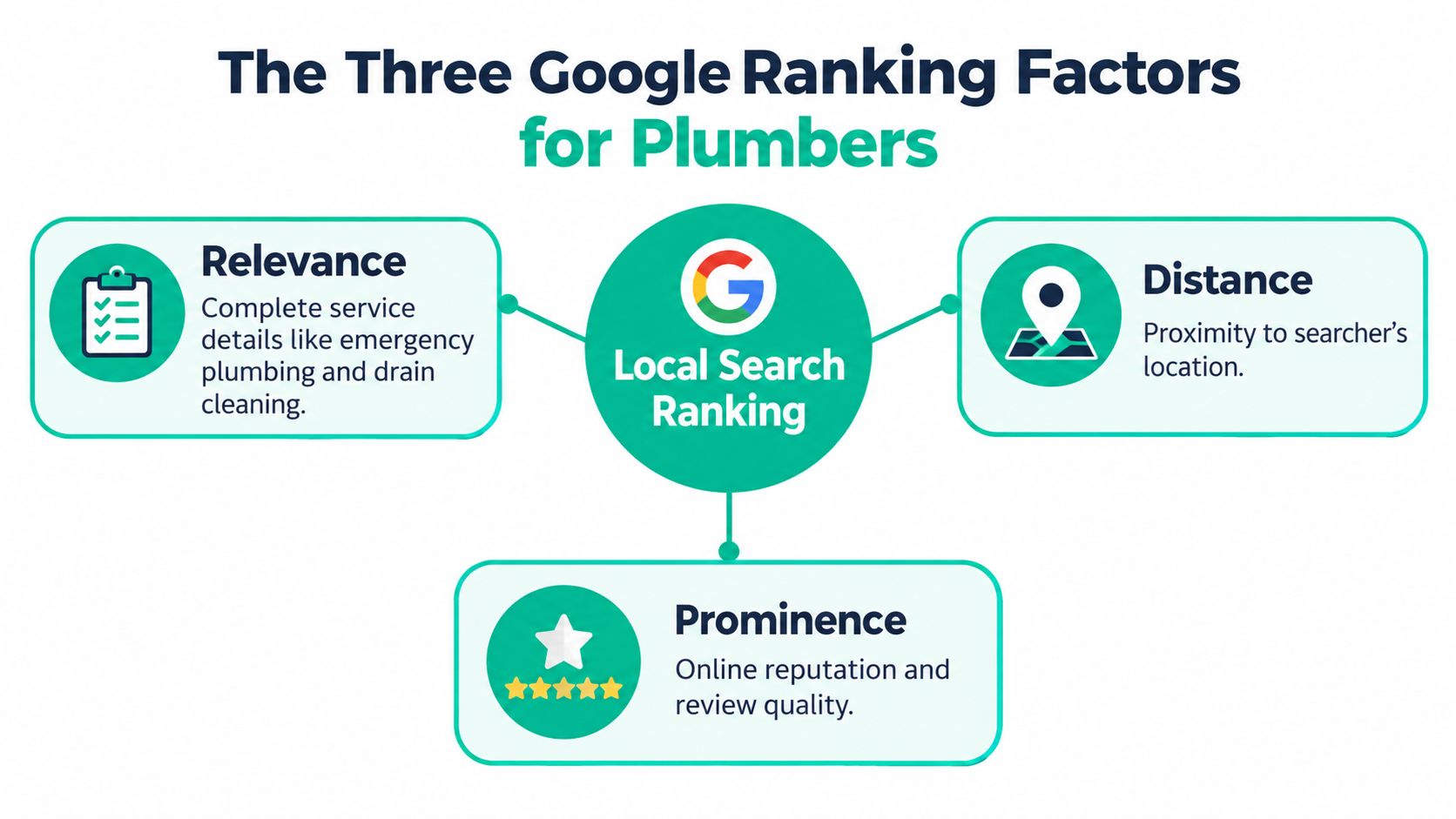
Relevance starts with clear service coverage
A plumber wins relevance by using plain language that matches real jobs. If your Business Profile and site clearly say you handle emergency plumbing, drain cleaning, water heater repair, sewer line replacement, and the rest of the work your crew takes, Google has a better chance of matching you to the right search Google local ranking factors. Vague wording leaves too much room for the wrong lead.
A quick self-check helps here. Do the services listed online match what the crew really does? Does the profile use the same city, the same trade terms, and the same service depth your office gives callers? If not, relevance gets diluted by your own setup.
Distance is fixed, but service-area decisions still matter
You cannot move your shop to satisfy a search query. Distance depends on where the searcher is or where they name in the query, and that part sits outside your control. What you can control is whether your service-area coverage is explicit and believable.
Service pages and branch pages do that work. If you cover several towns, each real area needs a page that says so in a way people trust. If you run a service-area business, the profile and site should make that model clear instead of making callers guess. That clarity helps a homeowner decide faster, which matters when the call is urgent and the booked job depends on speed.
Prominence grows through reputation and recognition
Prominence is the part many owners underestimate. It can be shaped by links from other websites, review quantity, and review quality. For a plumber, that means the business people talk about, review, and link to tends to look more established.
The practical test is simple. Does your company show up on sites customers already trust? Do reviews sound current? Do local organizations mention you by name? If the answer is weak, prominence needs work, and a quick SEO audit usually shows where the gap starts.
Five-minute self-check: open your Google Business Profile, your main service page, and one directory listing. If the name, phone number, service list, and service area do not line up, fix that before you touch anything else.
Google Business Profile Setup That Gets Calls
Choose categories and services that match the shop
Your profile should say what you do, not what sounds broadest. A main category like plumber is usually the anchor, then the service list should reflect real offerings such as water heater repair, sewer line replacement, and hydro jetting. If the shop does not handle a service on a regular basis, leave it out.
Service-area setup matters too. A storefront shop with walk-in traffic needs one structure, and a service-area business that drives to customers needs another. The point is to remove confusion before it starts, because confused searchers click away fast.
The strongest plumbing profiles make a caller feel safe in one glance. Hours, emergency availability, photos from actual jobs, and a short description of the work all help.
Use real photos and freshness signals
Stock imagery does not tell a homeowner anything useful. Photos of the crew, the truck, a clean water heater install, or a finished drain repair give the profile real proof. They also make the brand feel local, which matters when someone is comparing three plumbers from a phone screen.
Google Posts can help keep the profile active, especially when they point to seasonal or urgent work. A post about frozen pipes, sewer backups after heavy rain, or water heater issues after a cold snap is more useful than generic promo copy. The goal is to show the business is active and reachable.
Push NAP data to the right places first
Once the profile is clean, the same name, address, and phone number need to match everywhere that matters. Start with Apple Maps, Bing Places, Yelp, Facebook, and the major data aggregators. If those are inconsistent, Google has more reason to hesitate.
If a caller cannot confirm the business quickly, they move on. That applies on maps, in the local pack, and on the site itself.
HVAC local SEO services can overlap with plumbing in the same home-services account, but the plumbing profile still needs its own service logic and its own calls to action.
Service Pages and LocalBusiness Schema Without the Trap
Build pages for real service areas, not one generic catchall
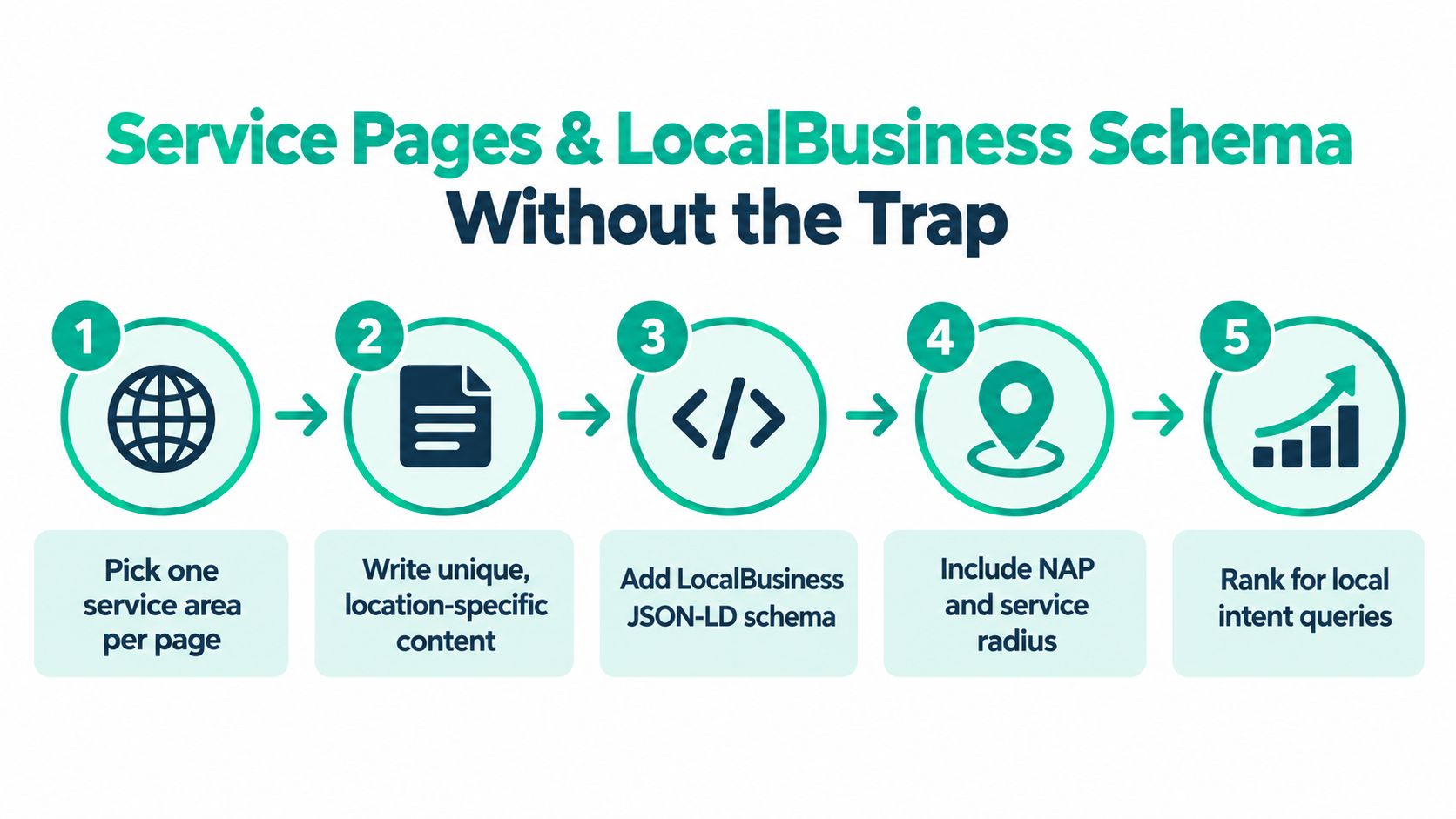
A location-specific entity model works better than one broad service page because each real area has its own context. One unique, indexable page per service area or branch gives Google and the visitor something specific to understand. A copied page with only the city name swapped is thin, and thin pages usually underperform.
Each page should cover locally relevant service coverage, emergency availability, licensing information, and a clear way to contact the shop. If the page says the crew works that area but doesn't show why, the page feels empty.
Add schema only for what the page already shows
Use LocalBusiness JSON-LD with the business name, address, telephone, opening hours, and department information only when that information is visible on the page. Google recommends adding required LocalBusiness properties, validating markup with the Rich Results Test, checking rendered interpretation through URL Inspection, and submitting an updated sitemap after changes LocalBusiness structured data. That sequence keeps the work clean and reduces guesswork.
A practical rollout looks like this. Reconcile the name-address-phone data across the site and major listings, build the local pages, add markup only for visible information, validate on a small set of pages, then watch indexing and Search Console enhancements before expanding. That order avoids the common mistake of scaling a broken template.
Don't use schema as a shortcut
Structured data makes pages eligible for certain search features, it does not guarantee enhanced display. That distinction matters because some owners treat schema like a ranking hack. It isn't one.
The other trap is review markup. Google's guidance limits review markup to reviews about other businesses that the site itself captures, so plumbers should not fabricate or republish unsupported review data in schema LocalBusiness structured data. If the review isn't on the page and legitimately captured there, leave it out.
Reviews as a Conversion Workflow You Can Actually Measure

Treat reviews like part of the booking process
Reviews are not a side task. They're part of how local search becomes revenue. BrightLocal's 2025 survey of 1,026 U.S. adults found that 42% of consumers trust business reviews as much as personal recommendations, down from 79% in 2020, which says a lot about how credibility is changing BrightLocal survey. The message for plumbers is simple, volume alone isn't enough.
Send the ask soon after the job is done, while the customer still remembers the experience clearly. Route them to the verified Google profile, not a gated landing page, and respond to positive and negative reviews one by one. That keeps the profile human and current.
Turn complaint patterns into operational fixes
Recurring review comments tell you what to fix in the business. If people keep mentioning arrival delays, that's a scheduling or dispatch problem. If price clarity comes up often, the estimate and the phone script need work. If cleanup or workmanship appears repeatedly, the field process needs tightening.
Those notes should feed into landing pages too. A page for emergency plumbing can highlight response clarity. A page for water heater work can explain what affects pricing. That's not just SEO, it's conversion hygiene.
Track the right review metrics
Raw review count is too blunt on its own. Watch review acquisition rate, response coverage, rating distribution, and lead-to-booking rate by source. Those are the signals that show whether the review system is helping the phone ring and the jobs close.
A five-star average means less than a current profile with real replies, recent jobs, and a pattern of credible detail.
Beating the AI Overview Citation Gap
Search visibility now includes AI answers
A plumbing company can rank well and still be absent from the answer customers see in AI-generated results. A 2025 Whitespark study of 540 local-business queries across three U.S. metros found AI Overviews in 68% of local searches overall, and 97% of hybrid informational-commercial prompts Whitespark local search study. That means the search surface is bigger than the blue links.
The overlooked move is to publish information that AI systems can corroborate. Emergency response areas, licensing and insurance details, pricing variables, and repair-versus-replacement guidance all help build a stronger factual footprint. If customers ask who can fix a burst pipe tonight, the business with clearer evidence has a better chance of being visible.
Third-party mentions matter more than most owners expect
The same research found that 60% of AI citations for hybrid plumber queries pointed to third-party publishers rather than the businesses themselves Whitespark local search study. That creates a useful, slightly uncomfortable lesson. A plumber may gain AI visibility through trade publications, community discussions, and consumer platforms even when the company site isn't the cited source.
That doesn't mean chasing spammy mentions or fake reviews. It means earning real references in places people already trust. Authoritative third-party coverage often carries more weight than another thin service page.
How to audit your current visibility
Search the questions customers pose. Use the emergency terms, the comparison terms, and the “how do I choose” questions that come up on calls. Check whether Google AI Overviews or other AI answers mention your brand, your location, or your service line.
If the answer is no, the gap is usually not just content. It's evidence, distribution, and authority. Those three things need to show up together.
Core Web Vitals on a Plumbing Lead Page
Speed and stability affect the exact moments that matter
Google's current Core Web Vitals guidance says a Good LCP is 2.5 seconds or less, a Good INP is 200 milliseconds or less, and a Good CLS is 0.1 or less. Poor thresholds are 4 seconds, 500 milliseconds, and 0.25 respectively Core Web Vitals guidance. For plumbing lead pages, those numbers map directly to how fast someone can tap, scroll, and submit on mobile.
A slow page hurts emergency calls first. If the phone number takes too long to load or the page shifts while the user is tapping, the job can be lost before the first conversation starts. That's why image delivery, script execution, and layout stability deserve the first round of fixes.
SEO-friendly website design matters here because plumbing pages should be built for mobile use, not just desktop viewing. A clean layout, fast load, and obvious call button do more for booked jobs than a decorative homepage ever will.
Read the report through the lens of booked jobs
Search Console's Core Web Vitals report is most useful on the pages that sell work. Start with emergency service pages, main location pages, and the highest-value service pages. Those are the pages most likely to turn a search into a call.
Use this table to keep the targets straight.
| Metric | Good | Poor | Plumbing Moment |
|---|---|---|---|
| LCP | 2.5 seconds or less | 4 seconds or more | Main content loads before the caller gives up |
| INP | 200 milliseconds or less | 500 milliseconds or more | Tap-to-call and form actions feel responsive |
| CLS | 0.1 or less | 0.25 or more | Buttons and text stay put while the page loads |
Use a monthly search-to-booking check
Replace rank-only reporting with a monthly operating review. Check listings accuracy, GBP completeness, review recency and response coverage, missed-call recovery, answer speed on phones and forms, AI Overview mention audit, and Core Web Vitals on money pages. That sequence keeps the focus on revenue, not just visibility.
If traffic drops suddenly, start with indexing and listing accuracy. If rankings rise but calls stay flat, look at response speed and conversion friction. If review volume looks healthy but the tone turns negative, inspect the actual job process and the follow-up scripts. For a plumbing company that wants to scale without doing all of this in-house, Assertive Agency handles local SEO, technical SEO, content, and website work for service businesses like this through its search and web programs.
If you want a plumbing SEO program that focuses on emergency call speed, booked-job conversion, and the newer AI search surface, visit Assertive Agency. The team can review your listings, service pages, schema, reviews, and Core Web Vitals, then turn the weakest parts into a plan that fits a real plumbing schedule.
